
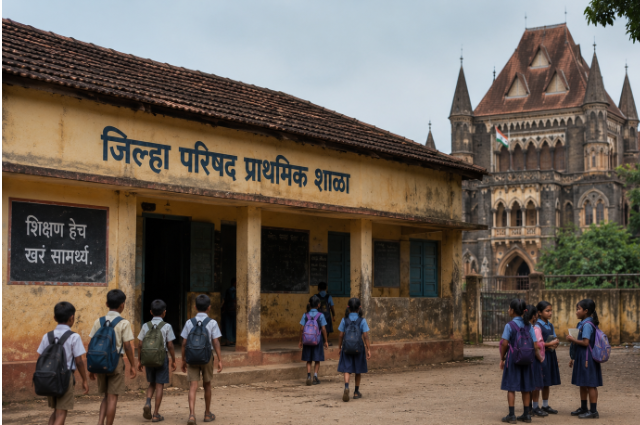
There is a particular kind of institutional irony that courts occasionally feel compelled to name out loud. The Bombay High Court did exactly that recently, when it turned its gaze on the Maharashtra government’s simultaneous celebration and quiet dismantling of the Marathi language.
On one hand, the State has made Marathi-language instruction mandatory in all schools from Class 1 to 10, backed by a penalty of ₹1 lakh for non-compliance — a measure framed as preserving Maharashtra’s linguistic identity. On the other hand, two Government Resolutions (GRs) issued on April 1 and 2, 2025, moved to permanently disqualify hundreds of unaided schools from receiving grant-in-aid, threatening the survival of over 433 primary schools and 324 secondary schools — the overwhelming majority of them Marathi-medium institutions rooted in rural Maharashtra.
“The State Government, on one hand, is insisting that the Marathi language should be given importance in the entire State and on the other hand, by said action, trying to close down Marathi schools.”
— Bombay High Court
What the GRs Actually Said
The resolutions directed affected schools to register under the Self-Financed Schools Act before April 30, 2025. Miss the deadline, and recognition stood automatically cancelled — no hearing, no assessment, no transition plan. The State appeared to treat this as an administrative formality. The court disagreed.
A Rural Crisis in the Making
The High Court identified several questions the government had failed to ask before issuing the GRs:
- Could these schools realistically convert into self-financed institutions?
- What would happen to their existing staff?
- Were there nearby schools capable of absorbing displaced rural students?
- Could those students even continue their education in the Marathi medium?
These were not rhetorical questions. For thousands of children in villages across Maharashtra, the Marathi-medium school is often the only school. These are not institutions that can pivot to a self-financing model overnight — they exist precisely because communities cannot afford fee-based education. The court found that these “facts were totally ignored” by the government.
Natural Justice: A Basic Right Bypassed
Beyond the policy contradictions, the petitioner schools raised a more fundamental objection: they were never heard. The State took decisions affecting their very existence without offering them an opportunity to respond — a clear violation of natural justice principles that the bench accepted.
The court granted relief to the petitioner schools, directing the government to remove their names from the GR lists and allowing them to continue functioning without any coercive action.
The Deeper Contradiction
Maharashtra’s linguistic nationalism and its school funding policy are now formally in conflict — and it took a High Court rebuke to say so clearly. Mandating Marathi instruction while defunding the institutions best positioned to deliver it is not a coherent language policy. It is, at best, an administrative oversight. At worst, it signals that the commitment to Marathi is more performative than structural.
Languages do not survive through legislation alone. They survive through classrooms — and the teachers, students, and communities that fill them, often in places where no better-funded alternative exists.
The Bombay High Court, in calling out this contradiction, has done more than grant interim relief to a group of schools. It has put on record what effective language preservation actually requires: not just mandates, but the institutions to carry them out.
References
- Bombay High Court proceedings, April–May 2025
- Maharashtra Government Resolutions dated April 1 and April 2, 2025
- Maharashtra mandatory Marathi instruction policy (Class 1–10).