
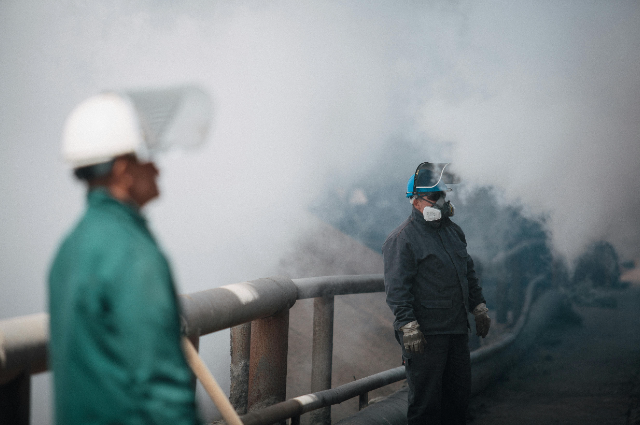
In mid-April 2026, the satellite city of Noida, one of Asia's largest planned industrial townships located on the outskirts of Delhi, became the epicentre of a fierce labour uprising. What began as a peaceful demonstration by garment and hosiery factory workers spiralled into days of unrest — vehicles set ablaze, properties vandalised, and tear gas fired by police — drawing national and international attention to the enduring fault lines of India's labour market.
The protests, which erupted on April 10 and turned violent by their fourth day on April 13, were ultimately a response to a glaring wage disparity: workers in Uttar Pradesh (UP) were earning significantly less than their counterparts in neighbouring Haryana, which had recently raised its minimum wage by 35 per cent. Against a backdrop of rising global living costs — exacerbated by fuel supply disruptions linked to geopolitical tensions in West Asia — workers across Noida's industrial belt could no longer afford to remain silent.
A Wage Gap That Became a Flashpoint
Noida and Greater Noida, situated in Gautam Buddha Nagar district of Uttar Pradesh, are home to thousands of manufacturing units, with garment export and hosiery industries employing a large share of the migrant working class. For years, minimum wages in UP had lagged behind neighbouring states. When Haryana raised its minimum monthly wage from Rs 14,000 to Rs 19,000, workers in UP — earning around Rs 11,313–13,000 for unskilled labour — found the disparity impossible to justify. A review by the UP Department of Labour later confirmed that legally mandated minimum wage revisions, due in both 2019 and 2024, had simply never been implemented, despite significant increases in the Consumer Price Index.
A Protest Turns Violent
Demonstrations began on a Saturday in early April, with workers from garment export units gathering in Phase 2 and Sector 60 of Noida to demand a wage hike, fixed duty hours, overtime pay, and better working conditions. The mood remained largely peaceful for the first two days.
By the fourth day, however, visuals of overturned and burning vehicles, stone-pelting at police, and barricade charges emerged from different parts of the city. Police deployed tear gas to quell the unrest. Gautam Budh Nagar police stated that only minimum force was used and that senior officials were making persistent efforts to counsel workers and urge restraint. By April 14, approximately 300 protesters had been arrested in connection with incidents of arson, stone-pelting, and highway blockades, with at least seven FIRs registered.
Vinay Mahoti, a 30-year-old worker from Bihar employed at a hosiery company in Noida, described how his protest began inside his manufacturing unit before he joined the broader movement on the streets — illustrating the spontaneous, decentralised character of a movement driven not by union leadership, but by economic desperation.
The Workers' Demands
Workers raised a range of interconnected demands:
- Wages on par with Haryana's revised minimum monthly wage of Rs 19,000
- Fixed and regulated duty hours
- Double pay for overtime and holiday work
- Timely salary disbursement by the 10th of each month
- Annual bonuses paid before November 30
- A formal complaints mechanism, including a women-led committee to handle harassment cases
Women workers from Sector 121 were found to be entirely unaware of the government-mandated wage of Rs 700 per day — highlighting not only employer non-compliance, but a systemic failure by the state's labour administration to communicate and enforce its own regulations.
Government Response: Concessions and a Committee
Within two days of the protests beginning, authorities announced immediate concessions — mandatory weekly offs, double wages for overtime and holidays, salaries disbursed by the 10th of each month, annual bonuses before November 30, and a formal complaints system. The Yogi Adityanath government also constituted a high-level committee to investigate root causes and recommend preventive measures.
The decisive response came on April 14, when the UP government announced an interim revision in minimum wages, effective retrospectively from April 1, 2026. The revision was graded by region, with workers in Noida and Ghaziabad (Gautam Buddha Nagar) receiving the steepest hike of approximately 21 per cent. Under the revised structure, unskilled workers in Noida would earn Rs 13,690 per month (up from Rs 11,313), semi-skilled workers Rs 15,059 (up from Rs 12,445), and skilled workers Rs 16,868 (up from Rs 13,940). In other parts of UP with municipal corporations, wages rose by 15 per cent; in the rest of the state, the increase was 9 per cent.
A Wage Board was also announced to be constituted the following month to finalise a long-term minimum wage structure. On April 18, the UP government formally approved and published the modified minimum wage rates in the Official Gazette.
Broader Context: Global Pressures and a Regional Wave
The Noida unrest did not occur in isolation. Living costs across the world climbed steeply in 2026, with fuel supply disruptions linked to geopolitical tensions in West Asia affecting global supply chains and hitting India's urban working poor hardest. Workers cited sharp increases in house rents and the cost of essentials as making survival increasingly difficult on existing wages. Just the week before the Noida protests, Haryana had seen similar labour agitation that led to a 35 per cent minimum wage increase — and the Noida workers were watching.
By April 16, domestic workers had also joined the protests to push for wage hikes and better working conditions, broadening the movement beyond factory floors. The protests are part of a wider global story of economic dislocation meeting organised labour action in conditions of rising inequality.
Disruption on the Ground
Beyond the industrial zones, the protests created significant logistical disruption across the Delhi-NCR region. Routes along the DND Flyway and Chilla Border experienced heavy congestion. Traffic authorities diverted vehicles via Char Kha Gol Chakkar and the DND Toll, with additional diversions near the Sector 62 Fortis Hospital Road. Industrial supply chains in Noida and Greater Noida were also disrupted, adding economic pressure to the situation.
Legal Dimensions: Rights, Violations, and Accountability
Legal observers noted the dual nature of the crisis. Workers exercised constitutionally protected rights — the right to peaceful assembly under Articles 19(1)(a) and 19(1)(b) of the Constitution of India. The Supreme Court in Ramlila Maidan Incident v. Home Secretary Union of India (2012) affirmed that peaceful protest is a constitutionally protected right. Yet the violence that followed — arson, stone-pelting, highway blockades — crossed into criminal conduct, resulting in over 300 arrests and seven FIRs.
Critically, analysts pointed out that the State bore responsibility for the underlying conditions. The Minimum Wages Act, 1948 and the Code on Wages, 2019, make it a cognizable offence to pay below the prescribed minimum — a law that both employers and the labour administration had failed to enforce for years. The Supreme Court in Workmen v. Reptakos Brett & Co. (1 SCC 290 [1992]) has held that a living wage is a constitutional imperative. Rights organisations, including Jan Hastakshep, called for the release of arrested workers and raised concerns about the alleged repression of legitimate labour protest.
Analysis: What This Tells Us
The Noida protests illuminate structural weaknesses in India's labour governance. Wage revisions legally due in 2019 and 2024 were simply not carried out — exposing the gap between labour law on paper and its enforcement in practice. The inter-state wage disparity between UP and Haryana highlights a competitive dynamic in which industries locate in states with the lowest minimum wages, creating structural pressure on workers. And the sharp, reactive wage revision under political pressure — rather than through systematic, timely review — shows how India's wage-setting mechanisms remain driven by crisis rather than policy.
The Noida factory workers' protest of April 2026 resulted in a tangible policy outcome: a 21 per cent wage hike for workers in Noida and Ghaziabad — the largest in the state — and the promise of a Wage Board to set long-term wage structures. Yet the arrests of around 300 protesters, the violence, and the years of wage non-enforcement that preceded the crisis point to a deeper reckoning India's labour system must undergo.
For the workers of Noida's garment and hosiery units — who built one of Asia's largest industrial townships with their labour — the events of April 2026 were a reminder that wages are not a concession, but a right. The question now is whether the government's response represents a genuine course correction or merely the minimum required to restore order until the next crisis.
References:
- Al Jazeera (April 13, 2026). Tear gas was fired at Indian workers demanding higher wages as living costs rise. aljazeera.com
- Wikipedia. 2026 Noida workers protest. en.wikipedia.org
- Business Today (April 14, 2026). Why Noida got the biggest wage hike in UP after protests. businesstoday.in
- SCC Online (April 18, 2026). Uttar Pradesh Revises Minimum Wages Following Industrial Unrest in Noida. scconline.com
- Newsgram (April 14, 2026). UP Government Announces Interim Wage Hike After Noida Protest. newsgram.com
- Prime Legal Blog (April 2026). Noida Labour Protests 2026: The Legal Limits of Trade Union Action & Minimum Wage Enforcement. blog.primelegal.in
- Deccan Chronicle (April 2026). Rights Body Seeks Release of Those Arrested for Noida Workers' Protest. deccanchronicle.com