
India is a diverse country, basically known for its cultures, languages, and traditions. Each part of the country has its own distinct language, religion, and view of the world. However, it is possible to find similarity in the architectural achievements that past historians left behind. From the north to the south and the east to the west of the world, the ancient architects and artisans built structures that are more resilient than modern-day counterparts. They did not make them for their own benefits, but for the benefits of infinity, or in other words, we can say that “They built for eternity, We build for decades”. It also means that they knew the value of architecture and, therefore, we should use it correctly. The purpose of the present article is to describe the architectural and engineering masterpieces of the ancient civilisations of the world, especially India. Scientists and engineers today continue to marvel at the engineering skills of ancient civilisations. They still cannot succeed in understanding and following the achievements of the ancient civilisation. Knowledge that existed before seems lost, leaving gaps in understanding. Some techniques appear too advanced for their era, raising more questions than answers.
Gangaikonda Cholapuram Temple
Standing tall since the early 11th century, this temple rose under Rajendra Chola I in Tamil Nadu. A UNESCO-recognised structure, it holds a soaring vimana adorned with detailed sculptures. Carved from one stone, its large Shiva lingam remains central to the design. Proportion guides the layout, reflecting Dravidian principles mastered by Chola builders. Delicate carvings trace sacred patterns across surfaces. Among them sits a floral-shaped altar, preserved through the centuries. Time has touched it lightly - over a thousand years have passed, yet much remains unchanged.
Kailasa Temple, Ellora
From solid basalt, shaped downward in the 8th century by the Rashtrakuta dynasty at Ellora in Maharashtra, stands a structure of extreme accuracy - no seams, layered chambers, built to resist tremors through understanding stone mass. Larger than any Chola sanctuary hewn from one block, it has lasted ages untouched, unaltered by time or need for repair.
Lepakshi Veerabhadra Temple
A curious feature stands within this 16th-century Vijayanagara temple located in Andhra Pradesh - one of its seventy hall pillars floats slightly above the floor. Although it appears disconnected from the base, the structure still holds up the ceiling without issue. Visitors can slide scarves beneath it, proving there's space below. Despite modern analysis, specialists remain puzzled by how ancient builders achieved such balance using only careful weight distribution.
The Iron Pillar of Delhi
Standing in New Delhi, made when Chandragupta II ruled the Gupta Empire near 400 CE. Rising 7.2 meters high, a solid piece of forged iron. Weighs 6 tonnes. Left outside for centuries, untouched by time's usual effects. Even now, after more than sixteen hundred years, corrosion still hasn’t taken hold. Its surface shows faint hammer marks from forge-welding small iron lumps (18-23 kg each) in a horizontal forge, showcasing ancient Indian blacksmithing precision. A fragile coating forms on ancient iron when moisture meets trace phosphorus - this film slows rust by blocking further decay. Unlike today’s metals, such artefacts develop defences over time because environmental conditions trigger crystal growth. Centuries of minimal rusting have left researchers questioning - until work in the 2000s began offering answers. Despite long-standing confusion, fresh evidence slowly clarified how such a condition persisted so long.
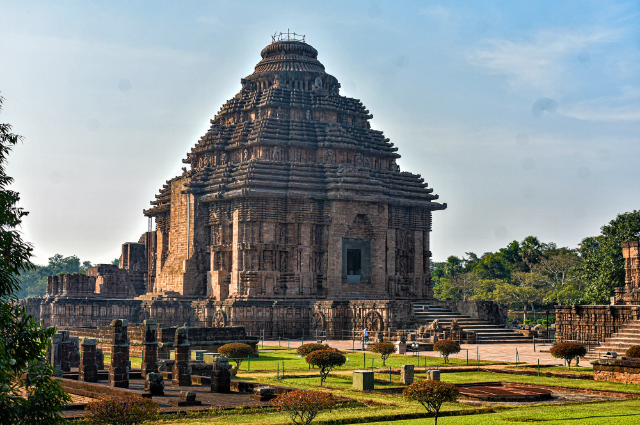
Kornak Sun Temple
1200 labourers shaped its form over a dozen years, under King Narasimhadeva I’s rule. Roughly in 1250 CE, on Odisha's coast, the temple rose through effort and vision. It’s not built like temples usually are, instead imagined as a chariot halted mid-motion, wheels caught in time, pulled forward by seven stone horses, carved into perpetual strain against invisible winds. Though dedicated to Surya, the sun deity, it stands now as weathered silence among ruins. Recognition came later: a place marked by UNESCO for its layered history. Work stopped when the king fell ill, legend claims, leaving purpose half-seen beneath moss and shadow. Its stones speak less of worship than motion - celestial travel made solid, then abandoned. Each pillar holds traces of movement, shadows shifting like reins pulled taut at dawn. Stillness remains today, yet the design suggests arrival, never completion. The site persists beyond function, echoing ambition set in black granite and open sky. Time has worn edges smooth, though shape insists on journey rather than rest. For generations, European seafarers crossing the Bay of Bengal relied on its presence to guide their routes. Known among them as the Black Pagoda, it stood out along the coast. https://www.indiatoday.in/education-today/gk-current-affairs/story/konark-sun-temple-history-myths-magnetic-mysteries-2660986-2025-01-07
Across India, each area shaped its own legacy - one left a granite temple, another a stone chariot, someone hollowed a mountain, others raised pillars untouched by rust. Built under separate rulers, distinct empires, varied beliefs, across shifting ages. Yet every structure whispered alike: this stands beyond now. Beyond those who follow after. Forever shaped their work, not just long spans of time. For more than a millennium, that intent never weakened. Still, the stones remain fixed in place. Without pause, the ceremonies continue as before. Where light ends and dark begins aligns precisely - measured long ago by people who used neither devices nor code, only certainty. Our projects aim for many years. They're aimed beyond them. A long time ago, forever wasn’t some grand dream. Instead, it just came naturally to them.
REFERENCES:
- https://amitavadgupta.wordpress.com
- https://en.wikipedia.org
- https://timesofindia.indiatimes.com
- https://www.britannica.com