
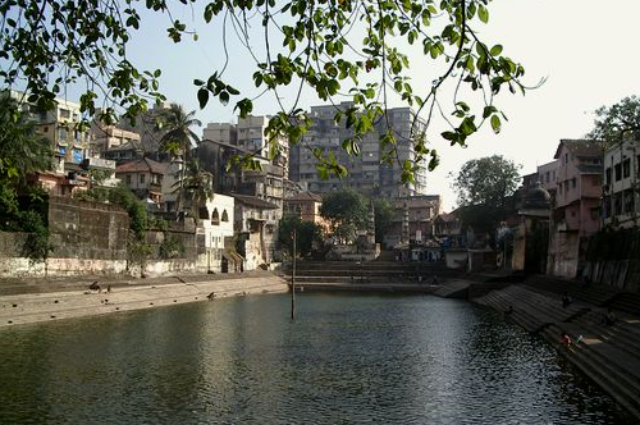
On the morning after another round of ancestral rituals, hundreds of dead fish were found floating in the Banganga Tank in Walkeshwar, south Mumbai. According to a PTI report, the fish were found during Pitru Paksha, the 16 days when Hindus honour their ancestors, which runs this year from 26 September to 10 October. The sight was grim, but for the people who live and worship around the tank it was hardly new.
A sacred tank, a recurring toll
Banganga is among the oldest surviving water bodies in Mumbai. Its origins are traditionally placed in 1127 AD, and it sits within the Walkeshwar Temple complex on Malabar Hill. The PTI report notes that it is a protected heritage structure, and that tradition holds that Lord Ram performed pind daan, a funerary rite for ancestors, at the site. [1] That belief is why thousands of devotees gather here during Pitru Paksha, especially on its final day.
The ritual itself is the problem. A BMC official told The Week that worshippers pour a slurry of flour and milk into the water, and the official described the resulting harm to fish as an annual problem. According to the civic body’s explanation, offerings such as flour dumplings, sweets, milk, oil and flowers add organic waste to the tank. As this decomposes, it draws down the dissolved oxygen in the water, and the fish suffocate.
Not a one-off
This is the part that makes the latest deaths hard to call an accident. BMC officials themselves say fish deaths at Banganga are reported around the same time every year. A long-time resident who helps conduct rituals at the tank has said he has seen fish die after Pitru Paksha for more than four decades. Deaths were reported in 2021, 2023 and 2025, according to the account I am working from.
The 2025 episode was large. Civic officials said BMC cleared at least 10,000 kg of dead fish, flowers and other waste, carried away in seven dumper trucks, between 21 and 23 September 2025. The corporation also reportedly spent about ₹1.2 crore on desilting the tank last year, a figure I could not independently confirm in the sources I reviewed.
There is also a reason to think the problem is fixable. The advocacy group Beauty Without Cruelty (BWC) reports that after it appealed to BMC and the temple trust, no fish died in 2022 because dewatering pumps were installed to aerate the tank. If that account is right, a basic intervention worked in one year, and the deaths returned in others. That raises the obvious question of why it was not made a standing practice.
The response this time
As in earlier years, BMC moved quickly once the fish had died. The civic body cleaned the tank and began protection measures, called a meeting with priests and residents to discuss how to protect the water body, and, according to the reporting I was given, added cleaning staff and installed an aeration pump. It also plans to pump out and refill the tank. One outlet reported a plan for ten artificial ponds, a detail I have not seen confirmed elsewhere.
Artificial ponds are not a new idea. Activists have urged BMC to set up temporary ponds around the tank during Pitru Paksha, similar to those used for Ganeshotsav immersions, so that puja material never reaches the water. They have also called for regular cleaning, arguing that if fish live in the tank, caring for them is the civic body’s responsibility.
The real question: why emergency, not planning?
Every element of the current response is reactive. Cleaning crews arrive after carcasses surface. Pumps arrive after oxygen has collapsed. Meetings with priests and residents are called after the damage is public. Yet the calendar is not a mystery: Pitru Paksha falls on predictable dates, the last day draws the largest crowds, and the pattern has repeated for years, by officials’ own admission.
A planned response would look different. Aeration could be running before the festival begins, not after it. Designated, supervised offering points could keep food waste out of the tank. Water quality, including dissolved oxygen, could be tested before, during and after the rituals. And talks with the temple trust, priests and families could happen in August, when there is time to change habits, not October, when fish are already dead. None of this requires banning a faith practice. It requires treating a known annual event as a scheduled operation.
Authorities also face a genuine balancing act. This is a living religious site as well as a heritage structure, and restricting rituals is sensitive. But if aeration in 2022 prevented deaths, the cost of prevention appears modest next to repeated clean-ups of thousands of kilograms of waste and crore-scale desilting.
What we still don’t know
Two caveats matter. First, I found no laboratory report on the tank’s water. The explanation of organic load and falling oxygen is BMC’s own, and while it is plausible and consistent with how such die-offs generally happen, it has not been independently verified here. Second, the scale is disputed. PTI and others describe hundreds of dead fish while another outlet reports thousands. Without a count, the true toll remains unclear.
Until water-quality data is published and a prevention plan is in place before the next Pitru Paksha, the likeliest forecast for Banganga is the one residents already know: the fish will die again, and the corporation will again arrive with pumps and trucks.
References:
- Press Trust of India (5 October 2026). “Hundreds of dead fish spotted in Banganga Tank; BMC undertakes cleaning, protection measures.” ThePrint. https://theprint.in
- The Week (8 October 2026). “Mumbai’s historic Banganga Tank sees fish deaths again: BMC plans meeting with priests, residents to protect the water body.” https://www.theweek.in
- The Week (8 October 2026), AMP version of the above, used to confirm the 12th-century origin. https://www.theweek.in
- [4] SANDRP (23 November 2025). “WFD 2025: Mass fish death in lakes, ponds in India.” https://sandrp.in
- Beauty Without Cruelty India. “Achievements 2021–2030.” https://bwcindia.org
- Free Press Journal. “Mumbai News: Activists urge artificial ponds for Pinda Daan to prevent annual fish deaths at Banganga Tank.” (Publication date not shown in the retrieved text.) https://www.freepressjournal.in
- The CSR Journal. “Thousands of fish found dead in Mumbai’s historic Banganga Tank.” https://thecsrjournal.in
Note: The 2021 and 2023 incidents, the ₹1.2 crore desilting spend, the added cleaning staff, the aeration pump and the ten-pound plan come from the reporting supplied for this article and were not independently confirmed in the sources listed above.