
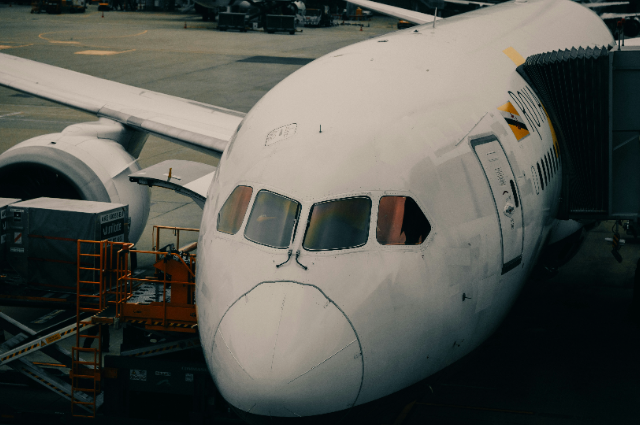
Source: Jimmy Whitson on Unsplash.com
A co-pilot on Flydubai flight FZ1073 allegedly attacked the captain with the cockpit's emergency axe on September 30, 2026, sending the Boeing 737 MAX 8 into a dive of more than 17,000 feet before passengers and crew overpowered him. The jet, carrying 174 people on a Dubai-to-Tel Aviv service, landed safely at Tabuk in northwestern Saudi Arabia. Israeli officials called the incident an attempted terror attack. On October 3, the UAE's attorney general also described it as a "terrorist act", though no motive has been publicly established and the suspect's identity has not been officially confirmed.
This article pulls together what has been reported, what has been confirmed, and what remains unanswered, using sources listed at the end.
What happened in the air
The attack unfolded about two hours into the flight and lasted roughly 12 minutes from the start of the dive to the plane levelling out, according to Flightradar24 data cited by Al Jazeera. The jet had left Dubai at 7:05 am local time and climbed to 34,000 feet.
| Time (GMT) | Events |
03:05 | Flight FZ1073 departs Dubai and climbs to 34,000 ft |
05:21 | Aircraft begins a steep descent, then climbs, then descends again; it drops more than 17,000 ft in about two minutes |
05:28 | Transponder broadcasts 7700 (general emergency) near the Saudi-Jordan border |
05:33 | Plane levels out at roughly 15,000 ft |
05:35 | Transponder switches to 7500, the code for unlawful interference (hijack) |
05:44 | Distress call to Tabuk air traffic control requesting an emergency landing |
about 06:45 to 06:58 | Jet lands at Tabuk; sources differ on the exact minute |
Passenger accounts describe the cabin during the dive. Adam Polo told CNN the power, entertainment system, and air conditioning cut out, and that anyone not seated was thrown down. Passengers who reached the cockpit door found the wounded captain on the floor. One of them, plumber Yaniv Hayun, said he pulled the co-pilot out of the cockpit, then took the controls briefly until a pilot travelling as a passenger arrived. Other passengers restrained the co-pilot, and a dentist, Shota Musayev, treated the captain's bleeding.
Some details are contested or unverified. US President Donald Trump said the dive was so severe that the plane's rudder was torn off, a claim that has not been confirmed by investigators in the sources reviewed here.
The captain and the landing
Captain Smit Machchhar, a 39-year-old Indian national, is recovering in an Abu Dhabi hospital, not in Saudi Arabia as early reports suggested. He was treated first in Tabuk, then flown to the UAE once doctors cleared him, India's Ministry of External Affairs said. The Indian embassy in the UAE described him as in good health and recovering well.
On October 2, he spoke to Indian Prime Minister Narendra Modi by video call. Al Jazeera reported that he described lying wounded on the cockpit floor, feeling the aircraft plummet, and deciding to push himself to release the door lock. He said he has flown for 17 years and been a captain for 11, and that he knew he could not let the passengers die.
Israeli Prime Minister Benjamin Netanyahu called him a "true hero" and credited him with saving all 174 people aboard. Modi said his courage and presence of mind saved many lives.
Who landed the jet is described slightly differently by different sources. Flydubai said on-duty crew travelling on the flight diverted and landed the aircraft. CBS News and Al Jazeera describe two off-duty or reserve pilots on board taking control. Either way, the cockpit was recovered, and the aircraft landed at Tabuk after passengers had restrained the attacker. Flydubai later sent a second aircraft to Saudi Arabia to bring the passengers on to Israel.
The suspect and the UAE findings
The co-pilot is not in Saudi custody, as early reports suggested. Both pilots were moved to the UAE after initial treatment, and Abu Dhabi leads the investigation because the aircraft is UAE-registered, Al Jazeera reported. Neither the UAE nor Flydubai has officially named him. Multiple outlets, citing diplomats and officials, identify him as Hamam al-Hammami, an Omani citizen reportedly born in the UAE.
On October 3, UAE Attorney General Hamad Saif al-Shamsi called the incident a "terrorist act" and said the co-pilot used the cockpit's emergency axe. On October 9, prosecutors went much further. According to the Gulf News summary of the findings, the 29-year-old suspect allegedly:
- planned to seize the aircraft and crash it into the passenger terminal at Ben Gurion Airport
- flew to Tel Aviv twice earlier to familiarise himself with the route and airport
- was exposed to extremist material from 2017, while studying in Australia
- said in a confession, made with his lawyer present, that the September 11 attacks inspired him and that he acted alone
The same account says a medical report found the captain's head injuries were consistent with an assault using an emergency axe. Prosecutors said they are still examining digital evidence and looking for accomplices, and that more findings will follow. AP reported the same key points.
These are prosecutors' allegations, not a court verdict, and the confession has not been independently verified. Earlier, Netanyahu had said Israel knew the co-pilot underwent "Islamist radical indoctrination", while also acknowledging that the motive was not yet established, according to CBS News.
How was he cleared to fly to Israel?
The vetting question has no settled answer yet, and responsibility appears to be spread across Oman, Flydubai, the UAE and Israel. Oman and Israel have no formal diplomatic relations, and Netanyahu has said Israel has longstanding arrangements with foreign airlines to keep pilots from such countries off its routes. He has called what happened a "loophole", per Al Jazeera.
What the reporting says so far:
Oman: AP sources said he had been barred from flying at Oman Air over concerns about extremist views and moved to an administrative role. It is unclear whether Oman told other countries or airlines.
Flydubai and the UAE: The UAE attorney general said the suspect met professional and security criteria, including a pilot's licence and a certificate of good conduct, and that checks showed no warning signs.
Israel: Haaretz reported that Israel received the crew and passenger lists before departure, as required by a 2023 law that demands names and nationalities up to 48 hours ahead. CNN reported that the Transport Ministry says its procedures do not include checking crew names, and the Tax Authority said such questions belong with the ministry.
Former El Al aviation security official Eytan Ben David told CBS News that an Omani pilot should never have been allowed to fly into Israel under its guidelines. Another expert, Menachem Bachrach, told NBC News that Israel relies largely on foreign airlines and governments to vet their own crews, which may point to a compliance failure rather than a flaw in the procedures. Israel's prime minister's office has since said pilots flying into the country will be vetted and their identities known to Israeli authorities.
The airline, Israel and what is still unknown
Flydubai's early language was cautious. Its first statement spoke of an "altercation" in the flight deck and said the underlying reasons and motives remained subject to formal investigation, according to Gulf News. The airline suspended all flights to and from Israel that evening, after a Shin Bet recommendation reported by the Jerusalem Post. Emirates also suspended its codeshare flights to Tel Aviv. No resumption date has been given.
Israel moved faster to a terrorism label. Netanyahu spoke of an attempt to crash the plane within hours, and Transport Minister Miri Regev pushed for a suspension of Flydubai services. Since then,x the UAE's own prosecutors have used the same word, which narrows the gap between the two sides. Flydubai itself had not, in the sources reviewed here, commented publicly on the prosecutors' findings.
Several questions remain open:
Did he act alone? The suspect says so; prosecutors are still checking digital evidence and possible contacts.
- What exactly did Oman Air know, and why did it not share the concern with other airlines or governments?
- Which Israeli body was responsible for screening foreign crew, and what will change?
- Why attack the captain over Saudi airspace if the target was Ben Gurion Airport?
- Will the UAE publish a full technical report, including flight-data and cockpit-recorder analysis?
The case is also a reminder of how much depended on individuals: a captain who released a door lock while bleeding on the floor, a handful of passengers who rushed in, and pilots who happened to be on board. The investigation is ongoing, and details in this article may change as more is announced.
References:
- Accurate as of October 12, 2026. The first four entries were read in full; the others were read as search excerpts.
- Al Jazeera, "12 minutes of madness: How Flydubai pilot, passengers saved plane midfall", October 2, 2026.
- Al Jazeera, "Who is the mystery co-pilot behind the Flydubai attack?", October 3, 2026.
- Al Jazeera, "How was Flydubai co-pilot cleared despite being deemed a security risk?", October 4, 2026.
- Gulf News, "flydubai incident probe: UAE reveals 10 shocking findings", October 9, 2026.
- AP via MS NOW, "FlyDubai co-pilot planned to crash plane into Tel Aviv airport, UAE prosecutor says", October 9, 2026.
- CBS News, "FlyDubai co-pilot stabbed captain, tried to crash flight to Israel after 'radical indoctrination,' Netanyahu says", September 30 to October 1, 2026.
- CBS News, "What we're learning about the FlyDubai co-pilot", October 2026.
- CBS News, "FlyDubai co-pilot planned to crash plane into airport, shouldn't have been cleared to fly to Israel, sources say", October 2026.
- CNN, "Alleged Flydubai hijacker likely wanted to target Israel's Ben Gurion Airport, sources say", October 5, 2026.
- NBC News, "Some of world's strictest aviation security measures are under fresh scrutiny after in-flight attack", October 2026.
- Business Today, "flydubai mid-air incident: PM Modi speaks to Captain Smit Machchhar", October 2, 2026.
- Gulf News, "flydubai suspends flights to Israel after FZ1073 'security incident'", October 1, 2026.
- The Jerusalem Post, "Flydubai flights to Israel suspended amid investigation into attempted hijacking, airline says", September 30, 2026.
- The Times of Israel, Live blog, September 30, 2026.
- Flightradar24 data, as cited in reference 1.