
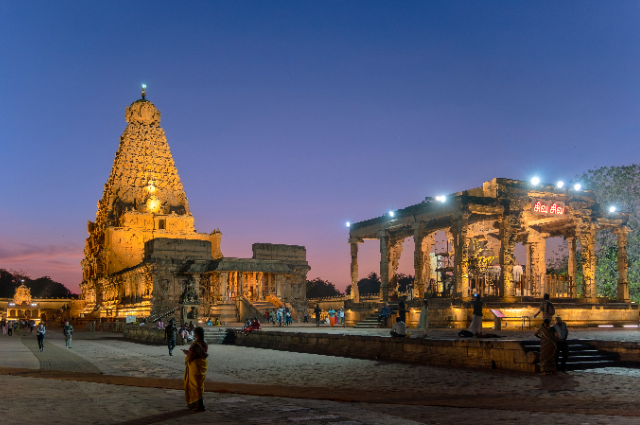
History often remembers kings for their wars, empires, and political power. Yet, occasionally, a ruler leaves behind something far more profound than victory: a question. In the 11th century, the Chola emperor Raja Raja Chola I constructed the Brihadeeswara Temple in Thanjavur, Tamil Nadu. Over a thousand years later, the temple still stands tall, almost unchanged, quietly posing a question that modern science and engineering have yet to fully answer: how was something so advanced built so long ago?
Imagine stepping back in time to 1010 CE, when the Brihadeeswara Temple, also known as Rajarajesvaram or the “Big Temple,” was completed. This magnificent structure, dedicated to Lord Shiva, was built during the height of the Chola Empire. It's not just any temple; it's a masterpiece of South Indian architecture and is part of the UNESCO World Heritage Site called the “Great Living Chola Temples.” Beyond being a place of worship, it stood as a symbol of political power, cultural pride, and architectural brilliance. Even after a thousand years, it continues to draw in historians, engineers, architects, and pilgrims, all eager to marvel at its grandeur and mystery.
The most striking feature of the temple is its towering vimana, the pyramidal structure above the sanctum. Rising to a height of around 216 feet (about 66 meters), it was among the tallest man-made structures in Asia at the time of its construction. What makes this even more extraordinary is that the entire structure was built primarily using granite, a material that is extremely heavy and difficult to transport or carve. Historians estimate that over 130,000 tons of granite were used in the construction. The puzzle becomes even deeper when we realize that there are no large granite quarries near Thanjavur. Scholars believe the stones were transported from locations nearly 50 to 60 kilometres away, a massive logistical challenge in the 11th century when modern machines did not exist.
Perhaps the most fascinating engineering mystery is the giant granite capstone placed at the top of the tower. This single block of stone weighs around 80 tons and sits at the highest point of the structure. Lifting such a massive object to a height of more than 200 feet would be difficult even today with cranes and advanced technology. The most widely accepted theory among historians suggests that builders constructed a very long earthen ramp, possibly stretching up to six kilometres from the temple site. Elephants, workers, and wooden rollers may have been used to slowly drag the stone up the slope until it reached the top. However, no clear archaeological evidence of such a ramp has ever been discovered, leaving historians uncertain about the exact method used.
The temple’s construction also demonstrates a deep understanding of structural engineering. The stones were assembled using a technique known as dry masonry, meaning the blocks were carefully interlocked without using cement or mortar. Instead of relying on adhesives, the builders used precise cutting and the natural weight of the stones to hold the
structure together. This method distributes the load evenly and increases the stability of the building. The fact that the temple has survived for over a thousand years through earthquakes, monsoons, and human conflict is evidence of the effectiveness of this technique.
Beyond engineering, the temple also reveals the administrative sophistication of the Chola Empire. Over a hundred inscriptions carved on the temple walls provide detailed records about the functioning of the institution. These inscriptions mention donations of gold, land, and jewellery, along with the names and salaries of people employed by the temple. Remarkably, more than 600 individuals, including priests, dancers, musicians, accountants, craftsmen, and administrators, were associated with the temple’s daily operations. This suggests that the temple was not just a religious site but also a major economic and cultural centre that supported an entire community.
Art and culture also flourished within the temple complex. The walls contain exquisite sculptures and murals that represent the artistic brilliance of the Chola period. One of the most fascinating aspects is the series of dance poses carved into the walls of the temple. These sculptures depict 81 of the 108 classical dance movements described in the ancient text Natya Shastra, which forms the foundation of Bharatanatyam, one of India’s oldest classical dance forms. Through these carvings, the temple becomes not only a place of worship but also a visual archive of Indian artistic traditions.
Another remarkable aspect of the Brihadeeswara Temple is its symbolism. The towering vimana represents Mount Meru, the mythical cosmic mountain believed in Hindu cosmology to be the centre of the universe. By designing the temple in this form, the Chola architects were expressing a powerful philosophical idea: the temple was not just a building on Earth but a representation of the cosmic order itself. The architectural layout reflects the belief that divine energy flows through geometry, proportion, and alignment.
Even today, many aspects of the temple continue to puzzle researchers. Scholars still debate the exact construction methods, the astronomical alignments, and the purpose of certain hidden passages within the structure. While modern engineering can explain some features, others remain speculative. What makes this even more intriguing is that the temple was completed in a relatively short period of time, especially considering its scale and complexity.
Perhaps the most powerful part of the temple’s story is its continuity. Despite centuries of political change from the decline of the Chola Empire to invasions, colonial rule, and the modern era, the temple has remained active. Daily worship and rituals have continued for over a thousand years, making it not just a historical monument but a living cultural tradition.
In many ways, the Brihadeeswara Temple represents the peak of ancient Indian engineering, architecture, and artistic imagination. But more than that, it represents the ambition of a
ruler who wanted to create something timeless. Raja Raja Chola I did not simply build a temple of stone. He built a structure that challenges our understanding of the past.
A thousand years later, the temple still stands in Thanjavur — silent, massive, and almost defiant — reminding us that history is not always a record of answers. Sometimes it is a reminder of how much we still do not know.
Some monuments tell us about the past. Others leave us with questions. The Brihadeeswara Temple in Thanjavur does both.
References:
- https://en.wikipedia.org
- https://whc.unesco.org
- https://www.britannica.com
- https://www.tamilnadutourism.tn.gov.in
- https://tmv.in