
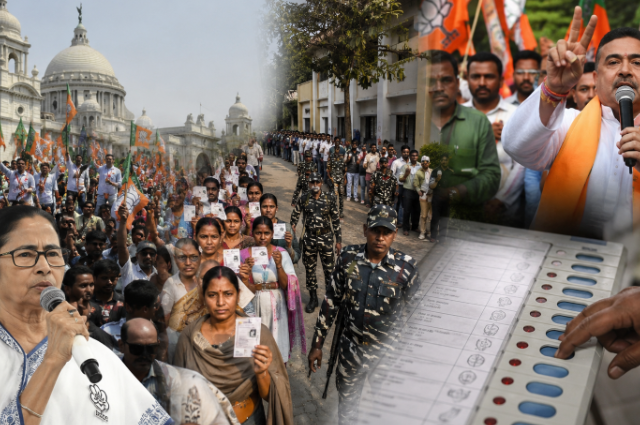
West Bengal has always posed challenges for governance and winning elections. For almost 49 years, from 1977 to 2026, with the CPI(M)-led Left Front holding power for 34 years and Mamata Banerjee's Trinamool Congress ruling for 15 years, the political landscape has been marked by fierce competition, identity, and violence. The 2026 Assembly Elections did not merely maintain this legacy; they broke it apart.
Bengal's 18th assembly election, which took place in two stages across 294 constituencies on April 23 and 29, 2026, with results announced on May 4, 2026 (a repoll in one seat was held on May 21, with the counting taking place on May 24), was not just a change in government but rather a major upheaval. It was overseen by 240,000 security personnel and the National Investigation Agency, and it was followed by political assassinations, mob violence, destroyed mosques, and the murder of a key aide to the Chief Minister-in-waiting. Mamata Banerjee and Suvendu Adhikari, whose rivalry had come to represent Bengal, were at the centre of this unrest.
The Deleted Voters: A 91-Lakh Controversy
The 2026 election had already sparked a constitutional crisis before a single vote was cast. About 9.1 million voters, or about 12% of Bengal's total electorate, were eliminated from the electoral rolls as a result of the Election Commission's Special Intensive Revision (SIR). Of these, 2.7 million had their cases pending before tribunals, while nearly 6 million were classified as absentee or deceased. Following additions from supplemental lists, the total number of voters was 68,251,008.
The Election Commission was accused by the Trinamool Congress (TMC) of attempting to change the demographic balance of West Bengal by alleging that minority and migrant voters were disproportionately affected by the Special Intensive Revision (SIR) of electoral records. Mamata Banerjee publicly denounced the widespread deletions as tampering with voter lists and connected the action to a larger NRC-style targeting of marginalised groups. On the other hand, the BJP argued that the effort was a long-overdue rectification of the names of illegal migrants and bogus entries. The Supreme Court eventually heard the case and ordered the Calcutta High Court to designate judicial personnel to help with the review. In a startling paradox that came to define the election itself, surviving enrolled voters turned out in unprecedented numbers, almost as if casting their ballots were a way of demonstrating their continued presence, even as the debate over erased voters remained unresolved before polling started.
A Campaign of Sharp Edges
Conventional development measures were not the only ones used in the 2026 campaign. The Citizenship Amendment Act served as the focal point of the BJP's platform, which promised to expedite CAA processing for Matua refugee groups, the Muslim-majority Jangipur, the tribal-dominated border region of Kushmandi, and other minority communities, if elected to power. In border districts, where fear of undocumented migration from Bangladesh had been simmering for years, the anti-infiltration narrative was particularly potent. Running for a fourth term in a row after 15 years in office, TMC was burdened by anti-incumbency sentiment, disillusionment with government, and a string of high-profile law-and-order blunders in 2024–2025 that had put women's safety at the centre of public conversation. In March 2025, Suvendu Adhikari stated at an assembly-related event that if the BJP formed the government, they would remove all Muslim TMC MLAs and toss them on the road in front of the Assembly. Additionally, he characterised the Banerjee government as a communal administration, akin to the second iteration of the Muslim League, prompting objections from civil society organisations and the TMC. In reaction, Mamata Banerjee denounced the comments as hate speech, unconstitutional, and a source of animosity between communities.
The Election Hour
All 294 constituencies participated in two rounds of voting on April 23 and April 29, 2026. The Election Commission's security deployment, which included over 2.4 lakh troops, including Central Armed Police Forces, in every crucial constituency, was remarkable by any standard given Bengal's history of political violence and booth seizing. According to the article, around 2,407 CAPF companies and 1.9 lakh men were deployed, with sensitive voting sites under direct central force supervision. During the 2026 state assembly election, the National Investigation Agency was stationed in a number of vulnerable West Bengal constituencies for security and bomb-threat investigations in an unprecedented, extensive security measure for a state election.
During the voting process, legitimate allegations surfaced of opposition candidates' EVM buttons being purposefully blocked with black tape and, in certain instances, even coated with perfume, making it impossible for voters to choose the candidates they wanted. Following verification, the Election Commission mandated a re-election in 15 booths, including the Falta Assembly constituency, on May 21, 2026, and 11 in Magrahat Paschim and 4 in Diamond Harbour, on May 2. Official statistics revealed a 92.47% voter turnout, the highest in the state's electoral history. For reference, the 2011 election, largely regarded as one of the most emotionally charged polls in modern Indian history (ending 34 years of Left Front administration), saw an 84.72% turnout. Voters were mobilised by the SIR debate itself, according to analysts: many were ready to exercise the right they had almost lost after fighting to stay on the rolls.
The Result: A Wall Collapses
On May 4, 2026, the political scene was buzzing as the results for 293 of the 294 seats were revealed. In a stunning display of support, the BJP secured a commanding victory, clinching an impressive 207 seats. The excitement was palpable as the final count drew near! Due to recorded electoral offences, the 294th seat in Falta was scheduled for a re-election on May 21. Suvendu Adhikari defeated Mamata Banerjee by nearly 15,000 votes in Bhawanipur, mirroring their 2021 battle in Nandigram. The man Mamata had previously mentored had now defeated her twice in direct competition. Banerjee's response was, by any precedent in Indian democratic history, extraordinary. She refused to resign. "I will not resign," she declared. “The mandate has been looted. Where does the question of resignation arise?” TMC had been “defeated not by public mandate but by conspiracy,” according to her. According to the Indian Constitution, the Governor may either demand her resignation right away or wait until her term ended on May 7, at which point the process of establishing a new administration would start.
Bengal Burns: Post-Poll Violence
West Bengal turned into a riot within hours of the results. Over the next few days, at least four political staffers were confirmed dead. Vandalism occurred at TMC offices in Tollygunge, Kasba, Baruipur, Kamarhati, and Baranagar. Videos of bulldozers demolishing buildings, including what the TMC claimed to be its party office, went viral on social media in Kolkata's historic New Market, also known as Hogg Market neighbourhood, while crowds waving BJP banners yelled "Jai Shri Ram." Derek O'Brien of TMC said that the demolition was authorised by the police. Some locals disputed that statement, characterising the destroyed building as an unlawful construction.
Abir Sheikh, a member of the TMC Anchal Committee, was fatally hacked during a fight in Santoshpur village in Birbhum's Nanoor. Safikul Islam, a CPI(M) worker in Domkal, Murshidabad, was shot by unknown attackers on his way home. Five police officers, including Officer-in-Charge Bharat Purkait (or Bharat Prasun Purakayet), were shot during a late-night patrol in Bamangheri in Sandeshkhali, a region notorious for political violence, along with two wounded central force personnel. In Asansol and Dinhata, TMC offices were set on fire, while BJP-affiliated employees advocated for a "Naxal-free" university and sought a permanent police outpost. Saffron flags emerged overnight throughout the campus of Jadavpur University. Claims suggest that Muslim-owned businesses and meat stores are being targeted, along with reports of vandalism at a mosque. The West Bengal Chief Secretary and Director General of Police were put on personal notice by the Chief Election Commissioner's zero-tolerance directive, and more CAPF troops were sent to the areas most severely impacted.
The Killing That Shocked Bengal
Chandranath Rath was shot and killed on the evening of May 6, 2026, two days before the inauguration of the new administration and less than 48 hours after the BJP's historic triumph. Rath served as Suvendu Adhikari's closest helper and personal assistant. Just 15 to 20 steps from the entrance of his own housing complex, Orchid Society, where he lived in Apartment 205, another automobile blocked his path on a narrow internal lane while he was travelling in a white Scorpio SUV through the Doharia neighbourhood of Madhyamgram in North 24 Parganas. Shortly after, attackers on bikes came over and opened fire at close range. Rath was hit by four bullets, two of which penetrated his heart in his chest, and one of which hit his abdomen. The doctor stated, "There was no opportunity to resuscitate him." Buddhadev Bera, his driver, was taken to the hospital in severe condition after suffering multiple bullet wounds. The inquiry revealed that the murder was premeditated, with police stating the plot was developed and practised over the previous three days. Chandranath Rath's travels were noted, his schedule was thoroughly observed, and he was followed. Intimate prior scouting is suggested by the assailants' choice of a crowded internal lane over a neighbouring highway, which is counterintuitively more difficult for escape yet far more difficult for the victim to manoeuvre. The intercepting car may have had anomalies in its chassis and displayed phoney registration plates. CCTV footage was gathered from many locations along Rath's path.
Samik Bhattacharya, the State President of the BJP in Bengal, was blunt in blaming TMC. He exclaimed, “This was expected only from Trinamool. They are responsible for this death.” Rath's mother claimed that the TMC's rage over Mamata Banerjee's defeat in Bhawanipur was the reason her son was assassinated. Rahul Sinha, a Rajya Sabha MP, went so far as to say that Adhikari was the true objective. Pradip Jha, Adhikari's then personal assistant, was found dead on Kolkata's Strand Road in 2013, leaving a disturbing memory for those who remember. At the time, Adhikari was still with the TMC. Now, this was the second time his PAs had been killed. In a carefully crafted statement, the TMC denounced the killing, called for a court-monitored CBI inquiry, and mentioned the deaths of three TMC employees in what it claimed was BJP-backed post-election violence at the same time.
What Bengal Faces Now
With Mamata Banerjee's term as Chief Minister ending on May 7 and a repoll in Falta scheduled for May 21 with results expected on May 24, West Bengal's political transition is at a turning point. The front-runner for Chief Minister is Suvendu Adhikari, who has previously defeated Banerjee. Deeper worries, such as whether the BJP can successfully rule a culturally complex state like Bengal, how to control post-election unrest, and the course of the CBI probe into the Rath murder, are hidden beneath the electoral math. Similar changes have previously occurred in Bengal, most notably when the Left Front was overthrown in 2011, and the TMC promised reform. The term "Parivartan" is currently making a comeback, exposing a long-standing trend in the politics of the state.
References:
- https://results.eci.gov.in
- https://frontline.thehindu.com
- https://economictimes.indiatimes.com
- https://www.jstor.org
- https://timesofindia.indiatimes.com
- https://results.eci.gov.in
- https://wbxpress.com
- https://www.youtube.com
- https://www.facebook.com
- https://www.newsgram.com
- https://www.youtube.com
- https://bernama.com
- https://www.hindustantimes.com
- https://www.instagram.com
- https://www.telegraphindia.com
- https://www.aljazeera.com
- https://www.oneindia.com
- https://www.devdiscourse.com
- https://www.youtube.com
- https://tfipost.com
- https://www.instagram.com
- https://m.dailyhunt.in
- https://www.deccanherald.com
- https://theprint.in
- https://www.indiansdaily.com
- https://www.millenniumpost.in
- https://hinduexistence.org
- https://www.business-standard.com
- https://www.indiatoday.in
- https://timesofindia.indiatimes.com
- https://www.indiatoday.in
- https://www.nationalheraldindia.com
- https://www.moneycontrol.com
- https://myind.net
- https://www.youtube.com
- https://thenewsmill.com
- https://timesofindia.indiatimes.com
- https://economictimes.indiatimes.com
- https://www.facebook.com
- https://www.mid-day.com
- https://www.hindustantimes.com
- https://www.tribuneindia.com
- https://www.facebook.com
- https://www.theguardian.com
- https://www.ndtv.com
- https://www.constitutionofindia.net
- https://www.indiatoday.in
- https://www.newindianexpress.com
- https://www.aljazeera.com
- https://www.rediff.com
- https://www.india.com
- https://en.prothomalo.com
- https://www.facebook.com
- https://www.news9live.com
- https://www.deccanchronicle.com
- https://www.republicworld.com
- https://timesofindia.indiatimes.com
- https://bengalinfo.com
- https://x.com
- https://www.telegraphindia.com
- https://www.deccanherald.com
- https://www.moneycontrol.com
- https://www.newsonair.gov.in
- https://timesofindia.indiatimes.com
- https://www.ndtv.com
- https://www.hindustantimes.com
- https://timesofindia.indiatimes.com
- https://www.indiatvnews.com
- https://www.ndtv.com
- https://economictimes.indiatimes.com
- https://www.instagram.com
- https://www.deccanherald.com
- https://timesofindia.indiatimes.com
- https://www.tribuneindia.com
- https://timesofindia.indiatimes.com
- https://www.instagram.com
- https://www.wionews.com
- https://economictimes.indiatimes.com