
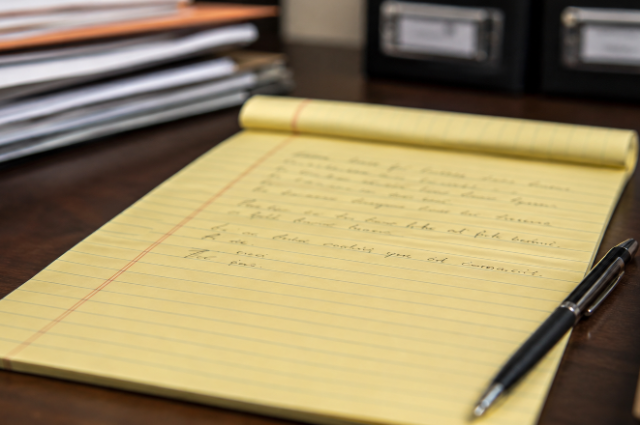
On May 6, 2026, a claimed suicide note written by Jeffrey Epstein was discreetly unsealed by a US federal judge, and it instantly revived one of the most disturbing tales of the last decade. Scribbled across a yellow legal pad, the note carried no signature, no date, and no definitive proof of authorship, yet its arrival into the public record through a tangled and deeply unusual chain of custody was enough to send speculation spiralling once again. The contents themselves are remarkably brief, almost unnervingly so, but in a case where every missing detail has fuelled years of suspicion, silence often speaks louder than words. Nearly six years after Epstein died in a federal jail cell, which was officially ruled a suicide, the release of this document has reopened old questions that never truly went away, not because the note answers them, but because it threatens to deepen the mystery surrounding a man whose death remains somewhere between official conclusion and public disbelief.
The Document Itself
The note is sparse and raw in its phrasing. It includes the statement: "They investigated me for a month - FOUND NOTHING!!!", and references charges from 15 years ago. It further continues saying, "It is a treat to be able to choose one's time to say goodbye. Watcha want me to do - Bust out cryin!! NO FUN - NOT WORTH IT." The note consists of only seven lines, leaving uncertainty about its intended meaning. The capitalisations, triple exclamation marks, and deliberate misspelling of "chose" used in place of "choose" give the fragment an almost eerie sense of urgency. However, no court or agency has verified or authenticated the note, which is unsigned and undated. Legally, at this stage, it is simply a piece of paper with words on it. The existence of the note is the result of a complicated and unusual set of circumstances that begins not with Epstein, but with his cellmate, Nicholas Tartaglione.
The Cellmate Connection
Nicholas Tartaglione, a former New York police officer, was convicted in 2023 of quadruple murder, including kidnapping and narcotics offences in 2016, serving multiple life sentences. At the Metropolitan Correctional Centre in Manhattan, he and Epstein were housed in the same cell. According to Tartaglione’s claims, on July 23, 2019, Epstein was found injured in their shared cell with bruises and ligature‑type marks on his neck. Epstein initially reported to prison staff that Tartaglione had attacked him, but the Bureau of Prison Records subsequently determined that Tartaglione had no involvement and that the incident was a suicide attempt. Since then, Tartaglione has insisted that he attempted to resuscitate Epstein because he thought he was seriously ill in addition to being injured. At times, he described Epstein as seeming to have suffered a heart attack. The memo was accompanied by a letter that former Tartaglione attorney John A. Wieder filed with the court in May 2021. The note, according to the attorney, was "the original document" that federal Judge Kenneth M. Karas ordered to be presented to the court at the moment in question. Additionally, Tartaglione says that he found the note in his book by accident: "I opened my book to read, and there it was." The dichotomy in this situation is that a man convicted of one of the most serious crimes under American law is the only source of the note's provenance, discovery, safekeeping, and eventual submission to the court. Whether Tartaglione found the note as described, whether it was placed there deliberately, or whether its origins are entirely different are questions that remain open.
A Death Surrounded by Questions
Epstein, 66 at the time of his death, was arrested on 6 July 2019 on federal sex-trafficking charges relating to the alleged sexual abuse of underage girls, some as young as 14, during a period spanning 2002 to 2005. He died in his cell on August 10 2019, and the official finding was suicide by hanging. But from nearly the moment his death was announced, the circumstances attracted scrutiny that has never fully abated. In 2023, a federal investigation by the Department of Justice (DOJ) Inspector General Michael E. Horowitz concluded that Epstein's death was the result of a cascade of misconduct, negligence, and institutional errors at the Metropolitan Correctional Centre, New York. Guards had falsified log entries to indicate they were conducting required rounds when they were not. Surveillance cameras outside his cell malfunctioned. Epstein had been removed from suicide watch despite earlier warning signs, including the July 23 incident, the very same episode to which Tartaglione's account and this note are tied. The 2023 report did not determine that Epstein was murdered, but highlighted systemic failures at the facility. This context is crucial to understanding why an unverified suicide note carries public weight, reflecting a lack of institutional accountability.
Why Unsealing This Document Matters
US District Judge Kenneth Karas in White Plains, New York, clarified that making the note public does not verify its authenticity or confirm the circumstances surrounding its discovery. The note is now subject to challenge and scrutiny in future legal proceedings, having circulated informally before its unsealing in 2026, years after Epstein's death. This delay highlights the slow progress of Tartaglione's case, the ongoing civil litigation involving Epstein's estate, and the public interest in his network. The document raises more questions than answers, lacks authentication, and originates from a convicted murderer. Produced through a civil case years after the events it describes, its authenticity remains uncertain, reflecting the incomplete and complex nature of the facts surrounding this case.
References
- https://www.bbc.com
- https://edition.cnn.com
- https://timesofindia.indiatimes.com
- https://www.indiatoday.in
- https://www.dw.com
- https://www.theguardian.com
- https://www.lemonde.fr
- https://www.bbc.com
- https://www.reuters.com
- https://www.newsweek.com
- https://www.police1.com
- https://www.cbsnews.com
- https://www.cbsnews.com
- https://www.washingtonpost.com
- https://www.livemint.com
- https://oig.justice.gov
- https://www.cbsnews.com
- https://oig.justice.gov
- https://www.pbs.org
- https://thehill.com
- https://www.instagram.com