
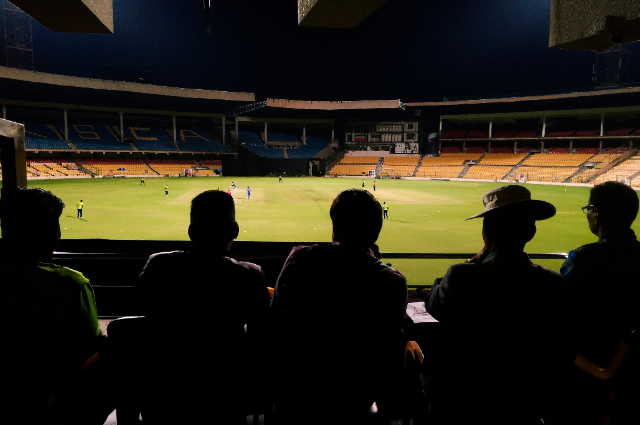
Imagine being counted among the top twenty players in your sport worldwide, possessing the kind of skill that compels franchises worth hundreds of millions of dollars to offer a king's ransom, and then watching the world's most-watched cricket league, an enterprise valued at roughly $18.5 billion in 2026, launch a new season and knowing with the absolute certainty that no phone call is ever coming for you. It’s not because your fitness wavered, not because of a doping violation, and not because a knee finally gave out in your mid-thirties, but solely because of the passport resting in your drawer.
As it stands, that’s the daily existence of professionals like Babar Azam, Shaheen Shah Afridi, Muhammad Rizwan, and virtually every elite Pakistani cricketer competing today as they are frozen out of the Indian Premier League by a geopolitical standoff that has calcified into an ironclad unwritten rule. This tournament is so flush with cash that it distributed crores of rupees in prize money and player fees during the 2024 season alone, yet the ban is not a permanent clause etched into the IPL's official rulebook, it does not need to be, for it operates through a force far more enduring than policy, rooted in the wreckage of the 2008 Mumbai terror attacks and persisting for more than 17 years to render, making the Pakistani cricketers the only elite athletes from a major Test-playing nation who are systematically barred from competing in the sport's most lucrative T20 extravaganza.
The Locker Room of Lost Hours
The Indian Premier League, launched in 2008 by the Board of Control for Cricket in India (BCCI), with Lalit Modi as the founder, the first Commissioner of the league, and the one who created and ran the tournament for its initial good years until 2010, is not merely a cricket tournament. On a per-match basis, it stands as the second most valuable sports media property in the world, trailing only the National Football League (NFL), which alone tells you everything about the scale of what Pakistani cricketers are locked out of. After a bumper 2023 season, the IPL's total combined brand value grew 28% to $10.7 billion, according to Brand Finance, the world's leading independent brand valuation consultancy, and the money flowing in from broadcasters is just as staggering as on June 14 2022, the BCCI secured what became the biggest broadcast deal in cricket history ₹48,390 crore ($6.2 billion) for IPL media rights spanning 2023 to 2027, with Disney Star retaining television rights for ₹23,575 crore while Reliance-backed Viacom18 grabbed digital rights for ₹23,758 crore, marking the first time in Indian sports that digital rights commanded a higher price than television. For a professional cricketer, the IPL is therefore far more than just a tournament, as it is a financial ecosystem unlike anything else in the game, where a mid-tier overseas player can earn up to ₹18 crores for a single seven-week season. In contrast, elite players command figures that defy easy comprehension. At the 2024 mini-auction, Australian fast bowler Mitchell Starc shattered the record for the most expensive player in IPL auction history when Kolkata Knight Riders bought him for ₹24.75 crore (approximately $3 million), surpassing the winning bid of ₹20.50 crore that Sunrisers Hyderabad had paid for Pat Cummins just hours earlier, both figures for a single season of cricket. The IPL has, in effect, redrawn what financial success looks like for a professional cricketer, and Pakistani players, who were once key contributors to the league’s early success, have watched every rupee of this transformation from across a permanently closed border.
The Locker Room of Lost Hours
To understand why no Pakistani cricketer has played a full IPL season since 2008, one must return to the Taj Mahal Palace Hotel in Mumbai, where the 26/11 2008 Mumbai terror attacks, carried out by the Pakistan-based militant group Lashkar-e-Taiba, killed more than 170 people and fundamentally altered the diplomatic relationship between the two nations.
The inaugural IPL season earlier that same year had, in fact, featured 23 Pakistani stars shining brightly on Indian soil. Shahid Afridi turned out for the Mumbai Indians, Shoaib Akhtar spearheaded the Delhi Daredevils attack, Younis Khan represented the Rajasthan Royals, and Sohail Tanvir famously claimed the Purple Cap with 22 wickets in just 11 matches, including a devastating 6/14 spell against the Chennai Super Kings that remains etched in tournament folklore. Yet within weeks of the attacks, the landscape shifted irreversibly, resulting in Pakistan's foreign ministry deeming travel to India unsafe and barring its players from the 2009 edition, while the BCCI made a quiet but seismic decision ensuring no Pakistani player would be retained or signed for the upcoming season. The performances were celebrated, but the removal from the next campaign was swift and total. The Pakistan Cricket Board, citing "security concerns," also withdrew its players ahead of the 2009 edition, giving BCCI political cover for what was, in practical terms, an indefinite ban, and by 2010, even after Pakistan obtained No Objection Certificates (NOCs), no IPL franchises bid for the 11 listed Pakistani players. including World Cup winners at the auction, a snub that players attributed to politics rather than cricketing merit. BCCI vice-president Rajiv Shukla confirmed in 2012 that participation hinged on resuming Indo-Pak cricket ties, which remain suspended outside ICC events. This is the moment the unwritten norm calcified into something permanent, a "silent policy" that operates without a single line of text in the IPL's operating guidelines and yet governs the league with the force of scripture. There is no formal ban to challenge through legal or sporting governance channels, which is a feature of its construction, not a bug. No franchise has expressed interest in signing a Pakistani passport holder since the 2009 auction, and the only player of Pakistani origin to feature after that year was Azhar Mahmood, who did so exclusively as a British citizen. Furthermore, Former Pakistan Prime Minister and cricket icon Imran Khan captured the enduring frustration of this exclusion when he told Times Radio, "I find it strange that the Indian cricket board would take it out on the Pakistan cricket players, and it just reeks of arrogance." That sentiment echoes across the border, where elite athletes like Babar Azam and Shaheen Shah Afridi watch a tournament flush with billions of dollars begin each season, understanding with quiet resignation that the velvet rope at the IPL's entrance is one they will never be permitted to cross.
The Shadow Ban Spreads: Beyond the IPL
What began as a bilateral India–Pakistan political problem has, in 2025 and 2026, started to metastasise into a global cricket governance crisis as IPL franchise capital flows into overseas leagues. In 2025, IPL owners acquired stakes in multiple teams in England's The Hundred competition including Reliance Industries (Mumbai Indians) bought a 49% stake in the Oval Invincibles, and promptly rebranded it as MI London; Sun Group (Sunrisers Hyderabad) acquired 100% of Northern Superchargers, and renamed it Sunrisers Leeds; GMR Group (Delhi Capitals) consolidated control of Southern Brave; and RPSG Group (Lucknow Super Giants) bought Manchester Originals, and unveiled it as Manchester Super Giants. With the Indian Capital now embedded in half the competition, a BBC investigation in early 2026 reported that these four franchises were operating under what multiple agents described as an "unwritten rule" dictating that Pakistani players were "not being considered" for the upcoming auction. The Pakistan Cricket Board, alarmed by the development, prepared an official letter to the England and Wales Cricket Board demanding fair treatment and equal opportunity for its athletes. The ECB responded by publicly reaffirming its commitment to inclusivity, with a spokesperson stating that "The Hundred welcomes men's and women's players from all over the world and we would expect the eight teams to reflect that," while chief executive Richard Gould went further, warning that "clear anti-discrimination policies" were in place and insisting he expected "players from all nations to be selected for all teams." Yet behind these public assurances, a senior ECB source conceded to journalists that genuine interest in Pakistani players would likely be confined to the four non-IPL-linked franchises, a tacit admission that the shadow ban had already crossed borders.
This expansion shows no sign of slowing, and the implications stretch far beyond a single English summer. South Africa's SA20 features six teams under Indian ownership, the UAE's ILT20 mirrors that same structure with six more, and the Caribbean Premier League counts three Indian-owned franchises among its ranks. Reports now indicate that Australia's Big Bash League and a proposed franchise league in New Zealand will see similar investment patterns emerge over the coming years, weaving Indian capital ever more tightly into the fabric of global T20 cricket. For Pakistani players already excluded from the IPL's vast financial ecosystem, the horizon is narrowing with alarming speed: they now confront the very real prospect of being systematically locked out of almost every major T20 competition on earth, wherever Indian ownership has planted its flag. The Pakistan Super League and the Bangladesh Premier League remain their primary alternatives, two islands of opportunity in an ocean increasingly defined by a quiet, unwritten, and profoundly effective exclusion.
Pakistan’s Showcase with PSL
The Pakistan Cricket Board has not been passive in the face of this mounting exclusion. Since its revival and relaunch as a genuinely competitive league from 2016 onward, the Pakistan Super League has worked tirelessly to attract global talent and build a credible brand capable of standing alongside the world's premier T20 competitions. The 2025 PSL edition drew players of the calibre of David Warner, Kane Williamson, Daryl Mitchell, and Kieron Pollard. To secure such names, the PCB deployed a special savings fund, which now holds a total of one million dollars, and announced to give each of those elite players an extra 100,000 dollars just to make sure they play in it. In the Pakistan Super League (PSL), officials initially set a maximum payment of $200,000 for foreign players. However, they have since increased their budget, as demonstrated by David Warner's record $300,000 deal. The official further explained that a few years ago, the PSL governing council decided that when the central pool’s net broadcast revenue reached 3 billion rupees, USD 500,000 would be allocated annually for elite players’ salaries.
Yet the PSL's structural disadvantages remain almost impossible to overcome through salary increases alone. The IPL's media rights deal is worth roughly 65 times the PSL's total revenues, a financial chasm so vast that players from other nations routinely abandon their PSL contracts mid-season, the moment an IPL replacement call arrives. Zimbabwe pacer Blessing Muzarabani departed Islamabad United without hesitation to join Kolkata Knight Riders, while Sri Lanka's Dasun Shanaka left Lahore Qalandars for Rajasthan Royals, both earning multiples of their PSL salaries in the process. The Pakistani league simply cannot hold even its foreign recruits against the gravitational pull of an IPL opportunity, and for the Pakistani players themselves who remain permanently ineligible for those same lucrative contracts, this dynamic carries a bitter secondary wound which the very foreign teammates brought in to elevate the PSL's standard may vanish mid-tournament for the richer league across the border, weakening the one competition upon which Pakistan's cricketers most urgently depend.
The Frontier’s Toll
Beyond the cold arithmetic of broadcast deals and franchise valuations lies a quieter, more human story featuring Pakistani cricket's production of some of the most gifted T20 players of their generation, such as Shaheen Shah Afridi's searing left-arm swing, Babar Azam's classical and metronomic batsmanship, Naseem Shah's raw and unrelenting pace, and Shadab Khan's deceptive wrist-spin are precisely the qualities that franchises would pay enormous sums to acquire were the passport barrier ever to dissolve which further adds to the 2025 IPL auction alone, when franchises committed ₹27 crore to Rishabh Pant and ₹26.75 crore to Shreyas Iyer, a narrative open to challenge, given that were Pakistan’s best allowed to step onto the same stage, the compensation they would attract would serve as a new baseline for the very skills in question.
There is also the less quantifiable but equally consequential question of development and exposure, along the IPL ecosystem, with its world-class coaching infrastructure, its sophisticated analytics departments, and its unrelenting high-pressure match environment against the planet's finest players, consequently evolving into something of a finishing school for elite T20 cricketers. Additionally, Players from Australia, England, the West Indies, and South Africa arrive for IPL seasons and return to their national teams measurably improved; their techniques refined under the gaze of the game's sharpest minds. However, regrettably, Pakistani cricketers are structurally denied this entire development pathway, thus compounding year after year with no remedy in sight.
It is worth pausing to consider how exceptional this situation is in the context of global professional sport. In the NBA, players from countries with fraught relationships with the United States, China, Russia, and Iran compete freely. European football's top leagues feature players from every geopolitical corner of the world. Even in cricket, the IPL has included players from nations with significant political tensions with India; the league has featured Sri Lankan, Bangladeshi, and Afghan players without any equivalent political mechanism of exclusion. The Pakistan exclusion is singular precisely because it operates not through any formal rule but through a tacit agreement that has become normalised enough to export. What was once a bilateral India–Pakistan problem, contained within India's borders and justified with reference to Indian security conditions, has now migrated into English cricket with its own anti-discrimination laws, its own ECB governance framework, and no bilateral political dispute with Pakistan. For fans, it represents a missing chapter in the league's narrative that could have enriched rivalries and elevated competition to heights still left unexplored and as long as the currents of diplomacy remain frozen between these two neighbours, this gap will endure as a quiet monument to the truth that sport, for all its unifying promise, cannot outrun the shadows cast by history and the intractable weight of conflict.
. . .
References:
- https://www.espncricinfo.com
- https://wpleague.in
- https://www.abplive.com
- https://timesofindia.indiatimes.com
- https://arthnova.com
- https://brandfinance.com
- https://sports.ndtv.com
- https://www.espncricinfo.com
- https://wpleague.in
- https://www.moneycontrol.com
- https://www.stimson.org
- https://www.espncricinfo.com
- https://www.cricketnews.com
- https://www.espncricinfo.com
- https://sports.ndtv.com
- https://timesofindia.indiatimes.com
- https://www.facebook.com
- https://thesportjournal.org
- https://football-observatory.com
- https://www.gprjournal.com
- https://thewire.in
- https://www.espn.in
- https://www.espn.in
- https://www.edinburgpost.com
- https://cricketwebs.com
- https://cricketaddictor.com
- https://www.quora.com
- https://www.ipl.com
- https://www.yardbarker.com
- https://www.hindustantimes.com
- https://www.news18.com
- https://wpleague.in
- https://gulfnews.com
- https://www.espn.in
- https://www.facebook.com