
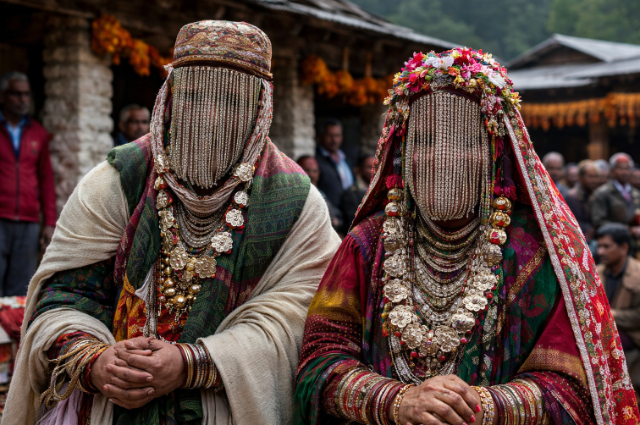
In the high-altitude villages of Kinnaur district in Himachal Pradesh and along the Lahaul Spiti border near Tibet, rituals reflect a unique blend of local tribal traditions and Tibetan influences, shaping everyday life in ways that feel both ancient and deeply meaningful. Among these traditions, a 5000-year-old ritual, called the Raulane festival, stands out as a ritual that blends mythology, community belief, and seasonal change into a powerful cultural experience. Celebrated in early Spring, often soon after Holi, the festival is believed to honour the celestial spirits, who descend to protect the village during the harsh winter months, and for the people of Kinnaur, it remains a deeply spiritual event closely tied to their identity, history, and relationship with nature.
Cultural Background
Kinnaur, located in the north-eastern corner of Himachal Pradesh, is known for its rich cultural heritage and strong connection to traditional beliefs. Due to its remote mountainous geography, many customs in this region have remained preserved for centuries. This five-to-seven-day ritualistic dance festival, celebrated mainly in the village of Kalpa and Kothi, marks the conclusion of the Suskar or Phagul Festival (a winter festival focused on worshipping mountain spirits to request protection for the coming year), representing a farewell to the skyward sentinels as they return to high pastures, marking a transition from winter to spring.
The Legend of the Saunis
According to the local folklore in Kinnaur, the Raulane festival is closely connected to the belief in celestial beings known as the Saunis (mountain fairies). Villagers believe that these spirits descend from the high mountain meadows, locally called Kandas, during the winter season. In earlier times, winters in this region were extremely harsh, and survival depended on both physical preparation and spiritual faith; hence, the Saunis are believed to protect the village, its people, and their livestock from natural dangers such as heavy snowfall, illness, and misfortune. When the cold season ends and spring begins, the community organises the Raulane festival as a way of expressing gratitude and bidding farewell to these protective spirits before they return to the mountains. Anthropological research frequently highlights that in mountain societies, rituals connected to seasons help people cope with uncertainty and give them a sense of security, even when life depends on unpredictable weather and difficult living conditions (Poudel, J. M., 2020).
The Symbolic Union between Human and Divine
One of the most distinctive features of this ancient winter-spring heritage event is the symbolic marriage ritual performed by two selected men from the village, known as Raula (groom) and Raulane (bride). The two roles are chosen carefully with community approval. Kalpa is divided into parts called Saring, and from each Saring, the elders select the people who will perform. According to local belief, the elders also observe small signs during the selection, which are considered blessings from Sauni. In this ritual, one man represents the masculine divine force while the other takes the role of the feminine spirit. The person chosen as Raulane is dressed in traditional Kinnauri women’s attire, which includes the doru (Kinnauri shawl), choli (coat-like top), pattu (waist shawl), and gachchi (belt), along with floral headwear made from local flowers such as Chamka and Narkasang, and colourful cotton seeds known as Bakhri Kan. The attire is further adorned with heavy ancestral silver and gold jewellery like daglo, bithri, contai, and similar pieces, which are usually preserved by families for special religious occasions. Both participants keep their faces completely covered throughout the ceremony, as they are believed to act as vessels for spiritual power during the ritual. The marriage performed during the festival is not considered an actual wedding but a symbolic union representing the connection between the human and spirit worlds. Such rituals are common in many Himalayan traditions, where symbolic performances reflect the balance between masculine and feminine energies, nature and humans, and the visible and invisible realms.
The individuals performing as Raula and Raulane are expected to remain silent and avoid direct interaction with the crowd. Their faces stay covered, and local belief warns that looking directly into their eyes could bring bad luck or spiritual disturbances, as they are considered to be temporarily possessed by divine forces. During this cultural patrimony, the village gathers near the Nagin Narayan temple in Kalpa, where slow and deliberate dances are performed to the sound of traditional instruments such as the dhol and damau. Unlike many festive dances in Himachal Pradesh that are energetic and celebratory, the movements in Raulane are calm and almost trance-like, giving the ritual a meditative quality.
The Challenges of Preserving Tradition
In 2025 and 2026, the Raulane festival garnered attention beyond the Kinnaur district, particularly through social media platforms where short videos of the ritual were widely shared. The unique costumes, masked performers, and mysterious atmosphere have attracted tourists, photographers, and researchers who want to witness the festival in person. While this increased interest has helped bring recognition to the cultural heritage of the region, it has also created concern among residents. Many villagers believe that the festival should be respected as a sacred ritual rather than treated as a public show. There have been instances where visitors tried to take close photographs of the performers or entered private spaces where preparations were taking place, which is considered disrespectful according to local customs. Community elders emphasise that Raulane is rooted in the long oral tradition, and its true significance can be overlooked when treated as mere entertainment. Cultural preservation groups in Himachal Pradesh caution that unchecked tourism risks turning authentic spiritual festivals into staged performances for tourists.
Importance of Traditional Rituals in Modern Society
In a time when younger generations are moving to cities for education and jobs, festivals like Raulane act as a link between past and present, helping preserve stories, beliefs, and values that might otherwise disappear. Even today, many villagers believe that participating in the festival brings peace, protection, and unity to the community.
The Raulane festival of Kinnaur is more than a cultural event; it is a living tradition that reflects the deep connection between people, nature, and belief. Even though modern life has brought many changes to remote Himalayan regions, the people of Kalpa continue to preserve this ritual with great respect and devotion.
References
- https://himalayandreamtreks.in
- https://www.facebook.com
- https://www.justwravel.com
- https://link.springer.com
- https://www.india.com