
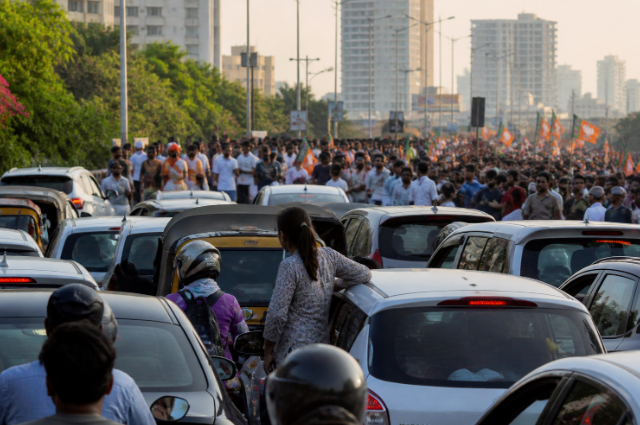
Mumbai never slows down for anyone, neither for monsoons, nor hartals, nor even the searing heat of April that turns the city’s asphalt into something close to a skillet. However, on the afternoon of April 22, 2026, a vital stretch of road in Mumbai came to a complete and embarrassing halt, captured on camera. In that moment, it was not a politician, journalist, activist, or opposition spokesperson who voiced what needed to be said. Instead, it was a woman, anxious to reach her destination and pick up her child, who had absolutely no patience left for the spectacle unfolding in front of her car.
The Rally, the Road, and What Followed
On the evening 5 P.M. of Tuesday, April 22, 2026, the Bharatiya Janata Party (BJP) under the Mahayuti alliance organised a large-scale protest march led by Maharashtra’s Disaster Management Minister and BJP stalwart Girish Mahajan, called "Mahila Jan Akrosh" or "Nari Shakti Vandan Adhiniyam Rally", protesting the bill's rejection due to a lack of majority, through Mumbai's Worli neighbourhood, one of the city's most densely trafficked corridors, ostensibly in support of the Women's Reservation Bill (Constitution 106th Amendment Act 2023). Thousands of women from across Maharashtra gathered at Jambori Maidan (also called Jamboori or Jambhori Maidan) and marched toward the Worli Dome (part of NSCI Dome) in the late afternoon, but delays caused severe jams in the busy Worli corridor during peak hours. A frustrated woman commuter, who had been stuck for over an hour while picking up her child, confronted the Minister and the police, demanding that the rally be moved to an open area. Videos of her outburst went viral, igniting discussions about rally planning. This incident also drew criticism from opposition leaders, including Congress members Harshwardhan Sapkal and Nana Patole.
A City That Cannot Afford to Stand Still
Mumbai does not do traffic lightly. The city of nearly 27 million people is consistently ranked among the world's most congested urban centres. The 2025 TomTom Traffic Index ranks it around 18th globally with 63.2% average congestion, where drivers lose about 126 hours yearly in rush hours, down slightly from 2024 but still among the worst. In a city where school pickup times, local train schedules, and evening commutes operate with the precision of interlocking gears, a blocked artery is not an inconvenience. Peak evening travel for 10 km takes 35+ minutes at 16.9 km/h average speed, far above free-flow times. This matches historical patterns of 65-100% extra time in peaks, affecting commutes, productivity, and costs like extra fuel (e.g., Rs 350+ daily round trips).
Worli, a coastal suburb that connects South Mumbai to the western suburbs via the Bandra-Worli Sea Link, serves as a vital transit route. Routing a large, slow-moving political march through this corridor during peak evening hours, when thousands of commuters are heading home, was, at best, a significant planning oversight. At worst, it was a deliberate exercise of political power that treated public inconvenience as an acceptable consequence.
One Woman, One Moment
In the midst of chaos, it must be addressed that a brave local woman, often unnamed in various reports, made a powerful statement that demonstrated how impactful political expressions can come from everyday people, rather than just politicians. The video of her confrontation fanned out rapidly online, capturing an unscripted moment that resonated with viewers. She wasn’t reading from a script or representing any party; instead, she was simply a resident expressing her belief in a basic right to use a public road without being subjected to political theatrics. Her grievance, clearly documented in the video, was that the BJP did not use the designated ground for their rally, and she demanded that the minister leave. The clip quickly gained traction across various social media platforms in India, which often thrives on raw, unfiltered interactions between citizens and authority figures. A fan-made Amul topical ad featuring a woman with the tagline “Question karna allowed hai!” began circulating, effectively capturing the prevailing sentiment. It illustrates how swiftly culture transforms real events into creative commentary, with Amul-style humour once again serving as the popular format for expressing the thoughts of many. Like this, the majority of comments supporting her viewpoint further strengthened her message.
The Regret from the Podium
The Maharashtra minister was interacting with journalists during the march, causing a complete road blockade on a narrow, congested street. Traffic came to a standstill, with vehicles backed up in all directions, thus shifting from the march itself to the lack of effective management. However, the day after a BJP march massacre, Girish Mahajan and Mumbai Mayor Ritu Tawde issued an apology for the inconvenience caused to commuters. Following the viral video of the woman's confrontation with him regarding the traffic disruption, the Maharashtra cabinet minister expressed that he was "personally sorry" for the issues caused by the rally. However, he also remarked that the woman's use of "foul language" towards party workers was inappropriate.
The Politics of Inconvenience
Opposition leaders moved quickly. Former Maharashtra Congress president Nana Patole shared the video, framing it as evidence that the protest had caused genuine hardship to ordinary citizens. This is, again, standard political choreography, the opposition amplifying a moment that embarrasses the ruling party. But the underlying point was not wrong. If a march organised in the name of women's rights managed to strand a woman trying to pick up her child from school, there is an irony that requires no embellishment.
The Women's Reservation Bill, formally the Constitution (One Hundred and Twenty-Eighth Amendment) Act, 2023, reserves one-third of seats in the Lok Sabha and state legislative assemblies for women. Its passage in September 2023 was welcomed across party lines, even as critics noted that its implementation is linked to delimitation, pushing meaningful effect to potentially 2029 or beyond. Protests in support are legitimate, but the choice of venue, timing, and crowd management reflects a party's public relationship as much as the cause.
What City Administrations and Parties Owe the Public
There is a broader civic conversation embedded in this incident that deserves attention beyond the viral moment. Indian cities have long struggled with a framework for balancing the constitutional right to protest with the practical rights of residents to move freely. Therefore, Indian courts recognise the right to protest under Article 19(1)(a)(b)(c) but balance it against mobility under Article 19(1)(d), often restricting protests on public roads to avoid blocking traffic. Rules like those in Ramlila Maidan emphasise designated protest areas to protect residents' free movement. Section 144 of the CrPC, now mirrored in the Bharatiya Nagarik Suraksha Sanhita 2023, allows authorities to restrict assembly in cases of public inconvenience, but its application is uneven and often politically selective. Rallies by the party in power tend to receive more accommodating treatment from local administration than those by the opposition. A more robust civic standard would require all political events held on public roads, regardless of which party organises them, to submit detailed traffic diversion plans, notify affected residents in advance through ward-level communication, and be held liable for the costs their disruptions impose on the city. Several democracies operate on versions of this model. In the United Kingdom, for instance, the Public Order Act 1986 requires organisers of processions to provide advance notice to police, including the proposed route, allowing for coordination with local traffic authorities. India has the legislative skeleton for similar requirements; what it often lacks is the political will to apply them uniformly.
The Worli incident illustrates that legitimacy goes beyond winning elections, thereby shaping everyday interactions between power and the people. A woman confronting a minister from a stalled vehicle symbolises a broader frustration with the way public space is often appropriated for political events, disregarding citizens' needs. Her act transcended beyond traffic to channel the exhaustion of feeling that daily lives are secondary to political agendas. Her demand for her road back highlighted a form of democratic accountability that no political speech could convey.
References:
- https://www.daijiworld.com
- https://www.indiatoday.in
- https://theprint.in
- https://www.drishtiias.com
- https://www.deccanherald.com
- https://www.youtube.com
- https://www.telegraphindia.com
- https://www.devdiscourse.com
- https://www.deccanherald.com
- https://www.newsbytesapp.com
- https://www.youtube.com
- https://www.youtube.com
- https://www.census2011.co.in
- https://www.tomtom.com
- https://www.tomtom.com
- https://www.tomtom.com
- https://timesofindia.indiatimes.com
- https://timesofindia.indiatimes.com
- https://timesofindia.indiatimes.com
- https://www.hindustantimes.com
- https://www.instagram.com
- https://www.nationalheraldindia.com
- https://indianexpress.com
- https://www.indiatvnews.com
- https://prsindia.org
- https://www.theweek.in
- https://juriscentre.com
- https://www.drishtiias.com
- https://judextutorials.com
- https://prsindia.org
- https://economictimes.indiatimes.com
- https://www.pastpaperhero.com