
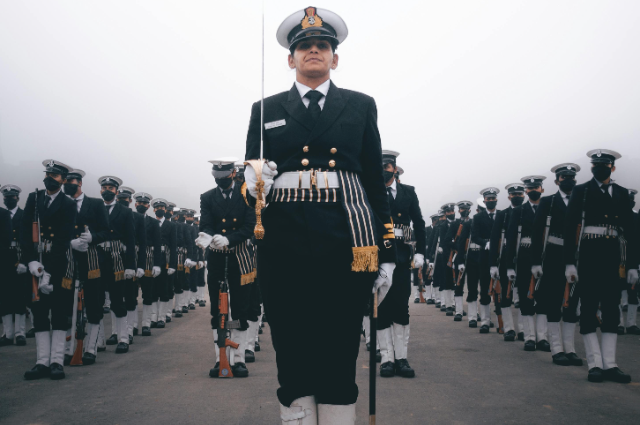
On the night of May 7-8, 2025, India carried out a targeted military operation designed to dismantle terror infrastructure beyond its borders. The whole country was observing. However, the two women who appeared on screen the following morning to explain the situation to the globe were what really resonated with millions of people, not only the boldness of the acts. For the first time ever in the history of the Indian Armed Forces, two women officers, Wing Commander Vyomika Singh of the Indian Air Force and Colonel Sofiya Qureshi from the Indian Army, jointly spoke to the nation during an official military press briefing about a crucial operational event. This was the outcome of years of unspoken, unshakable commitment that ultimately garnered national exposure rather than predetermined conduct.
The Colonel Who Built Bridges in Conflict Zones
Colonel Sofiya Qureshi was born in 1974 in Vadodara, Gujarat, into a family with a long tradition of military service, including her grandfather, who served as a religious teacher in the Indian Army. Yet choosing to pursue a military career herself in 1999, after completing her training at the Officers Training Academy and receiving her commission, meant stepping into a profession where women still faced significant and distinct challenges. She started her academic career in the sciences, earning a bachelor's degree in chemistry and a postgraduate degree in biochemistry from Maharaja Sayajirao University in Vadodara in 1997. After enlisting in the Army Signal Corps, she went on to pursue a Master’s in Defence and Strategic Studies at the Defence Services Staff College in Wellington, and later she specialised in strategic cybersecurity at the National Defence College in New Delhi, placing herself at the nexus of communication, technology, and national security.
Throughout her career, she has maintained an impeccable record, as evidenced by her crucial contribution to the establishment of the Indian Army's first mobile digital communication network in 2001. She received a Commendation Card from the General Officer Commanding-in-Chief for her crucial role in maintaining vital communication systems under pressure during Operation Parakram following the Parliament attacks. As part of United Nations Peacekeeping Operations, she was sent to the Democratic Republic of the Congo in 2006 to supervise ceasefires and support humanitarian efforts in one of the world's most unstable regions. Her Force Commander Commendation from the Congo mission demonstrates service that went above and beyond the call of duty, including, as mentioned, helping to reunite a child who had been separated from her mother during the chaos of battle. Yet it wasn't until 2016 that she made history as the first female officer to lead an Indian Army contingent in the multinational military exercise ASEAN+ FORCE-18, which involved over 18 countries and was centred on mine clearance and peacekeeping. 'Force 18' is the name of the week-long exercise, which runs from March 2 to 8. The primary goal of "Force 18" was to promote understanding and achieve interoperability among the 18 ASEAN-Plus countries, according to Lt Gen Bipin Rawat, Commander of the Army's Southern Command stationed in the city. During flood relief efforts in North-East India in 2024, her proficiency in handling vital communications once more proved crucial.
The Wing Commander Whose Name Foretold Her Destiny
"Vyomika," which means "daughter of the sky" in Sanskrit, now seems more like a fulfilled prophecy than a name. Without any military experience, Wing Commander Vyomika Singh grew up in a middle-class, civilian family in Lucknow. She was the first member of her family to enlist in the military, a distinction that frequently calls for greater bravery than people raised in military families can truly comprehend. Her early fascination with aviation led her to join the National Cadet Corps (NCC) while still in school, a crucial decision that changed the course of her life. In 2004, she was commissioned into the Flying Branch of the Indian Air Force. In the next twenty years, she racked up over 2,500 hours of flight experience over some of India's toughest landscapes, elevated areas in Jammu & Kashmir, hilly routes in the Northeast, flying Chetak and Cheetah helicopters in missions that included troop deployment and disaster relief. In November 2020, she commanded a 28-day operation in Arunachal Pradesh to retrieve personnel and gear stuck on a snow-laden summit close to the international border. In 2021, she became part of an all-female tri-services mountaineering team heading to Mt. Manirang, standing at 21,650 feet, which was a mission aimed not only at showcasing women's capabilities in extreme endurance but also represented a true act of physical bravery. There is, however, a facet of her narrative that addresses institutional obstacles instead of personal ones. For years, female officers in the IAF were not granted permanent commissions, implying they worked under time constraints throughout their careers, unable to attain the high-ranking leadership roles available to their male peers. On December 18, 2019, Wing Commander Singh was one of those awarded a permanent commission in the aviation division. That date marks a significant moment in the history of gender equality in India's defence sector, allowing women officers to hold leadership positions with equal rights, benefits, and opportunities as their male counterparts.
The Briefing That Rewrote a Narrative
Two female Indian Armed Forces officers, Wing Commander Vyomika Singh and Colonel Sofiya Qureshi, led the official briefing on Operation Sindoor, providing details of India's targeted airstrikes on terrorist infrastructure in Pakistan and Pakistan-occupied Kashmir (PoK), in a noteworthy display of leadership and symbolism. Following Foreign Secretary Vikram Misri's opening remarks, the two officials took centre stage, outlining the rationale, goals, and outcomes of the operation that was started in response to the terrorist incident in Pahalgam on April 22 that claimed the lives of 26 civilians. When Wing Commander Singh outlined the scope, intent, and outcomes of Operation Sindoor with precision and composure, the setting itself became the story. Two women, in uniform, at the podium of national security. One Hindu, one Muslim. Two women officers, one from the Air Force and one from the Army, stood at the podium on behalf of national security after years of distinguished service. Although there was immediate public interest, reports of phoney X accounts impersonating the two Indian military officers warned people not to interact with or share posts from these profiles. Colonel Sofia Qureshi and Wing Commander Vyomika Singh are not on X, according to the Press Information Bureau's fact-checking section. The administration has urged the people to rely only on official defence and PIB sources for news about the armed forces and to verify facts before sharing information.
What Their Presence Actually Means
India's military has historically been, and to a considerable extent still is, a male-dominated institution. Women were first allowed to join the Army Medical Corps in 1958, but they were permitted to take on non-medical roles only from 1992. Permanent commissions for women were granted in 2020 following a directive from the Supreme Court. However, combat roles for women remain restricted. While progress has been made, it has been uneven. Against this backdrop, Colonel Qureshi and Wing Commander Singh represent a significant shift in the military landscape. Their careers include counter-insurgency, peacekeeping, high-altitude rescue, and strategic communication. They advanced not by evading military demands but by fully embracing them in challenging conditions. Operation Sindoor will be remembered for its targets and geopolitical impacts, but the enduring legacy may be the image of two women in uniform addressing the national press about a live military operation, as a baseline from which there is no going back.
References
- https://ddnews.gov.in
- https://www.businesstoday.in
- https://www.ndtv.com
- https://vajiramandravi.com
- https://www.ndtv.com
- https://www.theprogresscatalyst.com
- https://www.hindustantimes.com
- https://www.rediff.com
- https://www.ptcnews.tv
- https://9jabior.com.ng
- https://www.indiatoday.in
- https://defencedirecteducation.com
- https://www.indiasentinels.com
- https://www.metroindia.net
- https://vajiramandravi.com
- https://timesofindia.indiatimes.com
- https://www.sheinspiremagazine.com
- https://www.ndtv.com
- https://www.drishtiias.com
- https://www.scobserver.in