
Consumption has moved from the lungs to the lip, turning a public vice into a private, odourless pulse. While the global adult tobacco use rate dropped from 26.2% in 2010 to 19.5% in 2024, the burden remains disproportionately concentrated in low and middle-income countries (LMICs), which account for over 80% of the world’s tobacco users. India, according to the WHO Global Reports, stands as the second-largest tobacco producer and consumer globally, with approximately 243.48 million adults using tobacco in some form. Despite measurable progress, tobacco-related diseases continue to claim upwards of 1.3 million lives annually in the country.
What remains unclear is: If a family struggling to afford education is still spending more on tobacco than on their child’s future, is poverty really just a lack of income or something deeper and more uncomfortable?
According to the Household Consumption and Expenditure Survey (2023-24), rural households allocate only 2.5% of their spending to education, while nearly 4% goes toward tobacco. This gap is not just economic but behavioural, cultural, and structural all at once. It forces a difficult reckoning, viz., poverty is not only something imposed by systems, but in many cases, quietly reinforced by everyday choices made under the weight of constraint.
The Smokeless Tobacco Scourge
Across rural India, over 70% of households in the bottom 40% of the income distribution consume tobacco, reflecting the concerning rise of gutka use among the economically vulnerable population. According to the data from the Household Consumption Expenditure Survey conducted by the National Statistics Office (NSO) under the Ministry of Statistics & Programme Implementation (MoSPI) between August 2023 and July 2024, the percentage of rural households consuming gutka has surged nearly sixfold, from a mere 5.3% to a staggering 30.4%. Consequently, gutka now points to 41% of total tobacco expenditure in rural areas, establishing it as the dominant tobacco product by value. As illustrated by Shamika Ravi and Partha Protim Barman in The Indian Express, this pattern is not uniform across the country but is heavily concentrated in certain regions. The central belt, particularly Madhya Pradesh, Uttar Pradesh, Bihar, Chhattisgarh, and Rajasthan, shows the highest prevalence. In rural Madhya Pradesh, more than 60% of households consume gutka, while in Uttar Pradesh, the figure has crossed 50%. Even more concerning is the fact that tobacco consumption exceeds 85% among the lower-income population in states like UP, MP, and Bihar. The troubling aspect of this trend is its direct connection to economic vulnerability. Poorer households, despite their limited resources, spend a larger percentage of their income on tobacco compared to wealthier households, which underscores that the poorest pay the most for a toxic luxury. Research suggests that reallocating even a portion of this expenditure could add over 500 calories per day to children’s diets, potentially helping to address undernutrition in these communities. (Husain et al., 2016).
The Inertia of the Familiar
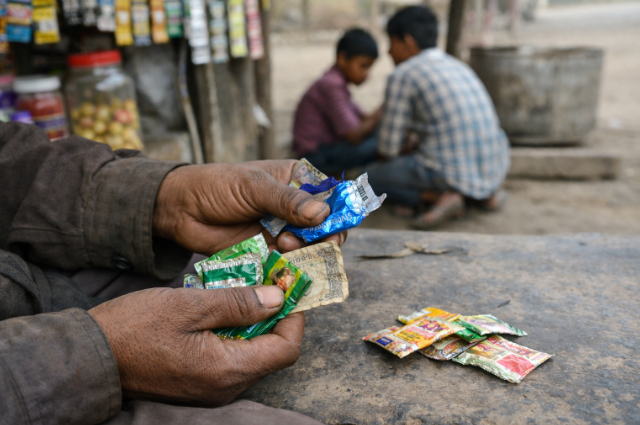
You cannot quantify the grip of gutka through spreadsheets; you have to look at the callouses on the hands holding the sachet. For the migrant laborer or the informal worker, life is a grueling marathon of physical exhaustion and financial instability. In this landscape of scarcity, a pocket-priced sachet is not just a product but a survival tool. It acts as a chemical blunt force against hunger, a fleeting stimulant to power through a double shift, and a cheap mental bunker against the weight or hardship, while “healthier alternatives” demand time and resources these workers don’t have. This cycle is reinforced by a cultural architecture that reframes a vice as a gesture of hospitality. In many rural communities, offering tobacco isn’t seen as a health risk, but rather a social lubricant, as common and expected as a glass of water. These habits are anchored by deep-seated folklore that a pinch of tobacco aids digestion or acts as a sedative for a frayed mind. These are not mere “information gaps” that a brightly coloured government poster can bridge, for they are lived convictions, woven into the fabric of daily interaction and historical precedent. Nevertheless, the least visible but incredibly profound is what we call psychological inheritance. In these households, tobacco is inhaled through observation when a child sees the pouch as a constant fixture of the domestic landscape. Household priorities shift almost imperceptibly to accommodate the addiction, and the “baseline” for the next generation is reset. What began as a desperate coping mechanism for the father becomes the default setting for the son, a vicious cycle of dependency that doesn’t just persist, but becomes part of the family’s DNA.
The Health & Economic Turmoil
Tobacco bankrupts the very systems designed to save countless lives. It remains the primary engine behind India’s surge in non-communicable diseases, fuelling a crisis of lung cancer, heart disease, chronic obstructive pulmonary disease (COPD), and numerous oral malignancies that dominate the national disease burden. According to the Ministry of Health and Family Welfare, the widespread use of smokeless tobacco products like gutka and khaini actively contributes to approximately 13 lakh deaths annually. Moreover, India bears the heaviest burden of oral cancer globally, recording over 83,400 cases in 2022 alone. The role of khaini is particularly lethal, accounting for 47% of all oral cancer cases in men. Beyond the physical toll lies a grim economic crossroads. As of 2017-18, the total cost associated with tobacco-related illness and premature deaths among Indians aged 35 and older reached ₹1,773.4 billion, roughly 1.04% of India’s Gross Domestic Product (GDP). The math of the industry is fundamentally predatory, for every ₹100 the government collects in tobacco tax revenue, society is compelled to absorb ₹816 in healthcare expenses and productivity losses (John et al., 2020).
The Business of Deception
Despite strict regulations under the Cigarettes and Other Tobacco Products Act (COTPA) 2003, tobacco companies have found ways to bypass advertising restrictions. Surrogate marketing has emerged as a powerful tool, allowing brands to promote products under the guise of harmless alternatives like mouth fresheners or elaichi, while retaining identical branding. This strategy is particularly visible in sports and media. Take, for example, during IPL 2024, pan masala brands accounted for over 15% of total advertisement volumes, spending more than INR 350 crore. Similarly, during the 2023 ICC Men’s Cricket World Cup, surrogate advertisements dominated 41.3% of total ad space. Along with this, celebrity endorsements further amplify this influence, lending legitimacy to these products and targeting younger audiences, specifically non-urban-based men, who already account for most of the dependence.
The Regulatory Failure
The steady drip of gutka consumption despite regulatory efforts illustrates significant gaps in policy enforcement. Although gutka was officially banned in 2012, manufacturers quickly adapted by introducing a twin-sachet system, where pan masala and tobacco are sold separately and later blended by the consumer. This caveat effectively bypasses the ban while maintaining the product availability. Despite being identified by the Supreme Court in 2016, enforcement remains weak. Recent policy measures, including the Central Excise (Amendment) Bill, 2025, and the Health Security and National Security Cess Bill, 2025, aim to increase taxation and reduce consumption. Additional initiatives, such as OTT regulations mandating anti-tobacco disclaimers and the Yellow Line Campaign around schools, indicate growing awareness at the policy level. However, the disconnect between policy intent and ground reality continues to undermine efficacy.
If there’s one lesson we can learn from here, it is that economic marginalisation is not about resources, but about the choices people are forced to make. When a trivial sum takes priority over nutrition or education, a deeper crisis that the government’s playbook alone cannot solve steps out of the shadow, thus requiring more than prohibitions or occasional awareness campaigns.
References:
- https://www.news18.com
- https://indianexpress.com
- https://www.opindia.com
- https://annalsofglobalhealth.org
- https://www.youtube.com
- https://www.timesnownews.com
- https://www.researchgate.net
- https://www.indiatoday.in
- https://www.who.int
- https://www.orfonline.org
- https://doi.org
- https://www.indiatoday.in
- https://www.thehindu.com
- https://ntcp.mohfw.gov.in
- https://eucam.info
- https://www.goodreturns.in
- https://sansad.in