
What’s left of American credibility when a superpower stumbles in a sprint, and the whole world has its eyes on the streets, not just the skies?
Military strength has long underpinned American global influence, yet the credibility of the United States depends less on its capacity to wage war than on its ability to end conflicts swiftly and decisively. When a superpower engages in prolonged strikes without achieving clear strategic outcomes, the repercussions extend far beyond the battlefield. Historically, the doctrine of “overwhelming force”, most closely associated with the Prowell Doctrine, held that military action should be undertaken only with well-defined objectives and a clear exit strategy to preserve that very credibility.
Forty Days of Fury
Forty days of American military airstrikes, launched with the rhetoric of swift resolution on February 28, 2026, under the banner of Operation Epic Fury, as designated by the Pentagon, or Operation Roaring Lion, as named by Israeli forces, have bled into something murkier, more corrosive, and more revealing than anyone in Washington seemed prepared to admit. The strikes targeted Iranian military bases, government sites, and assassinated Supreme Leader Ali Khamenei, yet the campaign was never intended to endure this long, coinciding with ongoing nuclear talks in Geneva and the start of Ramadan. The administration presented the offensive in the familiar lexicon of the American military power: decisive, surgical, and finite, a calibrated display of force designed to compel compliance, including explicit threats to strike power generation facilities unless Iran reopened the Strait of Hormuz. But what unfolded instead was a grinding demonstration that force, in the modern geopolitical theatre, is no longer the clean lever it once was. Targets withstood, with Iran retaliating via missiles on US bases in Bahrain, Qatar, and allies like Saudi Arabia, closing the Strait and triggering the largest oil disruption since the 1970s. Alliances wavered, and in the streets of cities on almost every continent, people gathered to say, loudly and without ambiguity, that they had seen enough. This pattern is not unfamiliar; in fact, modern conflicts increasingly resist quick resolution, especially when opponents rely on decentralised networks, asymmetric tactics, or regional alliances like Hezbollah (a Lebanese Shia Islamist political party and military group), whose escalation sparked the 2026 Lebanon war, killing at least 1,739 by early April. In such environments, prolonged strikes risk appearing less like control and more like containment without conclusion. The longer an offensive grinds forward without a discernible terminus, limping only toward a fragile two-week truce brokered by Pakistan on April 8, the more it broadcasts the boundaries of power rather than its expanse.
When threats stop landing, who’s left to hear them?
Military credibility is not merely the capacity to inflict destruction; it is the perception, among adversaries and allies alike, that a threatened action will be carried out, that it will prove effective, and that the state wielding it possesses both the will and the competence to see it through. When credibility erodes, the effects ripple outward: allies begin to question commitments, as NATO nations did when they rejected Trump's calls to help reopen the Strait; adversaries test boundaries; and neutral actors recalibrate their positions. Historically, U.S. interventions were designed to send clear messages. The Gulf War in 1991, for example, reinforced the image of overwhelming, rapid dominance. In contrast, prolonged engagements in Iraq and Afghanistan complicated that image, showing that tactical victories do not always translate into strategic success, much like the 2026 strikes, which destroyed some IRGC leadership but failed to achieve regime change or nuclear capitulation despite IAEA reports finding no active weapons program. The Trump administration entered these strikes with its reputation already fractured along ideological and diplomatic lines. The last forty days have further fractured it along the one line that is hardest to repair: results. Four U.S. troops perished in the opening salvos, and the financial toll has surged by $35 billion since the operation commenced. According to recent reports, the White House now faces the inevitable task of preparing a funding request exceeding $200 billion for congressional approval merely to sustain the Iranian conflict. The fundamental issue is not that the United States lacks capability, but that capability alone is no longer sufficient to guarantee influence. In an increasingly multipolar world, perception often outweighs raw strength, as seen when Saudi Arabia and Qatar defended against Iranian strikes without full U.S. escalation support.
When threats stop landing, who’s left to hear them?
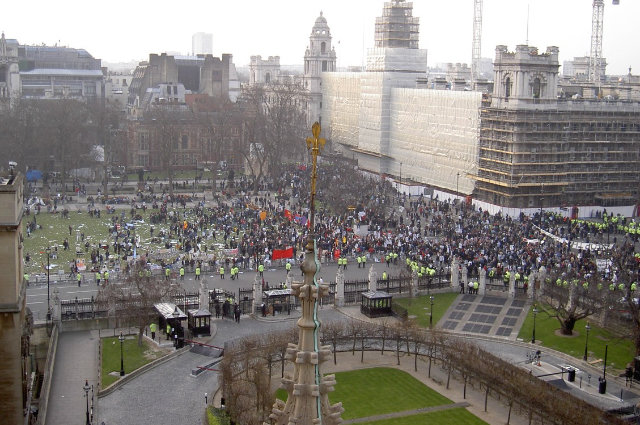
The international response to prolonged U.S. military action is rarely uniform. Allies often offer public support but privately reassess risks and dependencies. Governments at war have always had to manage two theatres simultaneously, the one fought with weapons and the one fought with public opinion. What is distinctive about this moment is the scale and geographic spread of dissent, peaking with the March 28 "No Kings" protests, the largest single-day US demonstrations ever, drawing approx 8-9 million across 3,300 events in all 50 states against the war, ICE shootings, and democratic backsliding. They have erupted in European capitals where NATO alliances are tense, in South Asian cities where American foreign policy is viewed with deep historical suspicion, and, critically, within the United States itself in numbers and with a persistence that suggests something beyond the routine, including massive turnouts in conservative areas like The Villages, Florida, and Billings, Montana. This matters not because protests have ever, by themselves, halted a war, for they rarely do; it matters because of what mass public dissent communicates to the strategic audience that actually shapes decisions: allied governments who must calculate the domestic cost of continued support, like the UK's defensive aid only, neutral states deciding which way to lean, and the adversaries themselves, who read street protests as evidence of fracture. The information environment in which modern wars are waged has inverted the old asymmetry, where states controlled the narrative, and populations received it.
A Shift Toward Multipolar Power Dynamics
The implications of a weakened perception of U.S. military credibility extend into the broader structure of global power. The international system is already shifting toward multipolarity, with emerging powers asserting greater influence. In such an environment, any sign of diminished effectiveness from a dominant power accelerates that transition, as China and Russia observed without intervening. Countries that once aligned closely with the United States may adopt more flexible strategies, balancing relationships with multiple global actors, like Qatar, and downing Iranian jets independently. This does not necessarily indicate a loss of power, but it does suggest a redistribution of influence; the ability to shape outcomes becomes more contested and less predictable, with UN condemnations of both US strikes and Iranian retaliation.
The Price of a Lost Leverage
The particular cruelty of squandered leverage is that it cannot simply be reclaimed by the next administration, the next military appropriation, or the next diplomatic overture. Credibility, once it begins to drain, tends to drain faster than it was ever accumulated. The nations that hedged their bets, those that refused to issue forceful statements of support when European allies rebuffed Trump's pleas over the Strait of Hormuz, those that quietly declined to enlist in American-led coalitions, will remember the lesson this campaign has inscribed. The cost of alignment with American power has risen while the expected returns have diminished.
What Trump's forty days of strikes have laid bare, and what future American presidents will inherit, is a strategic landscape in which the old grammar of coercive diplomacy no longer translates cleanly. The threat of force still carries weight, but it carries less than it did in 2003, less than it did in 2011, and almost certainly less than it will carry five years from now should this trajectory persist, a pattern that Al Jazeera's analyses have likened to repeated American hubris in Vietnam and Iraq. There exists a threshold, impossible to pinpoint in advance, at which a great power's threats dissolve into background static. The question that American strategists must now sit with, uncomfortably and honestly, is how close to that threshold these forty days have brought them. The threat of force still means something, yet it means less than it did, and a threshold once crossed does not uncross itself. Meanwhile, the people thronging the streets have their own accounting to undertake. Protest without political consequence is merely mourning dressed in public spectacle. It is legitimate, it is necessary, it is achingly human, but it is not a strategy. Any movement that aspires to transform dissent into something durable must confront the yawning gap between the magnitude of millions gathered at No Kings events and the glacial responsiveness of the institutions toward which that outrage is directed. That gap has been widening for years and shows no sign of narrowing on its own. The question is not whether the populace is angry; the question is whether anger, organised and sustained with discipline, can accomplish what forty days of airstrikes could not: a meaningful alteration in the exercise of power. History does not answer that question on demand. But it does record, with unsparing patience, who dared to ask it and when.
The significance of the recent military campaign lies not only in what was achieved but in what was left unresolved, including undestroyed Iranian missile stocks and a strained ceasefire. For a superpower, the inability to secure quick and decisive outcomes carries long-term consequences.
The question is no longer whether the United States remains powerful, but how that power is perceived and applied in a changing world. If credibility is the foundation of influence, then every prolonged and inconclusive conflict chips away at that foundation.
In the end, wars are not judged solely by their intensity, but by their conclusions. When conclusions remain out of reach, even the strongest nations must confront the possibility that their greatest vulnerability lies not in weakness, but in the limits of their strength.
References
- https://www.faf.ae
- https://www.youtube.com
- https://www.aljazeera.com
- https://ncrnow.ca
- https://www.bloomberg.com
- https://www.theguardian.com
- https://timesofindia.indiatimes.com
- https://time.com
- https://www.npr.org
- https://www.aljazeera.com
- https://www.fpri.org
- https://www.facebook.com
- https://www.hks.harvard.edu
- https://carnegieendowment.org
- https://www.instagram.com
- https://www.facebook.com
- https://www.instagram.com
- https://english.varthabharati.in
- https://www.aljazeera.com
- https://agsi.org
- https://www.emerald.com
- https://economictimes.indiatimes.com
- https://www.newsonair.gov.in
- https://mlfa.org
- https://www.aljazeera.com
- https://www.tandfonline.com
- https://www.pewresearch.org
- https://www.youtube.com
- https://floridaphoenix.com
- https://www.charkoosta.com