
Every day, government hospitals welcome an endless stream of people. Some arrive carrying medical reports and prescriptions. Some come in pain. Others arrive with anxiety, hope, and the expectation that the institution before them will help them heal.
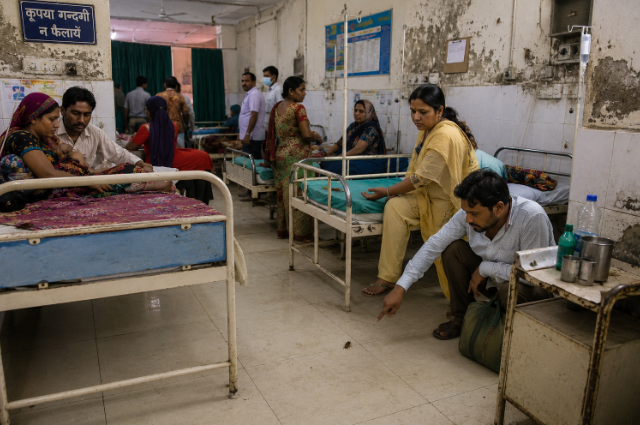
The scenes are familiar to anyone who has visited a public hospital in India. Crowded corridors. Long queues. Families are waiting for updates. Doctors and nurses are moving quickly from one patient to another. Resources are stretched, responsibilities are immense, and the demand for healthcare rarely slows down.
We know where these people come from and why they are there.
The same cannot be said for the cockroaches.
During a recent visit to a government hospital, where a family member had been admitted to a postnatal ward, I began noticing them on the ward floor. At first, it was easy to dismiss the sight as an isolated occurrence. Then more appeared. Some disappeared beneath beds. Others emerged from corners and cracks. By evening, they seemed to be everywhere.
What made the experience particularly unsettling was the location.
This was a postnatal ward.
Mothers recovering from childbirth lay beside newborn babies who had entered the world only days earlier. Families discussed medicines, feeding schedules, and discharge dates. Yet sharing that same space was another presence that appeared surprisingly at ease.
The irony was difficult to ignore.
The previous day, I had noticed large numbers of cockroaches outside the hospital campus near drains, holes in the pavement, and areas where waste accumulated. At the time, I thought little of it. Later, after seeing their presence in the hospital, I began to wonder whether those observations were connected.
The observation did not provide answers, but it changed the way I looked at the situation. Instead of viewing the insects as an isolated problem inside a ward, I began wondering whether they reflected larger questions about waste management, infrastructure, and the environments surrounding healthcare facilities.
That evening, visiting hours ended and families gradually prepared for the night ahead.
What had begun as an unpleasant observation transformed into something far more memorable.
Later that night, I received a call from a family member in the ward informing me that the cockroaches had become even more active after dark. They were visible near beds and across the floor.
Yet what stayed with me was not merely the sight of the insects.
It was the response to them.
Or rather, the absence of one.
One mother remained awake through much of the night, not because of a medical emergency, but because she wanted to keep watch over her newborn. While routine hospital activities continued around her, she focused on something no parent should have to worry about inside a healthcare facility. The concern was not theoretical. A newborn child was sleeping only a short distance away.
That image has remained with me, precisely because it did not appear extraordinary to anyone around it.
Their presence was not hidden. I saw them during visiting hours. Patients noticed the cockroaches. Attendants noticed them. They were difficult to miss.
The insects seemed to have become part of the environment rather than an interruption to it.
The more I reflected on the experience, the more questions emerged. Such as:
- How many patients had seen the same thing before?
- How many attendants had spent sleepless nights worrying about similar concerns?
- How many complaints have been raised over the years?
- What happened after those complaints were made?
- And perhaps most importantly, how many concerns were never voiced at all?
It is entirely possible that some people discussed the issue quietly among themselves. Yet private conversations and public concerns are not the same thing. What struck me was how little visible challenge there seemed to be to a condition that many appeared to have noticed.
Silence can emerge for many reasons.
Some people may fear being labelled difficult. Others may assume that raising concerns will not change anything. Many patients in government hospitals depend on the services they receive and may feel grateful simply to have access to treatment. When healthcare is a necessity rather than a choice, expectations sometimes become negotiable in ways they should not.
The experience also raised questions about whether our expectations of public institutions sometimes become lower than they should be.
That thought led me to another question: Why should healthcare be different?
If similar conditions existed in a luxury hotel, restaurant, or high-end private institution, public reaction would likely be immediate. Questions would be asked. Standards would be scrutinised. Accountability would be demanded.
A government hospital is not a favour extended to citizens. It is a public institution supported by public resources and entrusted with public responsibility. Affordability and accessibility are essential achievements, but they should not come at the cost of dignity.
These questions are not based on personal discomfort alone.
The concerns raised by such conditions are not limited to a single hospital. In June 2026, reports from Chennai’s Kalaignar Super-Speciality Hospital described patients and attendants complaining about rats and cockroaches inside wards, raising concerns about hygiene and patient safety. Hospital staff reportedly linked the issue to challenges involving pest control and waste management. The report served as a reminder that questions of sanitation and infestation are not isolated incidents but recurring concerns that occasionally surface across public healthcare institutions.
Scientific research suggests that concerns about cockroaches in healthcare settings are not merely matters of discomfort or appearance. A 2025 systematic review of studies involving hospital-collected cockroaches found that these insects can carry various bacteria, fungi, parasites, and even antibiotic-resistant microorganisms. The researchers noted that their presence in healthcare facilities may pose public-health concerns and emphasised the importance of effective pest-control measures.
Throughout my visit, the doctors I observed were carrying out their responsibilities.
The nurses were working.
The housekeeping staff appeared to be carrying out their duties.
Public healthcare systems often operate under immense pressure and with limited resources.
Yet acknowledging these realities does not erase another reality.
The contradiction remains.
If hygiene is recognised as a critical component of healthcare, why do conditions sometimes persist that appear inconsistent with that goal?
The more I considered this question, the more I realised that this article is not really about cockroaches.
Cockroaches exist in every city. They inhabit drains, waste sites, markets, and neglected corners. Their existence is not surprising.
It is surprising how quickly people can adapt to things that should never feel ordinary.
Over time, I realised that the issue was not only an infestation. It was the gradual normalisation of conditions that should never feel routine.
Normalisation rarely arrives all at once. It develops gradually. A problem appears, people react, nothing changes, and eventually the reaction fades. What was once shocking becomes familiar. What was once questioned becomes tolerated. Over time, the discussion shifts from whether a condition is acceptable to how people can adapt to it. That possibility troubled me far more than the insects themselves.
Long after the exact number of cockroaches fades from memory, one image is likely to remain: a mother sitting awake beside her newborn, trying to manage a concern she should never have faced inside a healthcare facility.
That memory continues to raise a question that remains unanswered.
How did something so visible become something so normal?
Until we confront that question, the issue is not merely about cockroaches in a hospital ward. It is about the conditions we learn to accept, even in places where we should expect better.
Perhaps that is the most troubling consequence of all: not the presence of the problem, but the possibility that we have learned to live with it.
The cockroaches seemed comfortable. The patients didn't.