
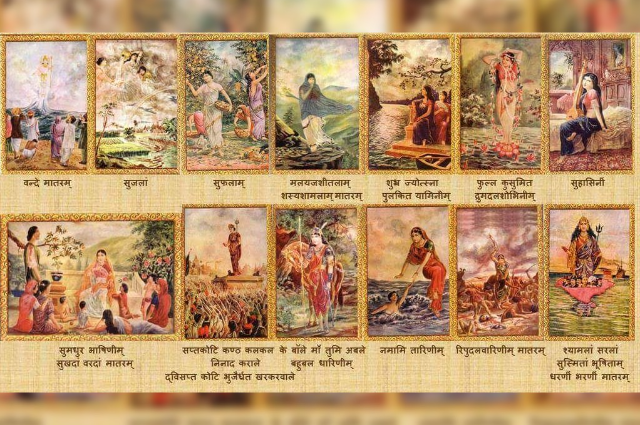
There are moments when a song becomes more than a song. Vande Mataram is one such song that acquires memories that belong not to one generation but to several. Its words are repeated by people who may not remember when they first heard them, where they came from, or even who wrote them.
Has Vande Mataram become more important now? Has the recent decision to extend to it the same statutory protection under Section 3 of the 1971 Act elevated its position? Or was it already carrying a historical weight that no law could create?
On 11 August 2026, President Droupadi Murmu gave assent to the Prevention of Insults to National Honour (Amendment) Bill, 2026. The amendment brought Vande Mataram, India's National Song, within the statutory protection of the 1971 law. Deliberately preventing or disrupting its singing can now attract criminal consequences, placing it on a similar legal footing to the National Anthem for the purposes covered by the legislation.
India is currently observing a year-long commemoration of 150 years of Vande Mataram, running from 7 November 2025 to 7 November 2026. The song is therefore being reconsidered at a moment when its historical anniversary and its changing legal position have coincided.
The 2026 law has changed the legal protection surrounding the song. It did not create the song's history, its emotional association with the freedom struggle, or the place it had already acquired in India's national imagination.
A song before it became a symbol
Bankim Chandra Chattopadhyay composed Vande Mataram in 1875. The poem was first published in the literary journal Bangadarshan on 7 November 1875. It was subsequently incorporated into his novel Anandamath, which was published in book form in 1882.
In the novel, the motherland is imagined through the language of devotion. Vande Mataram emerged from the literary and cultural world of nineteenth-century Bengal, before it became associated so closely with the political movement against colonial rule.
In 1896, Rabindranath Tagore sang Vande Mataram at the Calcutta session of the Indian National Congress.
From there, its association with the national movement grew rapidly. During the Swadeshi movement that followed the 1905 partition of Bengal, Vande Mataram became a public expression of resistance to colonial rule. It was shouted at political gatherings and used by activists.
And then came independence.
One of the most striking episodes in its history came on the morning of 15 August 1947.
At around 6:30 in the morning, Pandit Omkarnath Thakur sang Vande Mataram over All India Radio. The performance had been arranged at the request of Sardar Vallabhbhai Patel, and the broadcast became one of the notable musical moments associated with India's first day of independence. Prasar Bharati's archival record preserves this broadcast and identifies the time and circumstances of the performance.
India had just ceased to be a colony, and one of the voices heard at the beginning of that new morning was singing Vande Mataram.
This happened before the Constituent Assembly formally settled the question of the National Anthem and the National Song in January 1950.
The Constituent Assembly itself had used Vande Mataram before independence. On the night of 14 August 1947, when the Assembly met as India approached independence, the first verse was sung by Sucheta Kripalani, with the members standing.
Rajendra Prasad did not create its historical importance. He recognised it.
On 24 January 1950, as the Constituent Assembly was completing its work, Dr Rajendra Prasad announced that Jana Gana Mana would be the National Anthem.
Rajendra Prasad stated that, because of the historic role Vande Mataram had played in India's freedom struggle, it would be honoured equally with Jana Gana Mana and would have equal status with it.
That historical recognition, however, should not be confused with the statutory criminal protection now introduced in 2026. The two developments belong to different legal and historical contexts.
In 1937, the Congress Working Committee recommended that only the first two stanzas be sung at national gatherings, following objections to certain religious elements in the remaining stanzas.
The controversy is part of the song's history, just as its role in the freedom movement is. Acknowledging one does not require erasing the other.
So what has actually changed in 2026?
The Prevention of Insults to National Honour Act, 1971 already provided statutory protection against certain acts involving the National Anthem. The 2026 amendment extends that protection to Vande Mataram in the circumstances specified in the amended law. Intentionally preventing its singing or causing disturbance to an assembly engaged in singing it can attract criminal consequences.
But it would be historically misleading to describe it as though India has suddenly discovered the value of Vande Mataram.
A song I did not discover in a history book
I was born in Naihati, a place closely associated with Bankim Chandra Chattopadhyay, the writer who composed Vande Mataram. For someone who grows up around that history, the song acquires a different kind of familiarity.
I have grown up listening to and singing the song in school and at cultural programmes. It was not something that suddenly appeared in my life because a government notification told me that it was important.
It is the possibility that, as the generation that experienced the final years of colonial rule disappears, later generations may begin asking why Vande Mataram matters as though its importance were something that has only recently been invented.
Its legal position may have changed. Its public visibility may change, and the political arguments surrounding it may change again. But the passing of time does not make an old symbol a new one.
Vande Mataram was not made valuable by being remembered in 2026. It survived long enough to be remembered because it had already become valuable to generations before us.
Perhaps, then, when someone asks why it still matters, we do not always need to create a new answer.
Sometimes the answer has been waiting there for more than a century.
We only need to turn the pages back.