
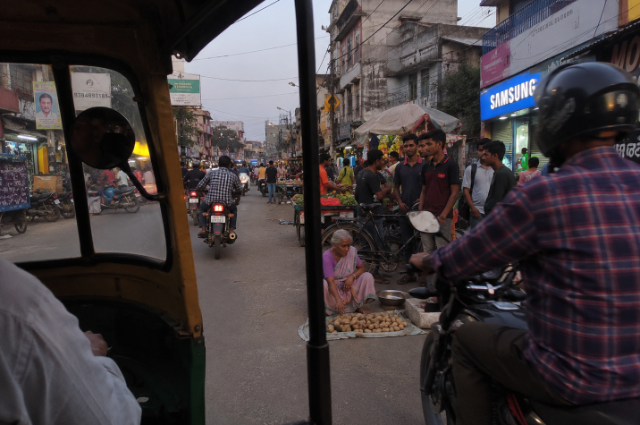
Rising fuel expenses will do that to you — make you reconsider habits you have long stopped questioning. A few days ago, they led me to take an auto instead of a personal vehicle, something I had not done for quite some time. What began as a practical decision became, by the time I reached my destination, something considerably harder to set aside.
When you drive your own vehicle, your attention collapses into a narrow corridor: the road, the signal ahead, the pothole you almost missed. The world outside becomes peripheral, moving past the glass like something you are not quite meant to see. An auto is different. It puts you in the middle of the street — slower, open-sided, at eye level with everything around you. That evening, moving through the Barrackpore–Titagarh stretch, I found myself watching people in a way I usually do not.
Titagarh is a municipality in North 24 Parganas, part of the Kolkata metropolitan agglomeration. Its streets have historically been shaped by industrial labour — jute mills, paper mills, and rail manufacturing. As per the 2011 Census, the town had a population of 116,541 packed into just 3.24 square kilometres, giving it one of the highest urban densities in the country. The people who live and work here are overwhelmingly working-class and lower-middle-class families: daily earners, small vendors, piece-rate workers, and households trying to balance irregular income against fixed expenses.
The market that evening was active, not crowded. There is a difference, and it matters. People were moving, vendors were present, goods were laid out — but the pace had a flatness to it that I could not immediately name.
Then I noticed the old woman selling potatoes.
She was sitting at the roadside of the market area with a small stock arranged neatly before her. Only potatoes. No onions, no garlic, no green chillies, none of the other items that usually accompany such a stall.
Perhaps potatoes were all she could afford to stock. I do not know. What stayed with me was something else.
She was working at an age when many people would hope to slow down. The potatoes themselves were unremarkable. The fact that she was still sitting there, waiting for customers, was not.
A little further down the road stood small groups of young men.
That contrast remained with me.
An elderly woman was working.
Young men, seemingly in the years of life associated with energy and ambition, stood waiting.
They were not laughing loudly. There were no teacups in their hands, no animated arguments, no visible excitement. They were talking, but quietly. Some simply stood looking down the road.
I remembered how my friends and I once occupied street corners with laughter, arguments about studies, examinations, music, cricket, politics, films, and impossible dreams. These young men looked different. They were present, yet somehow absent.
Of course, appearances can mislead. They may have been discussing family matters, studies, work, or something entirely unrelated.
Yet the scene raised a question that followed me for the rest of the journey.
Why was one generation still working so late into life while another seemed caught in a state of waiting?
The image felt almost reversed, and the question it raised followed me for the rest of the journey — whether I was looking at two different expressions of the same underlying uncertainty, one generation unable to stop working, another unable to fully begin.
I found myself wondering what occupied their thoughts: jobs, competitive examinations, family responsibilities they had not expected to carry so soon, or simply the gap between what education had implied and what the market had actually offered?
That gap is not merely an impression. Discussions about unemployment, competitive examinations, contractual work, and the struggle to secure stable employment have become common features of conversations among young people across the country.
Many continue to prepare for examinations, search job portals, take temporary assignments, or wait for opportunities that match their qualifications.
A degree, in this context, does not always eliminate uncertainty. For many, it simply changes its form. Education promises a path forward, but the destination often appears less certain than expected.
A little further on, vendors were selling Himsagar mangoes at reasonable prices — yet there was no rush. It made me wonder whether affordability alone is enough to encourage spending. Sometimes people may hesitate because they are uncertain about what lies ahead.
This is what tends to get missed when people discuss food affordability in the abstract: it is not always the price that stops someone from buying. Sometimes it is consumer sentiment — the quiet decision not to spend even when you could, because you are not certain what is coming next. A reasonable price means little when the person considering the purchase is trying to calculate how long their money needs to last.
India’s retail inflation rose to 3.93 per cent in May, up from 3.48 per cent in April, driven primarily by food and fuel. Food inflation reached 4.78 per cent. State-owned fuel retailers raised petrol and diesel prices four times during May alone — the first such increases in four years — which pushed transport inflation from near zero in April to 1.75 per cent. The RBI's own projection for average inflation across FY27 now stands at 5.1 per cent, with a projected peak of 5.9 per cent in the third quarter. These numbers describe a direction. What they do not capture is the calculation a customer runs in their head while standing in front of a mango vendor, deciding whether to buy or walk away.
I also saw people arriving on motorcycles and in private vehicles, making purchases and moving on with their evening. Yet even among those who appeared financially comfortable, I noticed few expressions of ease.
But here is what the ride made me realise more clearly than I had before: what I was observing was not confined to poverty. It seemed to cut across generations, occupations, and income groups. The forms were different. Yet the uncertainty felt remarkably similar.
The elderly woman selling potatoes, the mango vendor watching customers walk past, the young men standing quietly by the roadside — all seemed, in different ways, to be negotiating an uncertain tomorrow.
If we extend the frame a little further, the same unease appears in different clothes. Salaried employees or people with stable incomes, by most definitions, increasingly keep one eye on job portals even while employed, because the stability they have feels more conditional than it once did. Small business owners worry, despite owning businesses, because demand is unpredictable, and costs are not. Middle-class families who have managed to build some financial footing still lose sleep over healthcare expenses they cannot fully plan for, over children's education fees that keep rising, and over housing costs that do not correspond to what salaries actually look like.
The faces are different. So are the incomes and the worries. Yet the underlying concern feels familiar. Beneath those differences, the structure is the same: people are making decisions — about buying mangoes, about switching jobs, about whether to start a business, about how much to spend this month — inside a cloud of uncertainty about what the next season will bring. And that uncertainty, distributed this widely, is not a temporary state of affairs. It has become the condition.
India’s economy continues to grow. The GDP numbers are real. Yet growth and security are not always experienced in the same way. A rising economy does not automatically remove the uncertainty people feel about employment, healthcare, education, housing, or the future of their families.
That evening, from an auto seat in Titagarh, the contradiction seemed visible. The macro story spoke of growth. The faces around me spoke of caution, calculation, and uncertainty.
Growth that does not reduce the uncertainty people live with does not fully reach them, regardless of what the headline number says.
When I got out of the auto, the journey had ended. The questions had not.
I do not know whether the old woman sold all her potatoes before returning home. I do not know whether the mango vendor finished the day satisfied. I do not know what occupied the minds of the young men standing by the roadside. But long after the ride ended, they remained with me. Different ages. Different circumstances. Different worries. Yet all seemed connected by the same uncertainty about tomorrow.
Perhaps the defining challenge of our time is not poverty alone, nor inflation alone, but the uncertainty that increasingly shadows people across generations and income levels.
It was that uncertainty, more than anything else, that travelled home with me.
Will tomorrow be easier than today?