
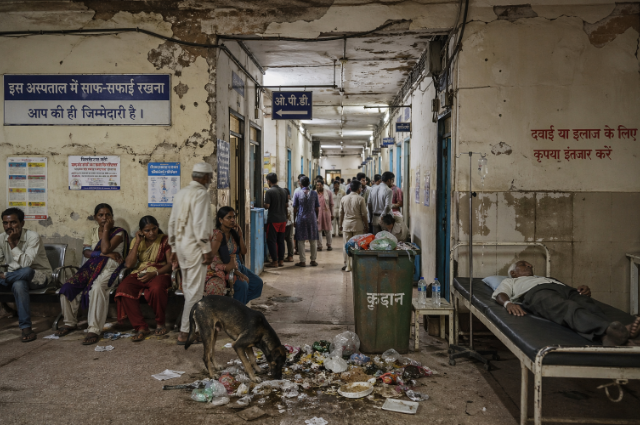
A Scene Inside a Place Meant for Healing
Recently, I visited a government hospital for a routine medical check-up of a family member. It was like any other crowded day. Patients were waiting in long lines, attendants were moving between counters, and staff were trying to manage the flow as best as they could. There was noise, movement, urgency, and a kind of silent patience that people carry in such places.
In the middle of this, I noticed something that should not have felt normal, but somehow did.
A stray dog was walking down the stairs. It was not running or frightened. It moved calmly, almost as if it were familiar with the place. It passed by people without hesitation and without drawing attention. No one stopped it, no one reacted. It reached the ground floor and walked directly towards a garbage area located just below the stairs, right in front of a toilet with a broken door that was left completely open.
The dog began searching for food there. It stepped in and out of the garbage area, moving comfortably between spaces. It continued to use the stairs, choosing its path without any restriction. What stood out was that it avoided entering the toilet, even though the door was fully open, as if it instinctively knew where not to go.
People saw it. They noticed it. But no one responded.
There was no panic, no concern, no intervention. What filled that moment was silence, not chaos, but acceptance.
Not an Isolated Incident
It would be easy to dismiss this as a one-time occurrence. Someone might assume it was an exception or an unusual lapse in management. Some may even suggest that the dog belonged to someone working there and was simply moving around.
But that explanation does not hold when similar experiences repeat themselves.
A year ago, when my mother was admitted to another government hospital, I witnessed something that felt equally unsettling. Inside an overcrowded ward, where beds were already shared, and space felt insufficient, a small cat was sleeping quietly under one of the hospital beds. The ward had broken walls, limited space, and too many patients for the available infrastructure. In that environment, the presence of an animal did not create disruption. It blended in.
At that time, it felt surprising, even slightly strange.
Now, it feels familiar.
And that shift, from surprise to familiarity, is what truly concerns me.
The Contradiction We Live With
We live in a time where awareness about health and hygiene is widespread. People are more informed than ever before. We read about infections, we hear about sanitation, and we are constantly reminded of diseases such as rabies and the risks associated with stray animals. Public health campaigns and medical advice repeatedly emphasise the importance of maintaining controlled and hygienic environments, especially in hospitals.
At the same time, we continue to encounter situations that directly contradict this awareness.
A hospital is meant to be a controlled environment where risks are minimised. It is designed to be safe, monitored, and regulated. However, when garbage is left unattended, infrastructure remains damaged, and animals are able to enter and move freely, that basic expectation of safety begins to erode.
This is the contradiction we live with. We understand the risks, we recognise the gaps, and yet we continue to accept both at the same time without meaningful resistance.
What the Data and Reports Indicate
This issue is not just about isolated observations. It is supported by larger public health concerns.
According to data tabled in Parliament and reported by The Hindu, India recorded over 37 lakh (3.7 million) dog bite cases in 2024, with 54 suspected human rabies deaths.
The numbers rose further in 2025, reaching nearly 47.48 lakh (4.75 million) cases — an increase of more than 10 lakh in a single year. The official figures of death caused by rabies in India remain low (around 50–54 annually), but the World Health Organisation estimates the actual burden to be nearly 36% of global rabies deaths, translating to roughly 18,000–20,000 deaths annually. A 2025 community-based survey published in The Lancet Infectious Diseases estimated approximately 5,726 annual human rabies deaths in India, highlighting both progress over the past two decades and persistent under-reporting.
This gap between official data and estimated reality itself reflects a deeper issue of reporting and monitoring.
The judiciary has taken serious note. In November 2025, the Supreme Court of India directed states to remove stray dogs from sensitive public spaces, including hospitals, schools, sports complexes, bus stands, and railway stations, and to fence such premises to prevent entry. The Court emphasised the responsibility of local authorities to shift dogs to shelters after sterilisation and vaccination. At the policy level, the Biomedical Waste Management Rules, 2016, clearly mandate that healthcare facilities prevent stray animals from accessing premises, install cattle traps at entrances, and secure waste to avoid scattering by animals.
On paper, the framework exists, and the system acknowledges the problem and provides solutions. However, the gap between policy and practice remains visible.
Open garbage areas near patient zones, a lack of proper waste segregation, and weak enforcement create an environment where animals are naturally drawn in. This is not a rare or unpredictable occurrence. It is largely the outcome of preventable lapses.
Responsibility Without Ownership
One of the most confusing aspects of this issue is that responsibility does exist within the system.
Hospitals have sanitation staff, supervisors, and administrative authorities. Municipal bodies are responsible for waste management and stray animal control. There are guidelines, roles, and procedures that define who is supposed to do what.
Yet the problem continues.
This happens because responsibility is distributed in such a way that ownership becomes unclear. Cleaning staff may ensure that floors are swept, but they do not decide where garbage is placed or how it is secured. Hospital authorities may issue instructions, but consistent monitoring is often missing. Municipal systems are in place, but their response tends to be delayed or reactive rather than preventive.
When an issue arises, it becomes difficult to identify a single point of failure. And when accountability cannot be clearly assigned, corrective action loses urgency.
In such a system, problems do not get resolved. They become routine.
The Culture of Adjustment
Perhaps the most concerning part of the entire situation is not the presence of the animal itself, but the reaction of the people around it.
No one seemed surprised. No one raised a concern. No one attempted to question what was happening.
Patients and their families, already dealing with stress, uncertainty, and urgency, adapt quickly to their surroundings. They learn to adjust to long waiting times, overcrowded spaces, and infrastructure limitations. Over time, this adjustment extends to conditions that should not be acceptable.
Gradually, the system begins to rely on this adjustment. Instead of ensuring that a safe environment is consistently maintained, it shifts towards the idea that treatment is the priority and everything else can be managed by the patient’s ability to cope.
This shift is not sudden. It happens quietly, over time, until it becomes normal.
Compassion and Confusion
There is also an emotional dimension to this issue that makes it more complex.
Looking at the dog, one may feel sympathy. It is not aggressive. It is simply searching for food and trying to survive. At the same time, there is an awareness of the risks associated with its presence in a hospital environment.
Both responses are valid.
However, the situation itself should not exist in the first place. Animals should not be forced to depend on hospital waste for survival, and patients should not be exposed to avoidable risks within healthcare spaces.
When systems fail to manage both aspects effectively, compassion and safety are placed in conflict with each other. That conflict is not natural. It is created by neglect.
Infrastructure and Neglect
The details of what I saw are important because they reveal how basic lapses contribute to larger problems.
A garbage area placed near stairs and toilets, a broken door left open, and unrestricted access to sensitive spaces are not complex issues. They do not require advanced solutions or large investments.
They require basic maintenance, routine checks, and consistent enforcement of existing rules.
When these simple responsibilities are ignored, the consequences become visible in everyday situations.
Like a stray dog walking through hospital corridors without interruption.
Why This Cannot Be Dismissed
At first glance, this may appear to be a minor issue when compared to the many challenges faced by public healthcare systems.
However, it reflects deeper structural problems. It points to gaps in sanitation, weaknesses in accountability, and a growing acceptance of conditions that should be corrected.
Hospitals are among the most sensitive public spaces. If standards are allowed to decline here, it raises questions about the overall functioning of the system.
Ignoring such incidents does not make them less significant. It allows them to become more frequent.
What really happened to us as human beings? When did we begin to see such scenes and move on without questioning them?
The Real Issue
The issue is not that an animal entered a hospital. The issue is that the environment allowed it to happen, the system failed to prevent it effectively, and the people around it accepted it.
When responsibility exists everywhere but ownership exists nowhere, accountability weakens. And when accountability weakens, even basic standards begin to fade.
What Needs to Change
The situation is neither invisible nor unsolvable. The policies already exist. The problem lies in how they are implemented, monitored, and prioritised.
India already has a defined framework under the Biomedical Waste Management Rules, 2016, which clearly requires healthcare facilities to ensure proper waste segregation, secure storage, and prevention of stray animal access within hospital premises. At the same time, municipal systems are responsible for vaccination, sterilisation, and population control of stray animals. The judiciary has also intervened, with the Supreme Court of India raising concerns about the presence of stray animals in sensitive public spaces, including hospitals, as highlighted in a report by The Hindu.
Despite this, the gap between policy and practice remains visible on the ground.
Addressing this does not require new laws. It requires enforcing what already exists and shifting from reactive responses to preventive systems.
The first and most immediate issue is waste management. Open garbage is the primary reason animals enter hospital spaces. As long as food waste remains accessible, no other measure will be effective. Hospitals must ensure that waste is kept in sealed and covered containers, properly segregated, and removed at regular intervals. This is not a high-cost reform. It is a basic requirement that directly reduces risk.
Physical infrastructure is equally important. Hospitals cannot function as open environments. Functional doors, secured entry points, repaired walls, and restricted access to sensitive areas are essential. If an animal can enter freely, it indicates a failure in basic design or maintenance.
At the same time, responsibility must be clearly converted into ownership. Instead of multiple departments sharing vague roles, there must be designated accountability within each hospital, supported by daily monitoring systems and internal audits. When accountability is clearly assigned, problems are far less likely to be ignored.
Coordination with municipal authorities is also necessary. Hospitals alone cannot manage the presence of stray animals. Regular vaccination and sterilisation drives, removal of animals from sensitive zones, and quick response mechanisms must be actively implemented in surrounding areas.
Most importantly, enforcement must accompany policy. Rules without consequences rarely lead to compliance. Periodic inspections, corrective action, and accountability mechanisms are essential to ensure that standards are maintained.
Public behaviour also plays a role. Feeding animals within hospital premises, though driven by compassion, can unintentionally create health and safety risks. Awareness and responsible behaviour are part of the solution.
A system improves not only when rules exist, but when they are followed consistently by both institutions and individuals.
Closing Thought
We often believe that time will bring improvement. Those conditions will change gradually, and systems will evolve. But time does not correct what is consistently ignored.
A year apart, two different hospitals, and yet similar experiences. Perhaps the real concern is not what I saw. Perhaps the real concern is how normal it felt.