
We grow up learning what service means.
We hear stories of people like Mother Teresa and many others who chose compassion as a way of life. We read lines about duty, responsibility, and the dignity of work. We are taught that certain professions are not just careers but commitments. Healthcare stands at the top of that list.
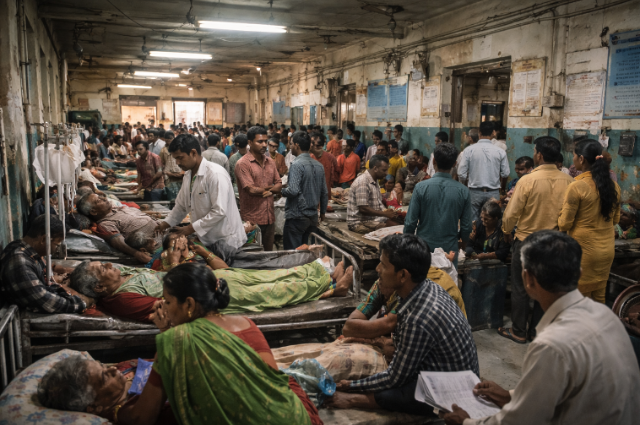
And yet, step into many public institutions today, especially government hospitals, and a different experience often unfolds.
Patients do not only face overcrowding, long waiting hours, a shortage of beds, or hygiene issues. Those are visible and widely discussed. What is less acknowledged, but deeply felt, is something else: the experience of being treated as if one is asking for a favour rather than accessing a service.
This is not an isolated complaint. It appears repeatedly in news reports, public feedback, and personal accounts across regions. The issue is not universal, and many dedicated professionals go beyond their duty every day. But the contradiction exists often enough to demand attention.
The Misplaced Narrative Around Overcrowding
Overcrowding is real. The scale of this overcrowding is not just anecdotal; it is documented. As recently reported by NITI Aayog, India has approximately 1.3 hospital beds per 1,000 population overall, though public sector availability is often cited as low as 0.6–0.8 beds per 1,000 in a recent analysis, including findings from the International Journal of Community Medicine and Public Health. At the same time, Forbes India analysed that two-thirds of patients opt for private healthcare, which often remains unaffordable or burdensome for a large section of the population. Even the government has acknowledged that healthcare infrastructure continues to fall short of global norms, with rising patient load putting sustained pressure on public facilities, as reported by The Times of India.
But overcrowding has slowly become an explanation for everything.
Patients are told:
- There are too many people.
- Resources are limited
- Staff are under pressure.
This is not just an abstract observation. I have personally experienced this during visits to government hospitals for my own and my family’s check-ups. All of this is true. But it is not the full truth.
Because the same reality leads to another logical expectation. If patient load is high, then staffing, infrastructure, and systems are supposed to expand in response. Governments allocate budgets, create sanctioned posts, and design administrative structures precisely for this reason.
So the question is not whether overcrowding exists. The question is:
Why does the presence of a crowd translate into the erosion of dignity? Pressure can explain delays. It cannot justify disrespect.
Recent reports across states reflect how this pressure translates into lived reality. In several government hospitals, patients continue to report poor hygiene, lack of basic facilities, and staff shortages affecting care delivery. Courts have even had to intervene in some cases, directing authorities to ensure transparency in hospital bed availability, highlighting the seriousness of access and management issues.
Service Is Not Charity
One of the most uncomfortable but necessary clarifications is this: public healthcare is not charity.
Doctors, nurses, and staff in government institutions are:
- Formally trained
- Officially appointed
- Publicly funded
Their salaries, benefits, and infrastructure are supported by the state, which in turn is supported by citizens.
So when a patient walks into a government hospital, they are not receiving kindness from someone’s personal capacity. They are accessing a system that exists for them.
Even charitable organisations, often operating with fewer resources, frequently manage to maintain a baseline of respectful interaction. That comparison raises a difficult but valid question:
Why does a system built on public funding sometimes fall short of the basic dignity maintained by voluntary service?
It may not be accurate to call this a government failure alone. It begins at a more fundamental level: the failure to perform a designated role. Roles exist for a reason. The distinction between a patient and a healthcare professional is not just semantic; it defines responsibility.
The Human Factor, and Its Limits
It is easy to say that this is human nature. People get tired. People lose patience. People become inconsistent. This applies to everyone, across professions and countries. But professions exist precisely to regulate human inconsistency.
That is why:
- Doctors are trained in ethics
- Public servants take oaths.
- Institutions create rules and procedures.
Because society cannot depend only on individual goodwill when the stakes involve health, safety, and dignity.
So when the same patterns of inconsistency continue within roles that are designed to overcome them, the issue moves beyond individual behaviour. It becomes institutional.
At the same time, the breakdown in communication and conduct is not occurring in isolation. Reports also show a rise in conflicts between patients and healthcare workers, often linked to overcrowding, delays, and perceived neglect. Reports from Delhi’s government hospitals have recorded numerous incidents of violence against medical staff in recent years, with many cases going unreported or unresolved.
This reflects a deeper systemic strain, where frustration exists on both sides, but is not managed through strong processes, communication, or accountability.
What Other Systems Do Differently
If poor civic sense, stress, and human inconsistency exist everywhere, then why do outcomes differ?
Countries like the United Kingdom, Germany, Japan, and Singapore also deal with pressure on public services. Yet, the everyday experience of a patient is often different.
Take the National Health Service of the United Kingdom. It operates under continuous public scrutiny, with performance data, patient feedback, and inspection reports regularly made available. Independent bodies such as the Care Quality Commission inspect healthcare providers, publish findings, and take action where standards are not met. Complaint and feedback systems are structured and accessible.
In Singapore, healthcare institutions function within a tightly regulated administrative framework where service standards, response systems, and internal accountability mechanisms are clearly defined and enforced by the Ministry of Health Singapore.
In Germany, there is a strong process orientation and administrative efficiency to help reduce delays and uncertainty in healthcare. While Japan has clearly defined roles, disciplined workflows, and high levels of system organisation, which help maintain order even under pressure.
These systems are not perfect. But they share a common feature:
They are not built on the assumption that individuals will always behave well. They are designed to ensure that even when individuals fall short, the system continues to function within defined standards.
That difference is not cultural alone. It is structural, monitored, and consistently enforced.
Accountability, or the Lack of It
The difference, at its core, is accountability. In many strong systems:
- Complaints lead to action
- Performance is monitored
- Behaviour affects professional standing
In contrast, when accountability mechanisms are weak or inconsistently applied, behaviour becomes habitual.
Good conduct is rarely reinforced, and poor conduct is rarely corrected. Over time, this creates a culture where:
- Indifference feels normal
- Authority becomes unchecked
- Patients are seen as interruptions rather than responsibilities
The Normalisation Problem
Perhaps the most concerning shift is acceptance.
“It happens in government hospitals” has become a common response. It quietly lowers expectations until what should be unacceptable begins to feel routine. Because once a problem is normalised, it stops being questioned. And when it stops being questioned, it stops being corrected. Between Understanding and Action, there is another layer to this contradiction.
As a society, there is no shortage of understanding. We discuss ethics, responsibility, and reform extensively. Reports are published. Policies are drafted. Training includes modules on communication and conduct.
And yet, there is a gap between knowing and doing.
This is not limited to healthcare. It is a broader pattern where:
- Ideas are clear
- Intentions are stated
- Execution weakens over time
When this gap enters public service roles, its impact is no longer personal. It becomes collective.
A Question That Cannot Be Avoided
No one is forced into these professions. They are competitive, structured, and often considered secure and respectable.
Which makes the central question unavoidable:
If a role is chosen, trained for, and supported by public resources, why is its responsibility sometimes treated as optional in practice?
What Needs to Change
Improvement does not come from blaming one side.
Patients are not always ideal. Systems are not always efficient. Staff are not always supported.
But certain changes are structural, not optional:
- Complaint systems that are visible and effective
- Regular and transparent monitoring
- Clear consequences for misconduct
- Better distribution of workload
- Reinforcement of professional ethics as practice, not theory
Most importantly, a shift in how public service is perceived. Not as a favour extended, but as a duty performed.
The contradiction becomes sharper when seen together. A system already aware of its shortcomings, supported by data, reports, and policy discussions, continues to struggle not only with infrastructure gaps but also with consistency in behaviour and responsibility.
Conclusion
The issue is not that we lack examples, values, or understanding. The issue is continuity between what we know, what we say, and what we do.
Human inconsistency may be natural. But when it continues within roles built on responsibility, supported by training and public trust, it stops being just human. It becomes systemic. And when a system begins to make service feel like a favour, it is not the patient who has misunderstood their place.
It is the system that has forgotten its purpose.