
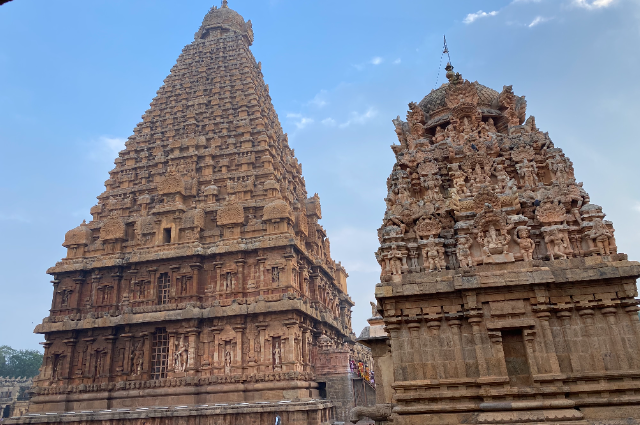
Built by Raja Raja Chola I in 1010 CE, the Brihadeshwar is located in Thanjavur, Tamil Nadu. Completed in just 25 years, it stood as Asia's tallest man-made structure at the time of its completion. The granite tower stands 216 feet tall. No mortar, no cement, no binding agent — every block interlocks purely through geometry, weight and perhaps DIVINITY- here's why: The nearest granite quarry was 60 kilometres away. The 80-tonne capstone at the summit was somehow placed at full height with zero machinery. The ramp required would have stretched 6.44 kilometres, and no archaeological evidence of it has ever been found. More than 1000 years have passed, and no explanation close to sanity.
Even its 216-foot height is not random — 216 is the cube of six, a sacred number in Vedic cosmology representing divine names and Gayatri Mantra syllables. The temple axis aligns so that on Raja Raja's birthday, sunlight directly illuminates the sanctum. What is a piece of artwork without bits of remembrance of its maker? — They make it whole, time-stamping it with ancient heritage.
The most intriguing detail of the temple is how it does not seem to cast a shadow. The former belief stated that the shadow of the tower never falls outside its own base perimeter. This myth stems from a 10th-century anecdote where King Raja Raja Chola I, when the temple was completed, questioned the architect, Kunjaramallan Raja Raja Perunthachan, about its stability. In response, the architect Perunthachan proclaimed, "Even its shadow will not fall, Raja!" This was likely intended as a metaphor for the building's perfectly sculpted shape and stability. Or it could have been a poetic description of how the vastness of the base absorbs most of its shadow.
Scientists, over the years, working tediously to find out the logic within the bounds of science, have discovered that the shadow only appears to disappear at noon because of the temple's specific geometry. The tower (Vimana) is designed with a broad base that tapers inward as it rises, causing the shadow at peak sun hours to fall on the temple's own tiered base rather than the ground outside. During the morning and evening, the shadow is clearly visible on the ground or the temple’s fortified walls. Photographers and researchers from the Archaeological Survey of India and independent historians have documented the shadow's movement throughout the day, confirming it follows standard laws of physics. Yet its architecture seems centuries ahead of its time, requiring precise solar and astronomical calculations. The shadow is not entirely non-existent, but the metrics remain greatly imperceptible.
The building is already fascinating enough. But there is more — the chiselled imagery of a native dance form. Adorning the outer walls of the Brihadeshwara Temple are intricate carvings depicting the "81 postures of Bharatanatyam," a classical dance form native to South India. These exquisite sculptures pay homage to the rich cultural heritage of Tamil Nadu.
More than six decades ago, an assistant staff member working for the Archaeological Survey of India was cleaning inside the huge temple, clearing cobwebs and dusting the place, when he discovered bat excreta piled up in a mound several feet high and blocking a passageway. "It had hardened so much that they had to cut through it to enter the area. It required several men to clear the passage, and many fell sick," she said. But the effort was worth it as the passage opened up to reveal the 81 graceful figurines depicting the various karanas (108 foundational, codified movement units in classical Indian dance). They were serialised as mentioned in the Natya Shasthra (an ancient treatise on performing arts). But unfortunately, only 81 of the 108 karanas were found in the temple, and there are blank spaces for the rest. Though the completion of the series is desirable, it has not been possible as it is a protected site. Perhaps it's for the best, keeping the ancient model wholly unchanged and preserving those 25 years of building something that beats modern minds.
It is not just a temple, it is the epitome of ancient artwork — what is art without the different ideologies people perceive it by? Today, it is a UNESCO World Heritage Site and still standing without a single structural crack. This artwork indeed does not require a map outlining its wonders; some things are evidently miraculous without clear interpretations. A thesis would help us understand the structure, but neither the sweat of 25 years of hard work nor the soul of the tower.
It is the instinctive splashes of the architect that make the earthy paintings on it, made with natural colours derived from flowers, spices and leaves — worth the view of every eye that widens at its beauty. At last, the question remains: is it a magical monument defying gravity or just a wonder of mathematical precision? — Neither, just the vision of a phenomenal architect.
References:
- https://timesofindia.indiatimes.com
- https://www.newindianexpress.com
- https://timesofindia.indiatimes.com