
Thomas Alva Edison was born on February 11, 1847, in Milan, Ohio. Edison was a poor student. When a schoolmaster called Edison "addled," his furious mother took him out of the school and proceeded to teach him at home. Edison said many years later, "My mother was the making of me. She was so true, so sure of me, and I felt I had someone to live for, someone I must not disappoint.” At an early age, he showed fascination for mechanical things and for chemical experiments.
Edison was a curious child driven by his mother’s unwavering faith in him, in contrast to the troubled Samuel O’Reilly, who faced burglary charges at a young age.
O'Reilly was born in Connecticut in 1854 to Irish immigrant parents. Very little is known of O'Reilly's early years, but the 1870 Census (as discovered by Carmen Nyssen and Rich Hardy at Buzzworthy Tattoo History) shows him as an employee in a clock shop, probably specialising in brass objects, given that the area he lived in was famed for its brass production.
By the time he was 19, he had left the clock shop and was making a living in dishonourable ways. Mischief turned into severe misconduct when, in 1873, he was arrested for burglary of a local convenience store. O’Reilly and his two accomplices were sentenced to two years’ hard labour for their misdeeds.
Despite these major differences during their youth, both were destined to make history.
Edison and his laboratory staff developed the electric pen and press during the summer and fall of 1875. The key feature of this copying system was the electric pen, one of the earliest consumer uses of an electric motor. This motor drove a small needle up and down the shaft of the pen, and as the user wrote, it created a stencil. This stencil was then placed in the press, and a roller was used to squeegee ink through the holes in the stencil, creating a copy of the document.
But bankers and Insurance people did not seem to want to take hold of it until it was established, and the resistance came largely from clerks who did not wish to use it. The biggest drawback, though, was the battery. Edison knew that electrical apparatus was not yet a common feature of business machinery and required messy acid batteries.
While the battery continued to prevent some sales, the electric pen proved to be a successful product. Edison quickly established an office in New York. By the end of 1875, he had a dozen agents operating along the east and west coasts, and in parts of the Midwest and Canada. The market for the electric pen soon expanded as Edison sold the British rights and also appointed agents in Cuba and South America. By 1877, he also had agents in Europe and had sold Asian rights as well.
By 1880, however, the electric pen business was in serious decline because it could no longer compete "against a field borne of its own seed" as a host of mechanical pens that did not require batteries came on the market. One of the electric pen's offspring was the mimeograph developed by A. B. Dick in the mid-1880s. Dick not only acquired rights to Edison's copying patents but also his assistance in marketing the system as the Edison Mimeograph. The electric pen had a successful renaissance in the 1890s when Samuel O'Reilly converted it into the first electric tattoo needle.
When O’Reilly left prison after the burglary conviction, he briefly joined the Navy before deserting. This is when it is believed that he learned the art of tattooing. After the Civil War, tattoos had become popular for American servicemen. But with this popularity came a widely believed notion that only drunk and disorderly military men got tattoos. As one American socialite put it, “It may do for an illiterate seaman, but hardly for an aristocrat.” Little did they know, an ex-con would soon make a legal invention that would transform the way tattoos were apprehended and public opinions were formed.
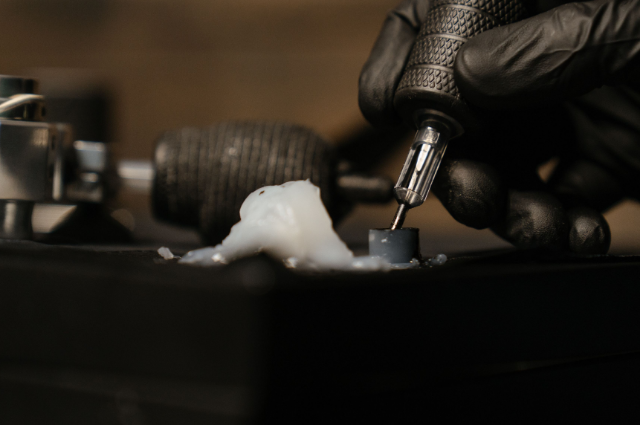
O’Reilly left the Navy and further developed Thomas Edison’s electric pen, seeing the potential it had for the art of tattooing. Through persistent experimentation, O’Reilly developed a machine which could ease the job of tattoo artists — the handheld tattoo machine. Samuel O’Reilly modified the electric pen as a quicker alternative to the “hammer and needle” method of tattooing. He adapted the basic idea with a stronger tubular shaft, an ink reservoir and a fitting for multiple needles.
On December 8th, 1891, US Patent No. 464, 801 was successfully filed by O’Reilly, changing the face of modern tattooing. With hand-poking, even the most experienced artist can only puncture the skin two or three times a second. His machine increased this to around 50 perforations per second; the change was revolutionary.
This enraged Edison, but the design was different enough that it didn't constitute an infringement of patent. A former-friend-turned-rival of O'Reilly's, Elmer E. Getchell, also claimed to have created the tattoo machine, and the case was brought to Federal Court.
Getchell teamed up with Edison in the case, claiming that O'Reilly wasn't responsible for the tattoo machine. The courts determined that since his patent included the ink reservoir, it was greatly different from Edison's, effectively giving O'Reilly the undisputed claim on the newly invented device.
O'Reilly was open about his modification of Edison's original electric pen. Despite his troubled past, he became a man of honour who credited Edison for the original device and the inspiration. He managed to use Edison's own game against him and proved that the tattooing machine, indeed, belonged to him.
Good artists copy; great artists steal. Artists who lack inventiveness rely on imitation. But O’Reilly had a vision for Edison’s electric pen. He abstracted inspiration and turned it into innovation.
References: