
West Bengal, home to approximately 100 million people, has been one of India’s most politically charged states for decades. From 34 years of Left Front rule to 15 years under Mamata Banerjee’s Trinamool Congress (TMC), the state has a long history of intense political competition, electoral violence and identity-driven campaigns.
From the Naxalite groups waging guerrilla warfare against landlords, businesspeople, politicians and security forces to the horrifying chaos during election months, Bengal has never not seen mayhem. Yet even by Bengal’s standards, the 2026 Assembly election result is transcending into something deeper and scary. This is no more a political clash between two parties, it is an ongoing battle over Bengal’s political identity itself.
The 2026 Assembly Elections were always going to be historic. Either Mamata Banerjee would secure an unprecedented fourth consecutive term, cementing her legacy as Bengal’s longest-serving Chief Minister, or the Bharatiya Janata Party (BJP) would script history by winning the state for the very first time. What actually happened is beyond exaggeration.
Back in 2011, draped in a plain cotton sari and rubber sandals, Banerjee hardly looked like a politician who would defeat one of the world’s longest-running elected Communist governments – Communist Party of India (Marxist) (CPI(M)). Now her white cotton saree with a narrow mono-coloured border has become something of an emblem.
After all the years she spent advocating for women, education and empowerment, BJP’s Suvendu Adhikari was garlanded as the new Chief Minister of West Bengal.
From a people’s campaign in 2021 on ‘No Vote To BJP’ to a music video by a galaxy of artists against the party, the civil society in Bengal had a powerful impact in the 2021 polls. The enormous change in 2026 has taken unpredictable turns including a series of serious deaths.
As celebrations and protests took the streets, the periodic post-poll violence entered the picture yet again. Chandranath Rath, personal assistant to Suvendu Adhikari, who was seen as the front-runner to become the state’s new chief minister after the Bharatiya Janata Party (BJP) won the vote was shot dead. Rath is among at least three people killed in the eastern state since the results were announced. Police said before Rath’s death that they had arrested more than 400 people in connection with incidents of violence and intimidation.
The election was also surrounded by controversy over the Election Commission’s “Special Intensive Revision” (SIR) of voter rolls. Critics alleged that millions of names were either removed, flagged or left unresolved before polling day. The BJP and Election Commission defended the process as an administrative exercise meant to eliminate duplicate or duplicit entries.
Bengal’s politics traditionally aimed at welfare – labour rights, land reforms, trade unions, women empowerment and class consciousness. The BJP’s victory reflects an expected shift from egalitarianism to conservative ideologies – focusing on nationalism, religious identity and Hindu consolidation rather than class-based politics that traditionally dominated Bengal.
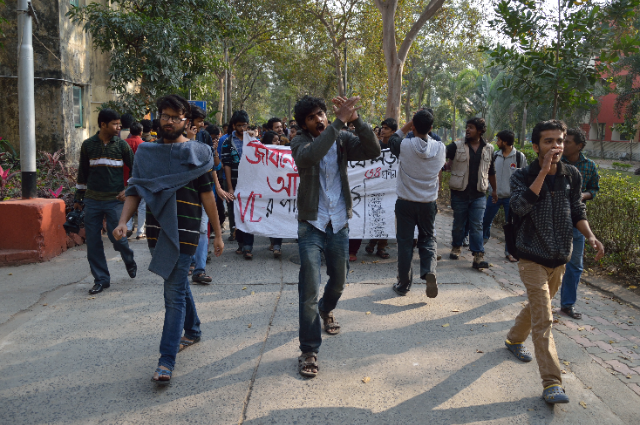
The ideological transformation is not only visible in the win but also in the academic environments of West Bengal. National Students’ Front (NSF), a right-wing students’ organisation, wrote to VC Chiranjib Bhattacharjee, demanding that Revolutionary Students’ Front (RSF) be banned from campus for promoting anti-national activities. “If they do not act, we will initiate a broader students’ protest,” said Somsurya Banerjee, NSF founding member.
For decades, Jadavpur University was a symbol of democracy, where intellectual debates were supported and neither of the Fronts demanded each other’s eradication. Student activism was a means to respectfully debate social causes, public policies and their implications, not political superiority. Critics have started to worry that dissenting voices may tend to be labelled “anti-national”.
The change is significant because Bengal, much like Kerala, stood as one of India’s strongest Left Wing political spaces focusing on public welfare. Kerala gave the world its first democratically elected communist government. Now, it voted the left out leaving no Indian state under the rule of the Left.
The outgoing government of LDF Chief Minister Pinarayi Vijayan has focused on improving Kerala’s infrastructure and welfare schemes. During the COVID-19 pandemic, about 5.5 million people – elderly, differently-abled and widows – in Kerala were paid 8,500 rupees each. Last November, after carrying out his four-year Extreme Poverty Alleviation Project (EPEP), Vijayan declared Kerala free from extreme poverty, becoming the first Indian state to achieve that.
In a lot of ways, Bengal once politically resembled Kerala more than the Hindi heartland – argumentative, welfare-oriented, secular and carefully shaped by the Left Wing. The 2026 election could possibly be the pivotal point where that resemblance could start to fade.
Bengal was never just another state. It represented intellectualism, secularism and continued resistance to majoritarian politics. Now, it’s 2026 and BJP won 207 seats out of 294 in West Bengal. Critics arguably fear that due to the increasing domination of the Right Wing rule nationwide, secularism could be overshadowed by the fight for religious identity under the veil of nationalism.
References:
- https://www.britannica.com
- https://www.bbc.com
- https://www.bbc.com
- https://www-indiatoday-in.cdn.ampproject.org
- https://m.economictimes.com
- https://m.economictimes.com
- https://m.thewire.in
- https://m.economictimes.com
- https://www-aljazeera-com.cdn.ampproject.org
- https://www-thehindu-com.cdn.ampproject.org
- https://timesofindia.indiatimes.com
- https://www-aljazeera-com.cdn.ampproject.org