
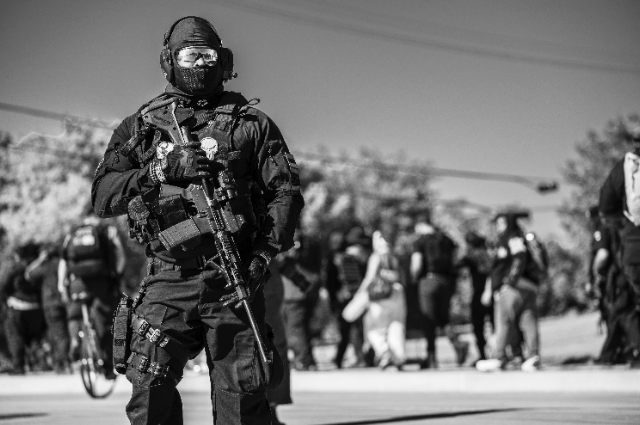
The grip of control started to slip from the government’s hands into its subjects.
The extrinsic muscles did not provide enough force to hold back mobs and the intrinsic muscles did not implement safety measures with precision. Perhaps the government did not realise the need to clench harder.
In 2023, the security crisis had its genesis. Police station records from across Manipur pertained to looting or attempted looting of arms from security personnel in Manipur. Mobs lobbed grenades, broke locks and fled with sophisticated weapons. An analysis of 46 FIRs was filed exposing precarious lapses in the protection of various armouries. Civilians got their hands on an estimated 4,000 weapons. When government-owned firearms shot bullets but the snipers positioned behind them were not government-authorised, it was bound to get uglier.
A raging mob of thousands of men had stormed the Manipur Police Training Centre at Pangei in Imphal East at 2.30 pm on 4 May, 2023. The lone guard at the gate watched helplessly. The civilians were armed with metal cutters, stones and sticks. Twenty guards on duty panicked and fired blank bullets, but they were clearly outnumbered. This instance merely blew the war-horns, more was yet to come. Arms were reportedly looted from police battalions and stations at multiple locations in Manipur. The armouries meant to store protective gear were weaponised for large-scale destruction. Their deep-seated hatred was the issue the government failed to resolve, communal peace could not be achieved.
Often, police guards willingly handed over the keys to the mob without firing a single shot. In the Battle of Saragarhi (1897), 21 soldiers in the British Indian Army fought against 10,000 Afghan tribesmen to defend their outpost. A century later, we witnessed officers yield.
Sometimes the men in the mobs handed over their Aadhaar cards to the guards — their ethnic kinsfolk — assuring them that they would return the weapons once the fight was over. But when will the fight really be over? Three years have gone by, innocents have had to die.
Even the registers recording the weapon inventory were destroyed or stolen. It has been extremely difficult to quantify the loss in numbers. How ironic it is that the initiatives such as the IndiaAI Mission and the Centres of Excellence for AI to make India a global leader are when the government never computerised significant military data?
A total of 328 weapons and 8,665 assorted ammunition were recovered during security operations later. But the damage was already done. Miscreants had looted over 6,000 weapons and over one lakh ammunition from state forces’ armouries. Security rhymed perfectly with mockery.
Considering the civilians’ acquirement of weapons, the federal government announced deploying 10,000 more soldiers in Manipur, taking the total number of troops to nearly 67,000 in addition to the 30,000-strong police force. But how will troops contain the abstract enmity of the population of 2.8 million Manipuris?
In June 2023, the federal government formed a committee to initiate a peace dialogue. This failed as it commenced as Kuki representatives refused to participate due to a lack of confidence in the committee’s composition, which included key political figures they perceived as biased such as Chief Minister Biren Singh. Rejecting the inclusion of Biren in the committee, the Kuki Inpi Manipur said it does not have “an iota of hope and confidence in the peace committee formed by the MHA (N-E Division).” Trust takes years to build. No amount of India’s movement towards AI inclusion can make the ongoing crisis stand still without mutual trust between the government and the communities.
In February 2024, India announced plans to fence its 1,600 km (995 mile) border with Myanmar. The India-Myanmar border cuts across communities with shared ancestral relations. Ethnic tribes living on both sides resent the fencing. Corporate AI usage is being promoted highly but the government chooses to fence families far apart instead of putting it to use. It could have deployed technology-driven surveillance (such as drones, infrared sensors, and biometric tracking), but it did not. How is this a step towards strengthened security when it is weakening the communities’ trust further in the government?
Bilateral cooperation for joint border patrolling and intelligence sharing can help curb insurgency and illegal activities while maintaining local mobility. But the government sees the “easiest” way out that will take 10 years, perhaps more since the plan does not even fit the monetary budget.
More importantly, the addressing of external issues surpasses the internal conflicts. The government wants to fix the external problems in a 10-year span and then perhaps, after further losses, it will resort to patching communities and maintaining the diversity.
More than 260 lives have been lost, while over 60,000 people have been displaced into segregated relief camps. Yet, neither will there be unbiased peace initiation nor the erasure of hatred among communities. Just a border that would expand the margins of displeasure with the government. Is this how the government plans to solve its spiralling security crisis?
A security crisis cannot be solved by enforcing territorial control at the expense of local freedom.
References:
- https://indianexpress.com
- https://indianexpress.com
- https://theprint.in
- https://www.pib.gov.in
- https://www.reuters.com
- https://journals.sagepub.com
- https://www.thehindu.com
- https://timesofindia.indiatimes.com
- https://www.thehindu.com
- https://www.civilsdaily.com
- https://indianexpress.com