
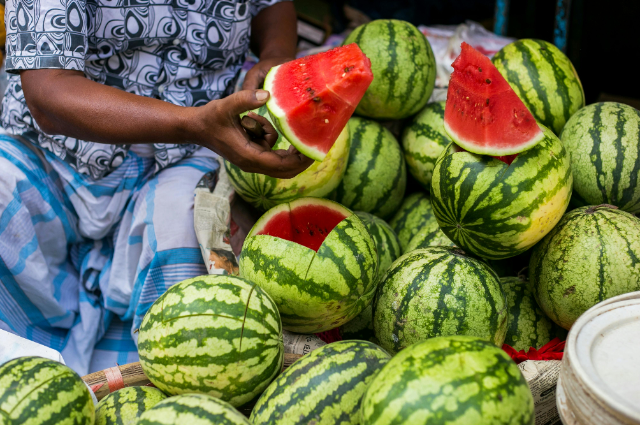
Four members of a family in the Pydhonie area of South Mumbai tragically passed away on April 26, 2026, after consuming watermelon. What was supposed to be a delicious late-night snack turned into a nightmare they never woke up from.
The deceased have been identified as Abdullah Dokadia (40), his wife Nasreen (35), and their daughters Aisha (16) and Zainab (13). The family resided in the Mughal Building at Ghati Galli, Pydhonie.
According to Mumbai Police, the incident dates back to the night of April 25, when a total of nine family members, including close relatives, had dinner together at around 10:30 PM. The relatives later returned to their respective homes. In the early hours of the night, between 1:00 A.M. and 1:30 AM, the four family members reportedly consumed watermelon.
By early morning, on April 26, all four began experiencing severe symptoms, including vomiting and loose motions. They were initially attended to by a family doctor and were later taken to JJ Hospital for further treatment in a semi-conscious state. Despite medical help, they met their untimely fates. Post-mortem examinations were conducted, but the final cause of death could be confirmed only after histopathological reports were received. Meanwhile, the police registered it as an accidental death report and sent food samples for forensic testing.
None of the dinner guests, who had eaten the same pulao earlier in the evening, fell ill at all. What possibly could be the reason a simple intake of watermelon caused such horrible, sudden deaths?
Soon after, traders said that the demand for watermelon fell nearly 30 per cent, with the fruit being offloaded for as little as five to seven rupees (4p to 5p) per kilogram – a fraction of its usual wholesale price of between 10 and 35 rupees (8p to 27p), according to Indian media reports.
Vendors at Crawford Market in south Mumbai mentioned to 'The Indian Express' that customers were attempting to return watermelons they had already purchased.
It happened right after social media posts started going viral regarding the death of the family, surrounding the fact that they had eaten watermelon before the incident.
Doctors said that the terror-inducing theories on social media about watermelons had no scientific basis; the sheer mayhem was a result of the fearful possibility of the same harming others.
Dr Sanjay Surase, medical superintendent of Sir JJ Hospital, where three of the victims died, said the clinical picture did not match food poisoning; it was not the watermelons' fault, but the world tends to run on presumptions until clear facts are stated.
"The speed of deterioration, the severity of the condition, and the fact that multiple members of a single family were affected are not consistent with a routine food-borne illness. We are looking at the possibility of a toxic or chemical substance," he told The Indian Express. The state food safety commissioner separately told the newspaper that even high levels of pesticide residues on the watermelon could not have caused such deaths, as fruits are routinely treated with multiple pesticides before harvest without fatal consequences.
Police started to investigate whether the family had been under any financial or psychological stress in the period before the deaths. Watermelons are hydrating fruits, they are not capable of depriving bodies of life when the doctors saw no signs of contamination in their remains. But fear reigned public perception, a non-living item - a fruit - was blamed for something it could not have logically caused. Even before the investigation had any potential leads, watermelon was voted culpable in the court of public opinion.
The police found that the family was not under any apparent financial strain. Abdullah, the father, had a mobile accessories shop in Andheri, and the family also received rent for a place they let out. Abdullah had kidney issues, and Nasreen was suffering from thyroid. The health issues were not bad enough to be the cause of their unexpected demise. The police had also recorded the statements of Abdullah and Ayesha, the elder daughter, before she died. They too did not mention any and only said they had watermelon late at night. How could a fruit they've probably been eating often since their birthday suddenly be guilty of their deaths?
The Forensic Science Laboratory (FSL) report recently confirmed the presence of zinc phosphide in the viscera (liver, kidney, spleen), stomach contents, bile, and abdominal fat samples of the deceased identified as Abdulla Dokadia (44), his wife Nasrin (35) and their daughters Aayesha (16) and Zaineb (13), said Deputy Commissioner of Police Pravin Mundhe. Zinc phosphide is a rat poison ingredient. The chemical is commonly used as a rodenticide to kill rats and mice and is known to be extremely dangerous even in small quantities.
Turns out, the watermelon indeed was innocent. Our fear framed it irrationally when Zinc phosphide was the real culprit. It released a lethal gas inside the human body that killed them within hours. The poison was detected only after 54 rounds of forensic testing, far more than the usual 10 to 20 rounds required in poisoning cases. According to forensic officials, the prolonged testing was needed because the victims had vomited out much of the toxin before reaching the hospital, leaving behind only trace quantities.
Police are still investigating whether the deaths were accidental, suicidal or homicidal. Officials said no rat poison was found inside the family's residence.
The uncanny presumption that reduced watermelon sales margins is not a new concept. In economics, it is referred to as "loss aversion". The chaos caused by the deaths led to the instant disappearance of watermelons from local markets and a fall in their demand that felt like a quick thud. Even though millions of people eat watermelon safely every day, people started to believe that no watermelon should be in their fruit basket anymore. All because this one specific story jogged their memory at the sight of watermelons. A Mumbai-based family died at the dawn of April 26; it was also the dawn of assumption.
References:
- https://www.thehindu.com
- https://timesofindia-indiatimes-com.cdn.ampproject.org
- https://www.ndtv.com
- https://www.thehindu.com
- https://www.independent.co.uk
- https://indianexpress.com
- https://m.economictimes.com