
Noida is among the largest planned industrial townships of Asia and houses thousands of industrial units. Its contribution of nearly 10 per cent to Uttar Pradesh’s GSDP shows the extent of the workers’ contributions. According to the UP Economic Survey (2025), Noida’s GDP was twice the size of Lucknow’s economy and larger than the entire GDP of Himachal Pradesh. Viewed through a purchasing power parity (PPP) lens, Noida’s per capita income matches that of Japan, placing it in a league far above the rest of the state. If it were not for the workers spending hours doing a sequence of recurring tasks, Noida would not be at par with the fifth largest economy in the world.
Researchers call the ability to perform uninteresting tasks “vigilant attention,” which reduces further with repetitiveness of chores. Psychology acknowledges how monotonous tasks reduce attention spans. But the workers perform them in a cyclic motion over and over again, every single working day, without complaint. Yet here we are, undervaluing their grit and determination to give their family a stable life – underpaying them.
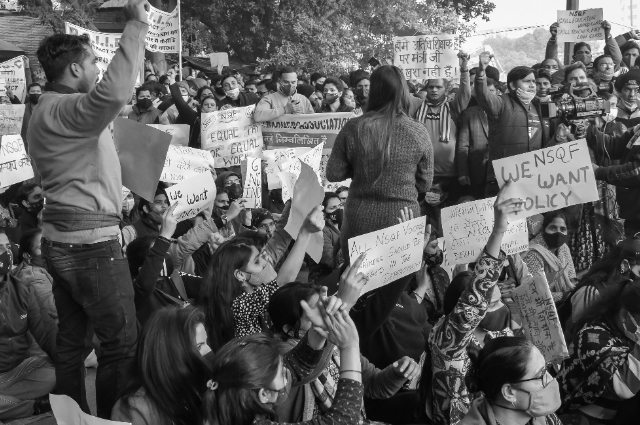
On 13th April, 2026, thousands of workers across Noida and Greater Noida assembled on the streets to protest for higher salaries and better working conditions. About 45,000 workers gathered at more than 80 locations, bringing traffic in key areas like Sectors 60, 62 and 63 to a halt. Can you blame them for the outburst – especially when inflation is at peak due to the ongoing war scenario? Living costs across the world have risen as the US-Israeli war in Iran has deprived us of fuel supplies.
At a garment factory in Noida, the production of a single kurta or a shirt is broken into a sequence of defined tasks, each carried out by workers who repeat the same motion for hours. Dinesh Shrivastava, 38, is a part of this labour chain. A decade ago, when he was working in Gurgaon, Dinesh earned Rs 90 a day, amounting to about Rs 2,700 a month, while still sending money back home to Sultanpur in Uttar Pradesh. Now, he operates a sewing machine, stitching sleeves and collars. He sits hunched at his table. There is no support to rest his back or even to straighten up. Workers are not mere slaves, they deserve the dignity they are fighting for. Human resources are not simply “assets,” they are HUMANS who deserve a fair compensation and a comfortable working environment.
Another victim of the same is Vinay Mahoti, 30, hailing from Bihar, works at a hosiery company in Noida. He said he initially protested inside his manufacturing unit but it went unheard, like the wailing of street animals half the world resents. Therefore, he joined workers from other companies who took to the streets. He did not plan on joining the chaos at first, the flippant attitudes of high-earning superiors towards the hard-working workers pushed him to do it.
“Duty hours should be fixed, overtime hours should be paid, and companies…should adhere to the guidelines laid by the federal government,” he said, listing his demands. Demands? That is what we are veiling rights as? Section 59 of the Factories Act, 1948 states that “where a worker works in a factory for more than nine hours in any day or for more than forty-eight hours in any week, he shall, in respect of overtime work, be entitled to wages at the rate of twice his ordinary rate of wages.” Those are not demands, they are rights.
“My salary is between ₹11,000-₹13,000 for a 10- or 12-hour shift in a garment factory. I haven’t been given any increment in the last two years. It’s difficult to survive and help the family with this salary. We are underpaid and exploited. Many a time, our salary is late by two months,” Babita Singh, working in Noida’s Sector 62 said. Here’s a list of constitutional principles and rights the situation violates:
- Article 39(d) – Equal pay for equal work
- Article 41 – Right to work and public assistance
- Article 42 – Just and humane conditions of work
- Article 43 – Living wage for workers
- Article 23 – Protection against exploitation
So many guidelines exist, none are followed. Protestors had to set fire to vehicles and pelt stones to be noticed and their demands to be considered by the government. Violent protests are not the right
way, but peaceful protests did not seem to rattle the officials. Resorting to such methods was not a productive use of free will but an effective one, we do know whom we must hold accountable for their inattention to the public.
With over 300 arrests and a heavy police crackdown, the Uttar Pradesh government announced an interim wage hike. Similar protests in the auto-making state of Haryana last week led to the government ordering a 35% hike in minimum wages. But in Noida,
many workers objected to the hike as insufficient, continuing protests and demanding salaries closer to Rs 20,000.
About 1,000-1,200 workers have been detained by the Uttar Pradesh police in connection with the protest against low wages by employees of industrial units in Noida on April 13 that turned violent, according to lawyers. Addressing reporters on Thursday, they alleged widespread illegal detentions, including of minors, with families left searching for relatives. They also accused the police of denying access to arrest memos, FIR copies, and legal access to the detainees.
Some detainees even faced torture in custody, like the case of Rupesh Rai, an autorickshaw driver, who has been named as a ‘key conspirator’ of the violence. However, the lawyers claimed he was taken into custody two days before the protest without being informed of the grounds of arrest. He was detained on April 10 while the violence began on April 13. His brother, Madhuresh, was reportedly detained despite not participating in the protests and remains in jail. His wife, Shubhi, has been missing since April 20, after the police allegedly brought Rupesh home in chains and raided his house.
It is not justice when people are arrested on grounds unknown, and questions unanswered are seeds of doubt in the public’s mind being sown. A protest that aimed at justice has become a spectacle of increased injustice.
References:
- https://www.thehindu.com
- https://www.thehindu.com
- https://www.indiacode.nic.in
- https://pmc.ncbi.nlm.nih.gov
- https://www.jagranjosh.com
- https://www.ndtv.com/business-news
- https://timesofindia.indiatimes.com
- https://indianexpress.com
- https://kathmandupost.com