
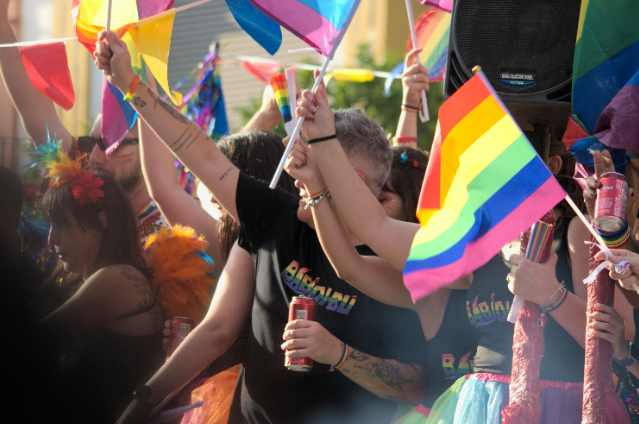
Today, Pride events take place worldwide. The month of June is dedicated to the LGBT+ community as Pride Month, which honours their rights and struggles. But 60 years ago, their existence was criminalised due to widespread homophobia. At that time, people discovering their identities being different from the society’s two-forked mindset meant facing lawsuits.
Humans have always preferred to rely on simple classifications under the guise of maintaining a natural order. Little do they know, gays have existed alongside men and women throughout history, just as discrimination has. It was never their absence that made their existence feel sudden but how they were silenced for ages.
In 1930, when 90% of the population went to the black and white works of articulated silence — films, William Haines was the biggest box office star in Hollywood. By 1927, he was one of only seven MGM stars to have his name above the title in his movies. Three years later, he had already made more than 50 silent films and successfully transitioned to talkies, yet a lot of people perceived his personal choice and identity as absolute abhorrence. Haines was gay and lived openly with his boyfriend Jimmie Shields.
Louis B. Mayer was one such scathing persona. Being the studio chief of MGM, he tore up Haines’ contract and threw him out of the studio. But Haines refused to hide his identity and enter into the sham of an opposite-sex marriage that Mayer outrageously demanded. He won at love, but at the cost of a successful and perpetually growing career.
Some had to give up their dream to preserve their identities and the others had to veil their identities to preserve their livelihood. When the Nazis came to power in Germany, between 5,000 and 15,000 men were imprisoned in concentration camps as homosexual offenders. This group of prisoners was typically required to wear a pink triangle on their camp uniforms as part of the prisoner classification system. They were forcefully taken away to concentration camps, humiliated and severely tortured. For years, there was not a single shred of hope to hold onto for the LGBTQ+ community.
By 1969, same-sex relationships were still not recognised; they continued to be criminalised. They were made completely illegal in most parts of the world. In the United States of America, gay bars were places of refuge where gay men and lesbians and other individuals, who did not fit the prescribed genders of society, could socialise in relative safety from public harassment. However, even those places were subject to frequent harassment and police raids.
One such well-known gathering place for young gay men, lesbians and transgender people was the Stonewall Inn in Greenwich Village, which was reportedly operating without a liquor license. On the morning of June 28, 1969, nine policemen entered the Inn to validate identities they could not interpret, or perhaps, did not wish to understand. They arrested the employees for selling alcohol without a license, roughed up many of its patrons, cleared the bar and then went on to carry out their duty misaligned with conformity. In accordance with a New York criminal statute that authorized the arrest of anyone not wearing at least three articles of gender-appropriate clothing, they took several people into custody. It was the third such raid on Greenwich Village gay bars in a short period, and the police decided their fate when they had barely figured themselves out.
In India, the harsh treatment against them persisted for decades despite their traces in Indian History. In the Ramayana, when Lord Rama was banished from the kingdom and was asked to spend 14 years in the forest, his followers followed him to the forest, but he requested all the “men and women” to return to the city of Ayodhya. But the transgender individuals (hijras) stayed back with Lord Rama. Lord Rama was deeply touched by their love and loyalty and sanctioned them the power to confer blessings on auspicious occasions like marriage, childbirth and inaugural functions.
But the humans only believe what they want to. Section 377 of the Indian Penal Code (IPC) referred to ‘unnatural offences’ and said that whoever voluntarily has carnal intercourse against the order of nature with any man, woman or animal, shall be punished with imprisonment for life, or with imprisonment of either description for a term which may extend to 10 years, and shall also be liable to pay a fine. The section came into force in 1861 during the British rule of India (modelled on the Buggery Act of 1533), which criminalised sexual activities “against the order of nature”, including homosexual activities. Many humans ignored injustice in the name of morality and labelled them as abominations, while the Gods they prayed to considered them pure creations.
Later in 1999, the U.S. president officially recognised Pride Month for the first time. In 2015, Obergefell v. Hodges, a legal case in the U.S. Supreme Court, legalised same-sex marriage across the United States. In India, Navtej Singh Johar v. Union of India was a landmark case that decriminalised same-sex intimacy. It was brought to light that it violated fundamental rights, including the right to privacy, equality and dignity. It took centuries for countries around the globe to finally start to accept what had always been true. For a planet so rich in geography and culture, it forgot to value the most prominent form of diversity – human diversity.
References:
- https://goldenglobes.com
- https://timesofindia.indiatimes.com
- https://www.britannica.com
- https://encyclopedia.ushmm.org
- https://pmc.ncbi.nlm.nih.gov
- https://www.presidency.ucsb.edu
- https://www.britannica.com
- https://www-thehindu-com.cdn.ampproject.org