
Being an Indian either means being an involuntary target of gulaal or the trickster who aims at others with water-filled balloons during the festival of Holi. Holi symbolises the triumph of faith and virtue over conspiracy and evil. On the eve of Holi, bonfires are lit, co the burning of the demoness Holika and the victory of Prahlad’s devotion to Lord Vishnu who walked out unscathed.
But in foreign states, ‘Holi’ is anything but a cultural celebration of values. In the United States, people wear white-coloured clothes to participate in a 5 kilometre-long run – known as Colour Run – to have Holi colours thrown at them. Religious groups in Utah organise the festival on a big scale to provide a platform to the young to have fun. In Spain, party lovers in Madrid too play Holi, albeit during the monsoons. Loads of gulaal, water guns, dances, etc. add festive cheer to the celebrations. Holi is reduced to a means of enjoyment that ends up with people bombarding social media with their photos, labelling Holi as a ‘party’. It is indeed enjoyable, playing with powdered colours, but a party is defined as a social gathering for entertainment rather than tradition. The essence of its celebration is defeated by the number of likes on people’s Instagram posts.
‘Aesthetic Holi’ involves a majority of pink shades on their white clothes and faces. The colours are not meant to be aesthetic but symbolic – red for love/fertility, yellow for knowledge/auspiciousness, blue for Krishna/trust and green for new beginnings. Even the old clothes worn and discarded after the festivities represent moving on from the past year’s negativity. It is symbolic of a fresh start. It is a way to let go of inhibitions and embrace a new journey with a positive mindset. But now it is more about appealing pictures than cultural beliefs.
Even Diwali has more firecrackers involved than prayers and more aesthetic pictures than memorable moments. The festival was traditionally celebrated with diyas, sweets and rituals, signifying the victory of virtue over sin. But then firecrackers came into existence.
Did firecrackers exist when Lord Ram returned from his exile? Lord Ram was born in the BCE era while it is widely believed that gunpowder, an essential component used in fireworks’ production, was invented in China and reached India during the AD era. Gunpowder technology trickled into India via Central Asia and maritime trade.
Once it arrived, fireworks began appearing in royal festivities, though not yet in common folk rituals. Then it started being used in warfare during the Islamic era. It was not until the Mughal rule that firecrackers became the centre of celebrations and entertainment for the emperors. When the British colonised India, firecrackers became easily accessible and a means of commercialization due to industrial production. Now, the novelty of firecrackers has shifted from elite spectacles to mass usage mistaken as Diwali’s tradition.
Pollution created by burning of crackers knows no bounds, neither does the person clicking a thousand pictures to have an ‘aesthetic’ photographic representation to prove her enjoyment. The sky was home to stars, now it is contaminated by smoke particles owing to crackers. They light up the pitch black and already greatly contaminated sky with another contaminant just to witness a tapestry of momentary glow.
Then comes Navratri. Spanning over nine nights and ten days, this festival is dedicated to worshipping the goddess Durga in her nine different forms. The story behind the festival revolves around Goddess Durga defeating Mahishasura who had grown arrogant with the boon that he could not be defeated by any man. It is a celebration of the divine feminine. Whether it’s through fasting, dancing or prayers, Navratri enhances India’s cultural diversity. But now, Navratri’s traditional dance forms, Garba and Dandiya Raas, have been reduced to mere commercialised DJ nights. Now, people go to dandiya nights not out of devotion but to capture picture-perfect moments to post on Social Media platforms.
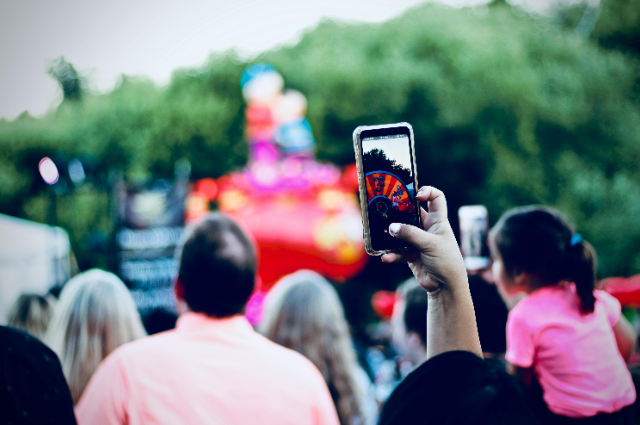
How has the world become so detached from its origin? The folklore does not have any keen folks to carry forward the beliefs to the next generations, it’s fading while people adjust the brightness of their photos to achieve perfection. Social media was supposed to be a way to bond communities. But somehow, it is being used for fabricating happiness through staged pictures. It has encouraged people to post idealised versions of their life instead of authentic ones. They are staging their life for mere likes on social media, celebrating a great picture more than the festival itself. It seems like the world is moving one step forward in technology and two steps back in cultural preservation simultaneously.
Holi is becoming a “Colour Run” and a huge bash internationally, Diwali is now about noisy sparkles than subtle rejoice and Navratri is basically a curated DJ night. Everything is commercialised and photographed, the quintessence of traditions behind festivals is being epitaphed.
References: