
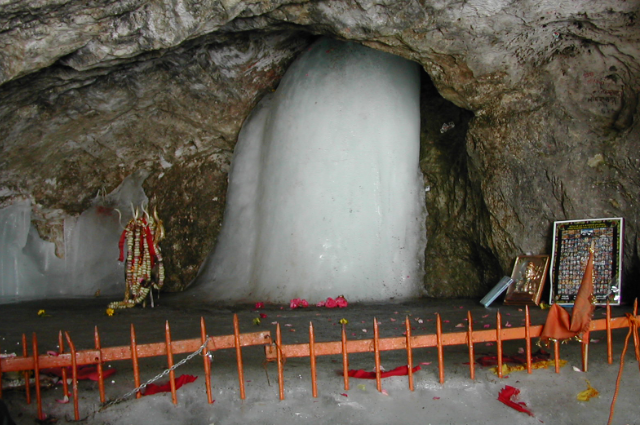
In 2026, pilgrims are rushing to catch a glimpse of the Amarnath Shivling, not because it is a tedious journey but because the destination may take a vacation itself.
As a large number of devotees returned to the Amarnath cave shrine this year to catch a glimpse of the divine ice lingam, also called Baba Barfani, it has become evident that the shrine has already melted by over 90%, almost disappearing just days into the 57-day yatra.
Over the past four to five years, the Lingam has tended to melt by mid-July. Two decades ago, it seemed impossible for a sacred relic to deteriorate. It is believed to be a self-manifested (Swayambhu) form of Lord Shiva, radiating divine energy. This year, the Shivling had already begun to melt around the very day the Amarnath Yatra commenced. Two decades ago, the ice lingam seemed to stall its departure. Now, the pilgrims’ earliest arrival is rather behind the ice’s schedule.
Twenty years ago, pilgrims would witness the marvellous ice lingam formed from water droplets that drip from the cave ceiling and then freeze. Its size gradually increased from May to August and was traditionally believed to wax and wane with the lunar phases, reaching its peak on the full-moon day in the Hindu calendar month of Shravana (July-August). The journey involves a 28-mile (45-km) trek from Pahalgam or a 9-mile (14-km) route from Baltal. The hard climb on the rough terrain is a spiritual transformation for the devotees; the essence of this sentence lies in Hindu mythology.
According to Hindu mythology, the Amarnath cave, also called Amaresha and Amareshwara, is the site where Lord Shiva revealed the secret of immortality to his wife, Goddess Parvati. It came to be known as the “Amar Katha”. The legend explains that a curious Parvati, who was caught in the cycle of rebirth (samsara), asked lord Shiva to reveal the secret of his immortality.
He agreed, choosing the secluded Amarnath cave for the revelation. He entered samadhi (a state of deep concentration) and created kalagni, a sacred fire, to ensure that no other being overheard, since the secret of immortality could disturb the natural order of the Earth’s beautiful creations.
Despite that, a pair of pigeons residing in the cave unintentionally overheard the secret. It is said that those pigeons became immortal, and pilgrims can sometimes spot them inside the cave even today, becoming the beholders of a divine phenomenon that is considered Lord Shiva’s blessing. The cave is also one of the most prominent shaktipithas, sacred sites where different parts of the Goddess Sati are believed to have fallen after her self-immolation. Each pitha is regarded as the fountainhead of divine energy, or shakti.
Sati, in Hinduism, is one of the wives of the god Shiva and a daughter of the sage Daksa. Sati married Shiva against her father's wishes. When her father failed to invite Shiva to a great sacrifice, Sati died of mortification and was later reborn as the Goddess Parvati. Lord Shiva, devastated by her demise, carried her corpse around the world on his shoulder until the other Gods dismembered it to pull him out of mourning. Each of the spots where a piece of Sati's body fell to the ground became a sacred place of pilgrimage called a pitha. Divinity arose from the poignantly soulful deed.
The Amarnath cave sits at an altitude of 3,888 meters (12,756 feet). Unusually warm summer conditions around the cave and nearby glaciers have raised local temperatures past the threshold required to sustain ice. Beyond rising temperatures, shifting rainfall patterns also contribute to how large the stalagmite can grow before the summer season starts and exposes it to premature heatwaves.
Professor Sarmistha Pattanaik, who teaches at IIT Bombay, argues with practicality, bringing to light more than just climatic causes. She states, "While scientists frequently frame the melting of the lingam purely around climate change and environmental impact, I view this crisis through other dimensions as well, from rising temperatures and reduced snowfall to diminishing winter days. This is not just a case of isolated environmental factors. Ecological processes and human activities are the deeply intertwined causes of the problem."
Pointing out the rise in pilgrim numbers, Professor Pattanaik argues that the arrival of thousands of pilgrims and heavy infrastructure to support the journey puts excessive pressure on fragile mountain ecosystems, leading to habitat disturbance and ecological degradation. Along with this, the contributing factors to degradation in the area could be the deforestation of the fragile Himalayan ecosystem, which has further caused global warming and the melting of the Shivling glacier.
When a massive number of visitors crowd the cave, it creates severe resource strain. Furthermore, the cave's immediate micro-climate is severely impacted when large numbers of visitors enter; their body heat and the introduction of artificial lighting inside the cave can further degrade the cave ecosystem. Faith is solid despite the dripping water, but every drop tells us that faith abides and natural wonders do not.
References:
- https://www.ndtv.com
- https://www.amargranth.com
- https://www.downtoearth.org.in
- https://www.britannica.com