
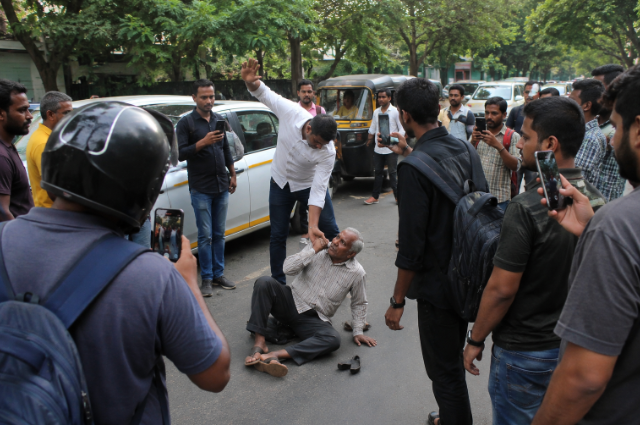
Just “saving in the memory” is bigger than actually “acting”.
A cab driver in Thane was arrested by the Vartak Nagar Police after allegedly assaulting a 70-year-old senior citizen outside Jupiter Hospital in June 2026. According to reports, the incident began when the elderly man asked the driver not to spit in a public place.
What started as a verbal disagreement quickly escalated. The driver allegedly became aggressive, attempted to strike the senior citizen on the head with a stone, and physically assaulted him, resulting in a fractured leg.
Footage of the attack soon went viral on social media, sparking widespread public outrage and renewed concerns about civic behaviour, respect for senior citizens, and public safety.
Police said the victim was initially reluctant to file a formal complaint. However, after the assault video went viral, Maharashtra Deputy Chief Minister Eknath Shinde personally reviewed the footage, contacted senior police officials, and directed them to register a case against the cab driver, including charges of attempted murder.
In a rare display of cross-party cooperation, leaders from rival Shiv Sena factions — Shiv Sena (UBT)'s Sumit Borate and Shinde Sena's Nitesh Patole — worked together to trace the accused and hand him over to the police. Emphasising that justice and social responsibility should transcend political rivalries, both leaders said the incident demanded a united response.
The incident occurred at around 7:00 p.m., when the accused, Nishant Shukla, allegedly abused and physically assaulted the 70-year-old senior citizen in the presence of his family. According to reports, the driver first punched the elderly man and then attempted to strike him on the head with a stone.
A case has been registered against the accused under Sections 109 (attempt to murder) and 352 (intentional insult with intent to provoke a breach of peace) of the Bharatiya Nyaya Sanhita (BNS). Authorities are examining the viral video footage and taking the necessary legal action.
The case serves as a grim reminder of how a simple civic request — asking someone not to spit in a public place — can escalate into a potentially life-threatening confrontation. Public outrage has been particularly intense because the victim was a senior citizen and the incident occurred outside a hospital, a place where respect, care, and public decency are expected to prevail.
The incident also highlights how dangerous an unchecked mindset can be. People often hesitate to correct others about basic manners, etiquette, or civic responsibility because even a simple suggestion can be perceived as a personal insult. When ego outweighs self-improvement, constructive feedback is rejected instead of accepted. This is precisely why values such as knowledge, etiquette, ethics, and morality remain so important in any society.
It is also worth reflecting on a broader social contradiction. Many people who litter public spaces, spit on roads, or ignore basic hygiene norms in their own country often behave far more responsibly when they are abroad. This raises an important question: would they treat their own homes the same way they treat public spaces? The answer is usually no. Their homes are kept clean because they see value in them, while roads, streets, and shared public spaces are often treated as someone else's responsibility rather than a collective asset that belongs to everyone.
The Thane incident is deeply shameful and troubling. In a major city, one would expect greater civic awareness and public intervention. Perhaps the most disturbing aspect is that, despite the presence of a crowd, a 70-year-old senior citizen was left vulnerable during the assault. The incident serves as a stark reminder that civic responsibility extends beyond keeping public spaces clean—it also includes standing up for those who need help and ensuring that basic human decency prevails in society.
The pattern has become all too familiar: an incident occurs, bystanders pull out their phones and start recording, the video is uploaded to social media, public outrage follows, comments and shares flood in demanding justice—and then the cycle ends. In reality, very few people step forward to help when it matters most.
Many bystanders may believe they are performing a public service by documenting the incident, but at the same time, they often avoid direct involvement. Some fear getting entangled in legal or personal complications, while others simply view it as someone else's problem. The unspoken attitude becomes: "Let them deal with it themselves; at least we are safe."
What is particularly troubling is that recording the event can sometimes become more important than responding to it. People may feel they are capturing something significant—something that will bring recognition, attention, or validation. Yet for the victim, there can be few experiences more distressing than being surrounded by spectators who choose to film rather than help.
This raises uncomfortable questions about modern society. Have we become so accustomed to viewing life through screens that witnessing an event has begun to replace acting on it? In some cases, the desire for attention, social approval, or online visibility may influence how people respond. A viral video can generate thousands of likes, comments, shares, and followers. For content creators, it can even translate into reach, influence, or financial gain.
Of course, recording incidents can play an important role in preserving evidence and helping authorities establish the facts. However, when a person is in immediate danger, and dozens of people choose to remain passive observers, society must ask whether documentation has begun to overshadow compassion. Technology can record an event, but only human action can prevent harm in the moment.
The true measure of civic responsibility is not how quickly we upload a video or express outrage online; it is whether we are willing to act, assist, and stand up for another human being when they need help the most.
References: