
A Sandbar Full of Dead Snakes
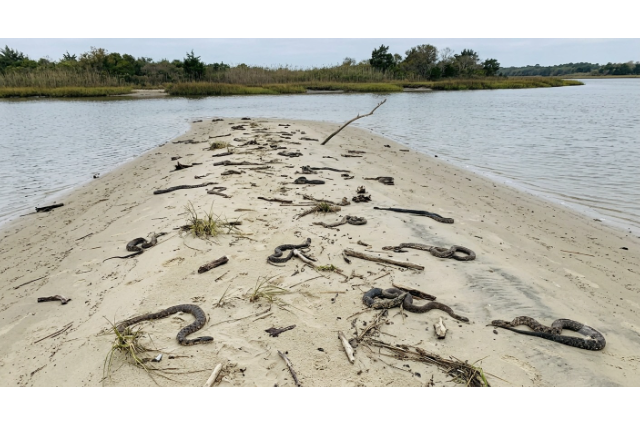
There is a particular kind of morning that stays with a person forever — not because anything dramatic happens in it, but because of what it reveals. For a sixteen-year-old boy walking along the banks of the Brahmaputra in 1979, that morning arrived in the form of snakes. Not one or two, but dozens of them, washed up on a barren, sun-scorched sandbar after the monsoon floods receded, their bodies lying lifeless in the heat because there was nothing — not a tree, not a bush, not a patch of shade — to shelter them.
His name was Jadav "Molai" Payeng. "Molai" was his nickname. He was a member of the Mishing tribal people of Assam, and he lived in Majuli - the world’s largest river island, which is situated right in the heart of the massive Brahmaputra River in northeast India. It wasn’t, in the grand scheme of things, a particularly remarkable sight. Sandbanks on Majuli had often been barren in the past. Erosion was a part of the landscape. Animals died due to heat, which was an accepted reality.
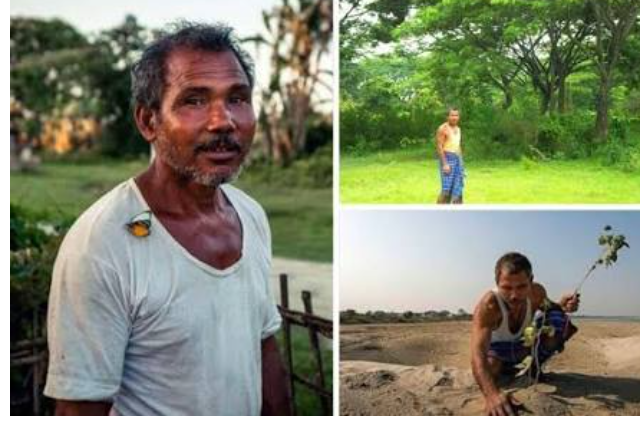
However, for Jadav, this wasn’t simply the reality. He felt this was not right, and it haunted him in an unsettling manner. So he made a decision which, looking back now, appears incredibly simple and somewhat foolish. He approached the local forest department and requested their help in planting trees on the sandbank, where some shelter from the heat could be provided for animals like those he had observed.
He did just that. In fact, he continued planting trees for the next forty years.
Majuli: The Vanishing Island
The sheer importance of Jadav’s work should really be perceived with reference to the island of Majuli. Majestic island Majuli is famous globally for being in a great big river, the world’s largest island on any river- that of the Brahmaputra! Situated squarely at the core of Assam, the island has its own age-old lineage of Vaishnavism, a nest of music, dance, and painting. It is home to the Assamese satras(monasteries), which have safeguarded the core of Assamese art and Culture for centuries. On its banks, men have historically lived with the river from time immemorial, a pact with the river whose every wrinkle has somehow been imprinted on the minds of its denizens forever.
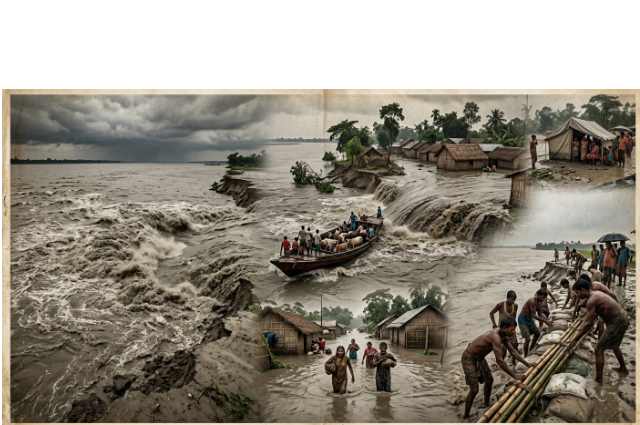
But this harmony has come at a certain cost. As one of the world’s most volatile waterways, the river Brahmaputra is characterised by being one of the most violent and unpredictable rivers in the world. It frequently causes havoc by flooding during the monsoons, destroying villages in a matter of months, and literally swallowing them along with the land they are situated on. The island has been shrinking over decades; a substantial portion of the island has disappeared, land bars have appeared and disappeared, and entire communities have been forced to relocate as the ground beneath them vanishes.
The Slow Invisible Work of Forty Years
The Slow, Invisible Work of Forty Years. What makes Jadav Payeng’s story incredible isn’t just the outcome but the simple, gritty mundanity of the process by which he arrived at the outcome. It was just a man, arriving on a particular sandbar, day after day, for forty years, planting seeds and saplings, watering them by hand, and watching them wither and die, only to start again.
He started, by virtue of availability, with bamboo. The fast-growing properties of bamboo and its ability to bind the loose sand with its rhizomatic root systems made it an ideal species for an eroding sandbar. As the soil began to consolidate, he introduced other species such as the cotton tree, the valcol tree, the arjun (a medicinal species widely used in Ayurveda), and soon a vast range of local plants that could adapt to the region. He later made the sandbar his home, living in a small hut and looking after livestock to generate the meagre funds needed to purchase the saplings as and when required.
His daily routine was so austere that it could best be described as monastic; it consisted of rising before dawn, walking the length of the growing forest, inspecting every sapling and newly planted sapling, planting more wherever there was space, and clearing weeds that threatened young seedlings. For decades on end, with no funding, no organisational backing, and no recognition for a very long time, this was the only work he did. It’s a detail that frequently goes unmentioned, overshadowed by the fact that one man can supposedly create a whole forest; his wife made crucial contributions throughout the project to maintain the living conditions that made his daily pilgrimage possible. While Jadav toiled on the sandbar, she worked the land back home.
The Unknown Government Forest
Perhaps the single most astonishing fact about this story is this: for nearly thirty years, the forest grew without the Assam government being fully aware of its existence or at least, without anyone connecting the dots about how it had come to be there.
It was only around 2008 that the scale of what Jadav had created became apparent to officials, and the trigger, fittingly, was wildlife.
Local villagers alerted to a herd of wild elephants that had emerged from the forest and gone into nearby villages, damaging the area, had forest officials searching for how a herd of elephants had suddenly popped up in a location that was barren and only a couple of decades back. Following their footprints, forest personnel have finally found the source of the elephants near the sandbar. They found a herd of wild elephants inside a dense forest of sandbar in Kokilamukh, Jorhat.
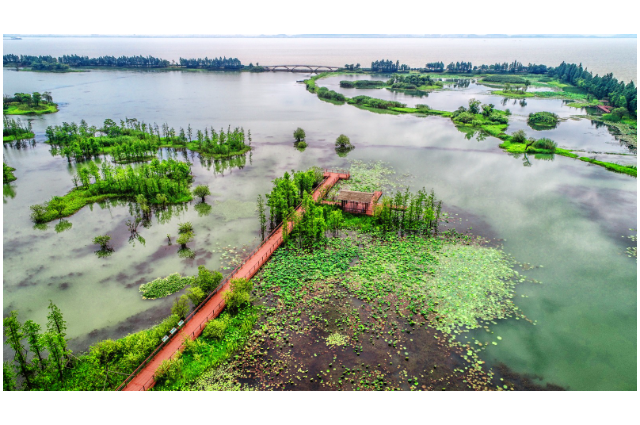
What they found, when they reached it, was not a small patch of trees. It was a fully formed, self-sustaining forest ecosystem spread across approximately 550 hectares — roughly 1,360 acres — an area larger than New York's Central Park, which covers about 341 hectares. And living within this forest was wildlife that had not been seen in the area in living memory: Bengal tigers, Indian rhinoceroses, more than a hundred deer, rabbits, monkeys, and an extraordinary variety of birds, including vultures — a species that has become critically endangered across much of India.
At the centre of all this, living in a simple hut, tending his cattle, was a man the officials had never heard of. When they asked who had planted all this, Jadav reportedly told them simply that he had, because the animals needed somewhere to live. The forest department official who investigated the discovery later remarked that he was shocked to learn that this vast expanse of green — teeming with wildlife that conservationists across India struggle for decades to protect — had been created by a single individual with no formal training, no funding, and no official backing of any kind.
The forest was named Molai Kathoni — 'Molai's forest' — after Jadav's childhood nickname. It is also referred to in English-language reporting as the Molai Forest.
What the Forest Actually Looks Like Today
You hear Molai Forest before you see it. Step off the boat at Majuli, walk maybe twenty minutes inland, and somewhere along the way, the open sky disappears, and the sound just arrives. Birds calling over each other, a woodpecker going at something nearby, rustling in the undergrowth that your brain immediately tries to identify as deer, probably, though you can't be entirely sure you don't want it to be something bigger.
And then it hits you, somewhere in the middle of all that noise and green: this was sand. Just sand. Not scrubland, not some half-recovered patch of degraded forest — bare, sun-baked riverbed where nothing grew because there was nothing to grow in, and nothing to shade what little life tried. Observing the current landscape, consolidating the dual imagery becomes impossible. The site functions less as a forest and more as empirical proof. The data helps, but at this scale, these numbers are so large that they don't sink in immediately. On the surface, the total land area of the Forest as a whole is about 550 Hectares or 1360 Acres. In these areas, nearly 40 million trees (which include bamboo, silk cotton, valcol, Arjun,1000 species) grow. Molai Forest stands at 60% more than Central Park’s 341-hectare size. Only with Central Park does the grounds crew take care of it; the water is available year-round, and there’s an entire city government to cover expenses. This place had one man with a bundle of saplings and a river that floods every single year, trying to wash it all away.
Bamboo does most of the heavy lifting structurally — the groves feed elephants and other herbivores while also holding the ground together — and above it sits a thicker canopy of Banyan, Sal, Neem, and Arjun, all native. What's easy to miss, if you're just skimming the species list, is that none of this was random. Jadav didn't plant whatever was cheap or available. He planted in a sequence. Bamboo first, as it takes hold of shifting sands very fast and grows rapidly enough that it is likely to still be around for the next rain. Only once that had changed the soil a little did the slower hardwoods go in, using the ground the bamboo had already stabilised. He didn't learn it from a book anywhere in school. He learned that by what survived and what died, from year to year, and changing it.
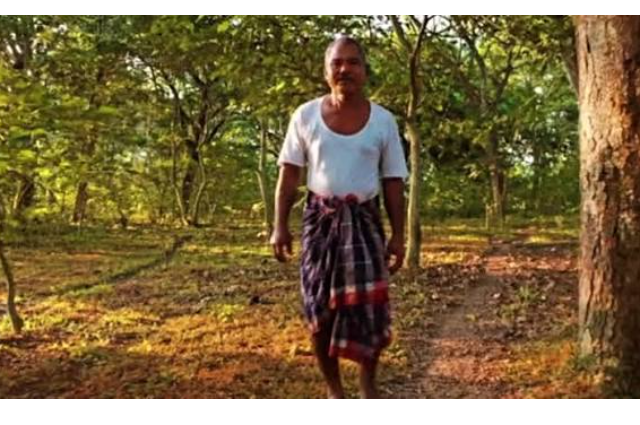
Under the sprawling tree Canopy, something else happened that nobody planned at all — an entire food chain just showed up. Bengal tigers. Indian rhinoceroses. Over a hundred deer and rabbits. Monkeys. More than 300 recorded bird species, including, notably, vultures, which is a bigger deal than it sounds. South Asia's vulture population in the past decade has fallen so drastically that being given Diclofenac (an animal painkiller) is lethal to the scavenging birds, as when they consume carrion, they die. These birds are very picky in nature. They are not birds that nest just anywhere. That they have landed here shows you how far this ecosystem has truly evolved.
And the tigers — that's the one that really stops people. Apex predators need an entire functioning food web beneath them to survive: enough deer, enough prey, enough range. A forest that can support a Bengal tiger isn't just "green." It's mature. Complete. The kind of ecosystem nature usually takes generations to build on its own, sitting on land that was empty sand within living memory.
But here's the part that matters most to the people who actually live on Majuli — and it's got nothing to do with tigers or rhinos. It's about the ground itself, which has been quietly vanishing for over a hundred years.
The island has been losing about 6.42 square kilometres a year, which, if you try to picture it, is something like 900 football fields disappearing into the river annually, every single year, gone for good. Scientists have actually warned that without intervention, the whole island could eventually go under. The government has sanctioned ₹2,500 crore toward saving it, and engineers have been trying for decades — concrete embankments, sediment control, all of it.
What has held, for over forty years now, is Jadav's forest. The root systems — bamboo, Bombax ceiba, Dalbergia sissoo, the rest — physically lock the sandy soil in place, season after season, flood after flood. You can actually see it from satellite images: the land around the forest eroding while the sandbar underneath the trees stays put. It's about as clean a before-and-after as ecological restoration gets, and nobody designed the experiment. It just happened because one person refused to stop planting.
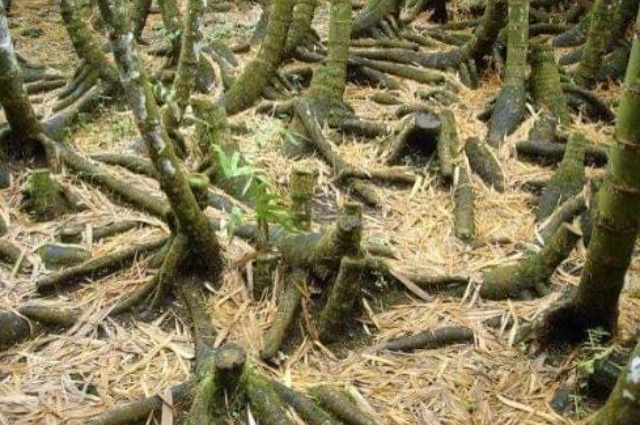
There's academic research on plantation forests in the Brahmaputra floodplains that essentially makes the case for exactly this kind of approach — that forests like this one can protect floodplains, take pressure off natural forests, and even support local livelihoods, which is a funny thing to read honestly, because it's just describing — in much more careful language — what Jadav had already figured out on his own, starting in 1979 with no grant, no department, no one watching.
Recognition, At Last — and What Came With It
As soon as the forest department’s discovery was made known, Jadav’s story travelled fast – first in India through local media outlets, and then around the globe through the media. He inspired the creation of several documentaries, including 'The Molai Forest' (2012) and 'Foresting Life' (2013), and a children’s book about his journey, titled 'Jadav and the Tree Place'.
His theories and methods were presented in some lectures he gave at Los Angeles and the University of Utah. A broadcast of these lectures was nationally shown as a TED Talk. The audience, who had previously dismissed the idea of a single individual stopping deforestation with the same scepticism as they would any fairy tale, found it a life-changing experience.
For his conservation efforts, the Balipara Foundation awarded him the Ecological Restoration Award in 2013.
In 2015, Jadav was presented with India’s prestigious Padma Shri award by the government in recognition of his role in forest conservation, and from there, the whole country became aware of his work. His awards and accolades were not limited to the boundaries of India. He received the Karmayogi Award in New Delhi in 2020, and a Commonwealth Point of Light – a public recognition that honours outstanding volunteers throughout Commonwealth countries - which was presented to him by the UK’s Deputy High Commissioner in Kolkata.
The collective impact of these achievements was a more public acknowledgement: that the world’s institutions, funded and staffed by countless individuals, could learn something from the single, persistent individual’s decade-long contribution.
The success of his efforts, it’s said, is less meaningful to him on a personal level than what it has enabled him to do – to raise the importance of reforestation and promote his methods more broadly on Majuli and beyond.
From One Man's Forest to a Model for Many
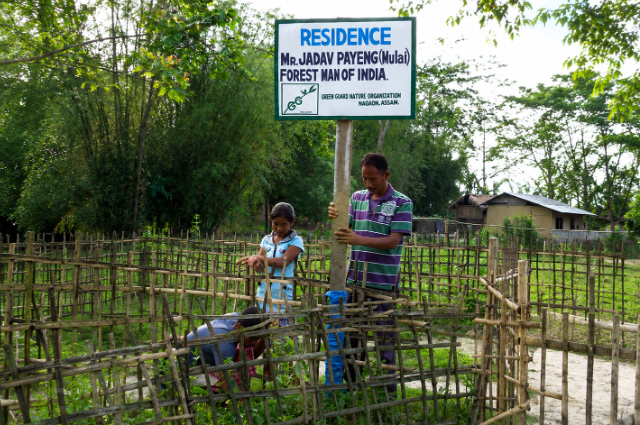
Perhaps one of the most heartening outcomes of Jadav’s journey is what happened afterwards – not just to him but to the principles he laid down. Majuli, like Jadav’s island home, has 33 eroding chaporis (sandbars), and authorities in Assam have now established roughly 745 hectares of new plantations on these, using a strategy clearly based on the model Jadav had established. The fact that this simple proof of concept gave rise to such widespread adoption by a large-scale government agency will likely prove more critical in the long term than any award or documentary.
Even today, in his sixties, Jadav longs to expand – further enlarge the size of the forest across more sandbars on the island, and possibly, if he could, to turn Majuli into a truly verdant paradise.
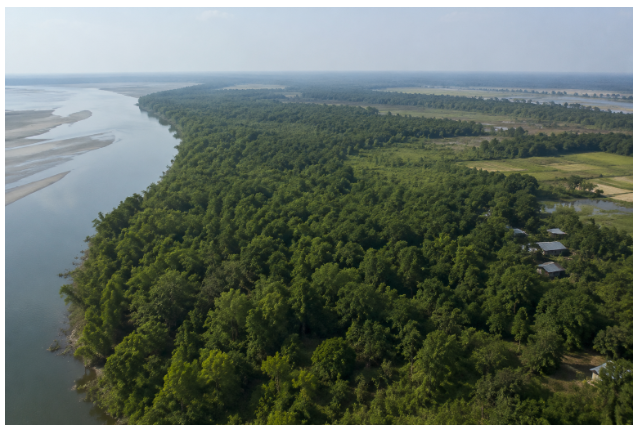
An expanded version of the 1,360-hectare Molai forest, stretching for kilometres along the Brahmaputra, creating an unbroken corridor for wildlife, it's a vision of regeneration far grander than one can imagine today. Now, countless other thousands of communities and persons alike have emulated him in launching their own mass-planting schemes across the various riverine islands of Assam. And the reach of that ripple effect will, in all probability, never even be able to be fully calculated. But we do know that Jadav’s tree planting created a movement.
Why This Story Matters More Than Ever
It might seem obvious to consign Jadav Payeng’s life story to the category of a quaint, feel-good anecdote about a man doing peculiar things. But it is indeed much more than just a feel-good anecdote and is important at a time when the world is contending with ecological problems on a monumental scale. For instance, in countries such as China, a large-scale forest restoration initiative, The Great Green Wall, that was conceived as a massive attempt to arrest desertification across a substantial area of the country, necessitated coordinated efforts involving billions of trees, millions of humans, and sustained government investment over decades.
But on a radically different scale is Jadav Payeng’s forest. It isn’t a project being undertaken with the backing of any national government but rather solely driven by one human being, working with all the time and material at his disposal and fuelled by his deep sense of self-conviction that it mattered. But its effects - restored habitat, carbon sequestration, erosion control, and biodiversity - replicate on a smaller scale the success of such global projects. This story matters as it addresses a ubiquitous mental hurdle when it comes to action against the climate issue: the idea that even individual action is of no significance against a global-scale threat. And Payeng’s story is perhaps living and concrete proof that, under certain circumstances, such efforts, sustained over time, have an impact – the effect of the action becomes of a magnitude that is noticeable to institutions, for they can adapt and grow on it.
But it does state that it does take nothing to effect a change rather, what it does takes ‘something’ which when scaled up, would impact change.
The Lessons Hidden in a Forty-Year Routine
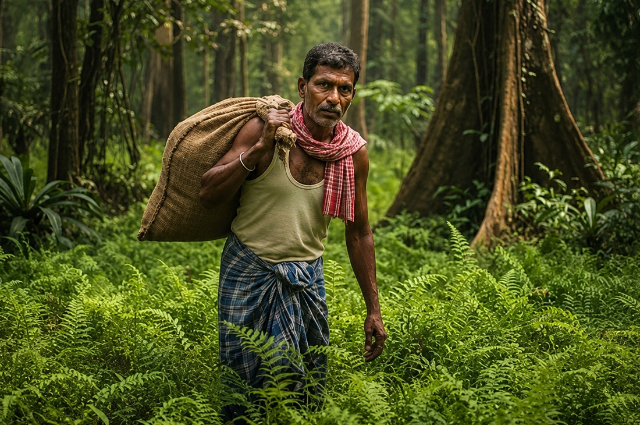
There are a couple of key takeaways from the work of Jadav Payeng that bear emphasis for going against some popular notions of what it takes to effect change:
First, is that he began with absolutely nothing-a cluster of bamboo saplings handed to him by officials in a manner that, it seemed, they did not anticipate would take root. He waited for no optimal conditions, sufficient resources, or expert supervision. He started with what little he was gifted with and adapted with time.
Secondly, he worked with the land and not against it. His decision to pick the bamboo species was no coincidence- it stabilises the loose soil so well, while its growth rate compared to that of other plant species would help it gain hold on the island fast. Only after it started altering the environment was he able to include other varieties of flora. His approach somehow mimics nature’s cycle of ecological transition, where forests are re-established after a disruption over a course of time.
And third, the most difficult to imbibe, probably for most people, the commitment that lasted for over 40 years! There was not even a point when Jadav could view what he was doing on the island as nothing short of the forest as it is now, not for 10 years or maybe 20. The transition from barren sand to fertile ground stretched into time beyond the attention of most individuals, funding cycles, or policy tenures. He continued without pausing, or so he has mentioned, because never was it his intention in the first instance to develop a ‘forest’; rather, it was the ‘more’ diminutive and immediate task of providing some shade for the animals on the desolate island.
A Single Forest, A National Awakening
To limit Jadav Payeng’s tale to a solitary act of singular, though affecting, devotion would be an injustice. In fact, if you step back and view the big picture, you see that Payeng’s forest was not an isolated incident for long. It became, over time, almost an idea that India’s institutions, though belatedly, have started taking notice of.
After all, India ranks ninth in the world in terms of forests, up from the tenth position in the earlier ranking in the Global Forest Resources Assessment 2025 - data from the Food and Agriculture Organisation of the United Nations Organisation- with the country ranking third in the world in net annual gain in its forest cover.
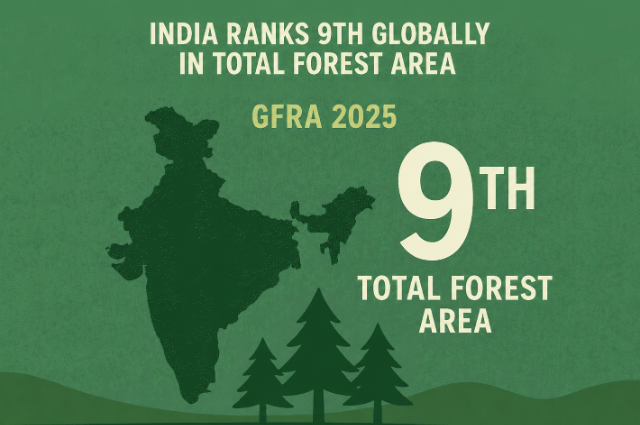
At latest reporting, the combined forest and tree cover for India measures in at 25.17 percent of the country’s total geographical area-an increasing trend, the Ministry of Environment, Forest and Climate Change is working on pushing “northward” with a slew of national projects, the National Mission for a Green India, the Compensatory Afforestation Fund Management and Planning Authority (CAMPA), and the Nagar Van Yojana among them.
Union Budget 2025-26: For a net positive impact (livemint.com) allocated to the Ministry’s budget 3,412.82 crore, a 9% increase over its previous year revised estimate - a subtly positive trend reflecting at the policy level India beginning to view deforestation as infrastructure, akin to roads and hospitals, rather than a noble act.
As told by The Ministry of Environment, Forest and Climate Change and Mongabay India, and other public resources, “India has consistently taken action to increase forest cover through afforestation and other initiatives over the past few years, with significant emphasis placed on this at all levels.” Mongabay
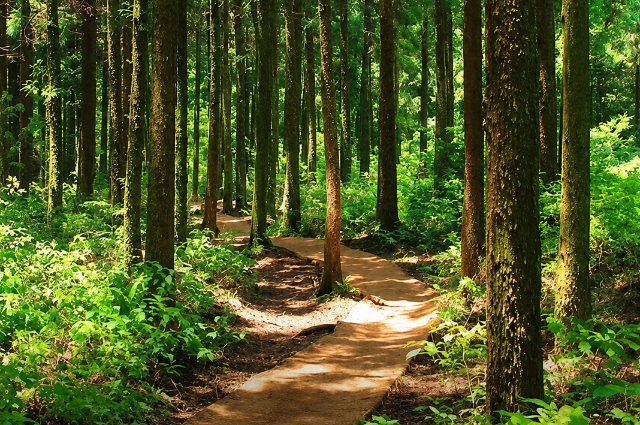
A study in February found that India “now has 2,54,660 square km of tree cover” to complement an expanding forest cover, which “increased by 3.4% to reach 2,11,389 sq km in 2021 compared to 2,03,540 sq km in 2019.”
There have also been some “positive and negative results reported due to the afforestation effort being implemented,” according to a 2022 Forest Survey Report of India. Jadav Payeng: The thing that is worth highlighting, given the long years it took for the state to catch up with Jadav's work: this isn’t just about the number, but what is behind it. India's forest services have embraced remote sensing, GIS mapping technology and drone deployment, using it to help us get a snapshot of what we are trying to grow; several private enterprises have sprung up offering up apps, artificial intelligence based system and even seed drones with clay-coated seeds designed to test survivability of individual saplings in areas inaccessible to human personnel or for steep hills; soil-test kits and moisture sensors ensure our teams know which tree species will thrive in which part of this depleted country-so they don’t just plant blindly; essentially the meticulous planting that Jadav initiated with nothing but his trial and error method, teaching himself which trees worked in which place and in what order, has matured into a full grown industry over recent decades; we use the power of state intervention, funded in large part by taxes on fossil fuel production, to retrace Jadav's steps many times over. Press Institute
Growing Billion Trees What also is noteworthy given Jadav’s years of work: along the drought torn landscapes of the state of Rajasthan, local officials have transformed some 394 square km of Thar desert into green oases using treated wastewater-these small forests retain nearly 40% more water than the surroundings and have transformed 5,000 hectares of desert to a thriving khejri-covered oasis since 2022-; and along the shores of the Gulf of Kutch, vegetation has been added to cut down on wave impact erosion by almost 15% in those fragile areas of the coast; while this is not about a scattering of good efforts at a distance, but about an accumulation, we can now identify an evident pattern at scale-the moment you plant on any land that was either degenerated or vulnerable in some other way with appropriate well chosen plantation, the land is ready to repay you and Jadav, through just himself and nothing else on one small island began a movement 40 years prior with what we now know thanks to remote sensing and government policy-it was possible. Grow Billion Trees
Yet there is also another, less dramatic kind of affirmation to be found in India’s afforestation practices, which increasingly reflect his own instincts. True, well-functioning, ecologically appropriate forests that provide cover for wildlife and add considerable value to the land in terms of carbon sequestration use indigenous species.
Since then, several Indian states have launched native-species-based afforestation initiatives. Kerala has integrated native-species planting into post-flood rebuilding efforts; Telangana’s massive Haritha Haram Programme aims to plant a billion-plus trees; Madhya Pradesh is trying to establish new forests on the banks of rivers and on degraded tracts.
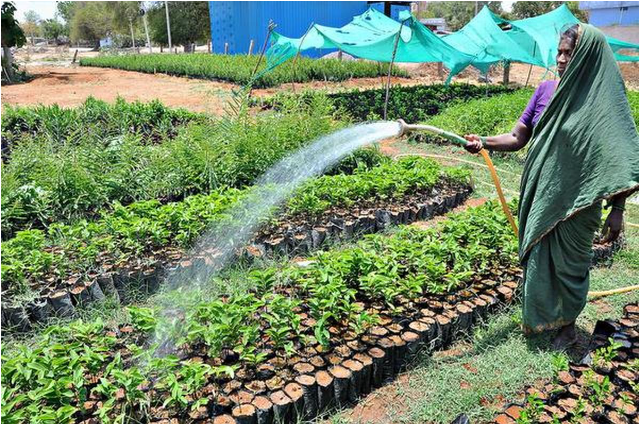
None of them would claim to have been taught by a self-taught farmer on a remote island in the Brahmaputra. But the convergence is certainly striking; the solution that a farmer arrived at by instinct and by necessity, the country’s foresters now appear to be coming to by dint of research and experiment. Earth Island Journal Press Institute. The area is increasing - while it was 6,97,898 sq km in 2010-11, it is now 7,15,342 sq km in 2021-22 – a marginal improvement for a nation as large as India, but progress at a time when the world is losing forests on a massive scale, and most countries’ efforts seem to be going nowhere. Earth Island Journal Press Institute
Jadav Payeng’s forest on Majuli Island is just one small figure in that huge dataset, but it’s perhaps the most accessible one: it’s possible to walk in it, to touch the trees, and feel the air and even understand the story from inside it without having to look at a single satellite image or chart. It’s uncommon in the arena of environmental policy that the work of an individual’s lifetime so perfectly anticipates the general direction a country will take. It’s even more uncommon that such a person had no training, no funds, and, for a long time, no audience at all.
And yet that is what has happened here on a small sandbar of the Brahmaputra River. For over four decades, he planted trees on faith that the land would heal, at least a couple of decades before India’s policy-makers, scientists and planners began (by way of diverse paths) to arrive at the same broad conclusion-that the future of the country will depend, at least in part, on the number of trees its citizens will plant, and the patience with which they will wait for them to grow.
Conclusion: The Forest That Started With a Question
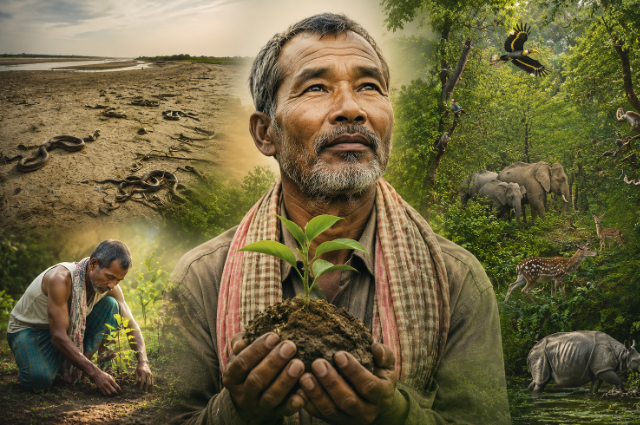
If A Tree Could Talk, the Forest that was born of a question. If there was one photo of Jadav Payeng’s entire life - the one that sums up the entire experience of him and his life’s work - it wouldn’t be of the full-blown 550 hectares of the Molai forest itself, as impressive and life-rich as it now is. No, it would be the very first one of them all - when the young teenager stood alone on that sandbank surrounded by snakes and posed that single, uncomplicated query. Is there no better way for the creatures to spend their last days?
He had no real answer at all in the conventional meaning.
He only had the intention to learn, a determination to get at something through a shot here and there. He was willing to give it forty-six years of his life to do so, and he eventually found his answer: there’s always a way and a person in every lifetime to make a difference – to re-green the most hostile of land on this earth - to transform hell into habitat and in today's context on the biggest environmental problem the world faces - he showed the way by simply choosing to begin.
References & Sources
- Wikipedia. (n.d) Jadav Molai Payeng (Biography). - https://en.wikipedia.org
- Wikipedia. (n.d) Molai Forest (Geographical perspective). - https://en.wikipedia.org
- One Earth. (2024, May 30)” We all are connected”. The Wisdom of Jadav Payeng, India’s Forest Man. - https://www.oneearth.org/
- Thursd.com (2023, November 15). Meet Jadav Payen: The Forest Man of India behind Molai Forest - https://thursd.com
- Interesting Engineering. (2005, March 12) Jadev Payang: The man who planted an entire forest by himself. https://interestingengineering.com
- Grow Billion Trees. (2005, August 31). Jadav Payeng: Forest Man’s legacy of a sustainable future. - https://growbilliontrees.com
- United Nations Development Programme. (2024, November 12). Jadav Payeng’s Molaikathoni. Equator Initiative. https://www.equatorinitiative.org
- Points of Light. (2020, March 5). The Forest Man of India (Commonwealth Point of Light Award Profile). UK Government. https://www.pointsoflight.gov.uk
- Bailaipara Foundation (2013). Ecological Restoration Award records.
- Government of India (2015). Padma Awards Directory
- Recyclobin. (2021, April 30). Jadav Payeng: Molai Forest Man of India. Smart Waste Manager. https://www.recyclobin.com
- Earth Island Journal (2014, December 11). The lone green warrior. https://www.earthisland.org