
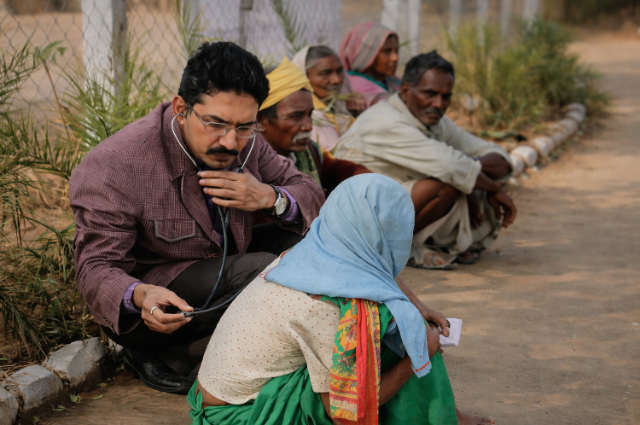
In the remote Melghat region of Amravati district, Maharashtra, where the infant mortality rate once stood at 200 per 1,000 live births which is nearly six times the national average of the mid-1980s, a young doctor named Ravindra Kolhe arrived with little more than an MBBS degree from Nagpur Medical College (1985) and a tattered copy of David Werner’s Where There Is No Doctor. He had spent six months in Mumbai learning to deliver babies without sterile operating theatres, diagnose pneumonia without X-ray machines, and treat diarrhoea with oral rehydration alone. But his most unconventional intervention was not clinical. It was matrimonial. Before leaving for Bairagarh, a village so inaccessible that the nearest road ended 40 kilometres away, Dr. Ravindra listed four conditions for a life partner: she must be willing to walk that entire 40-kilometer distance to reach the village, agree to a court marriage costing exactly five rupees, manage a household on a monthly budget of four hundred rupees, and be prepared to beg if necessary for the welfare of others. Hundreds of women declined. Dr Smita, a practitioner of Ayurveda and Homoeopathy from Nagpur, was the only one who said yes. They married in 1989, and she became the second doctor in a region that had none.
From a systems analysis perspective, these four conditions were not eccentric demands but operational filters for survival in a low-resource setting. The 40-kilometre walk represented a logistical commitment where no ambulance could reach. The five-rupee marriage eliminated the financial ceremony in favour of functional partnership. The four-hundred-rupee monthly budget mirrored the average tribal family’s disposable income at the time, forcing the couple to live exactly as their patients lived. The begging clause was a stress-test of moral alignment, a declaration that no conventional boundary between doctor and patient would be allowed to exist. Dr Smita’s acceptance created a closed-loop healthcare system where both practitioners shared identical risk tolerance, resource constraints, and accountability. This is a rare documented case of personnel selection directly determining public health outcomes in a tribal belt.
The defining moment arrived when their newborn son fell critically ill. Everyone around them advised rushing to a city hospital. But Dr Smita made a decision that would permanently alter the trust equation between the couple and the community. She said, “I will treat my child here, the same way you treat yours.” That single choice eliminated the distance between healer and patient. Until that moment, villagers had seen the Kolhes as educated outsiders performing charity. After that moment, they saw them as family. The data support this inflexion point. Within a decade of that decision, the infant mortality rate in Bairagarh and surrounding areas dropped from 200 per 1,000 live births to 40. The pre-school mortality rate for children aged one to five fell from 400 per 1,000 to 100. These reductions exceed the World Health Organisation’s benchmark for significant community health transformation and are comparable to well-funded district hospital interventions, achieved here with minimal infrastructure and no external funding.
But Dr Ravindra identified that the disease was only the immediate cause of death. The root cause was poverty. He observed that children died of pneumonia, not because antibiotics failed, but because families did not have enough clothes to keep warm in winter. They died of malnutrition, not because food was unavailable, but because once the farming season ended, there was no work and therefore no income. So the couple went beyond medicine. They developed fungus-resistant varieties of seeds suited to Melghat’s unpredictable rainfall. They started farming on small plots to demonstrate techniques. They organised camps to teach local youth about new farming methods and, crucially, about beneficial government schemes that had never reached the region. The result was systematic: an area once notorious for farmer suicides transformed into a suicide-free zone. This represents a rare case of healthcare-led economic regeneration, where clinical metrics and agricultural productivity improved in parallel.
Infrastructure followed trust, not the other way around. When then-PWD Minister Nitin Gadkari visited and offered to build the Kolhes a personal house, Dr Smita declined. Instead, she asked for roads and electricity connectivity. Gadkari kept his promise. Today, Melghat has all-weather roads, reliable electricity, and twelve primary health centres. The couple charged a nominal fee of one rupee for treatment, not as revenue but as a psychological anchor to ensure patients valued the service, and also ran a government ration shop to stabilise food access. Their work has been recognised with the Padma Shri in 2019 and a special Karamveer episode on Kaun Banega Crorepati in 2020. Their story is documented in Melghatavaril Mohracha Gandh by Mrunalini Chitale and Bairagarh by Dr Manohar Naranje.
The clear takeaway is this. Dr Ravindra Kolhe’s four conditions for marriage were not a prelude to his work. They were the work. They functioned as a personnel selection algorithm for extreme rural service, filtering for endurance, financial discipline, and moral symmetry. Dr Smita Kolhe was not merely the only woman who said yes. She was the co-designer of a healthcare system that reduced infant mortality by eighty per cent, eliminated farmer suicides, and brought roads and electricity to one of Maharashtra’s most isolated regions. Her decision to treat her own critically ill child with the same resources available to every tribal mother closed the trust gap that no government hospital could close. For any journal paper examining healthcare delivery in low-resource settings, the lesson is structural: infrastructure does not create trust. Trust creates the demand for infrastructure. And that trust begins not with a building, but with a single binding commitment made by two people under impossible terms. When only one person says yes to those terms, you have not found a spouse. You have found the co-founder of systemic change.
References
- Chitale, M. (2017). Melghatavaril Mohracha Gandh. Pune: Rajhans Prakashan. (Documentary biography of the Kolhe couple in Marathi)
- Naranje, M. (2019). Bairagarh. Nagpur: Vidarbha Sahitya Sangh. (Account of the Kolhes’ work in Melghat)
- Padma Shri Awards (2019). Padma Shri Awardees List – Maharashtra. Government of India, Ministry of Home Affairs. Available at: https://www.padmaawards.gov.in
- Werner, D. (1977). Where There Is No Doctor: A Village Health Care Handbook. Palo Alto: Hesperian Foundation. (The book that inspired Dr Ravindra Kolhe’s mission)
- Sony Pictures Networks India (2020). Kaun Banega Crorepati – Karamveer Special Episode featuring Dr Ravindra and Dr Smita Kolhe. Broadcast on Sony TV, December 2020.
- Government of Maharashtra, Public Works Department (2014–2018). Melghat Road Connectivity and Rural Electrification Reports. Mumbai: PWD Archives. (Documenting infrastructure development following Nitin Gadkari’s intervention)
- International Institute for Population Sciences (IIPS) (1990–2000). National Family Health Survey (NFHS) – Maharashtra State Reports. Mumbai: IIPS. (Reference baseline IMR data for rural Maharashtra)