
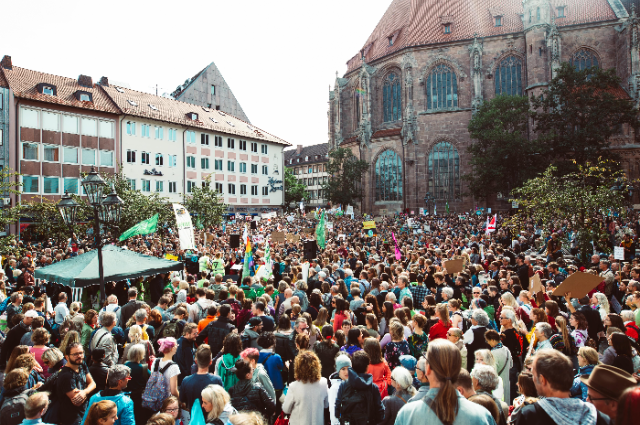
The chants echoing through Trafalgar Square on a late March afternoon were unmistakably American in origin, but the voices carrying them were distinctly European. “No Kings”, a slogan born in the US heartland, rang out alongside Union Jacks and EU flags. Yet the subtext was entirely local: a rejection of war, rising inflation, and the erosion of democratic norms that, protesters argued, no longer stop at the water’s edge.
What began as a domestic resistance to President Donald Trump has evolved into a systemic global realignment. On March 28, an estimated 9 million people participated in the third “No Kings” protest across all 50 US states and 16 other countries, according to data compiled by the Crowd Counting Consortium and independent election monitors. This made it the largest single-day mobilisation in American history. But the story is no longer just about the United States. It is about how one nation’s internal governance crisis has become a transnational liability, forcing allies to protest not in solidarity but in self-defence.
To understand the shift from isolated incident to durable infrastructure, examine the numbers. The protest movement has grown with mathematical precision: 5 million in June 2025, 7 million in October, and now 9 million. This is not a spontaneous burst of anger but a structured, scaling coalition. Over 3,300 rallies occurred simultaneously, coordinated by groups including Indivisible, MoveOn, and the grassroots network 50501, which specialises in state-level organisation. Crucially, the geographic footprint has changed. While US protests dominate headlines, the internationalisation of the movement is its defining feature. Cities including Paris, Berlin, Rome, Amsterdam, Athens, and Sydney hosted major demonstrations. In Madrid, protesters filled Plaza de Cibeles holding signs reading “El poder es del pueblo” power belongs to the people. In London, organisers rebranded the event as “No Tyrants” out of respect for local constitutional norms surrounding the monarchy, while maintaining the sharp edge of the critique against executive overreach.
European discontent is rooted in three systemic shifts triggered by the current US administration. The most immediate catalyst is the US military conflict with Iran, initiated in late February. While the White House framed it as “regime change,” European protesters see it as an economic and moral threat. Oil prices have spiked globally, directly impacting fuel costs in Madrid and heating bills in London. According to the International Energy Agency, crude prices rose 23 per cent in the first three weeks of the conflict, adding an estimated €450 annually to the average European household’s energy bill. The war has also killed hundreds of Iranian civilians, including over 200 children, per preliminary UN reports. For Europeans living in the shadow of the Ukraine war, the prospect of a wider Middle East conflict is unacceptable. Banners in Barcelona specifically condemned civilian casualties, linking them directly to Trump’s emergency powers.
The second driver is legal. In Berlin, one of the most circulated signs read “Führerprinzip”, a loaded reference to Nazi ideology, equating the president’s consolidation of power with historical authoritarianism. Hyperbole aside, the concern reflects real data. Trump signed over 220 executive orders in 2025 alone, a rate four times higher than his first term, according to the Federal Register. More significantly, he invoked the National Emergencies Act on 11 separate occasions last year, more than any previous president in a single term. For Germany, a nation built on checks and balances, the US president’s ability to bypass Congress via emergency declarations is no longer an abstract worry. It directly threatens the stability of the Western alliance when allies cannot predict which executive orders will reshape trade, defence, or treaty obligations overnight.
The third driver is economic contagion. US tariffs and the freezing of foreign aid have ripple effects that hit European markets within weeks. In Brussels, separate protests erupted against the US embargo on Cuba, but the underlying logic is the same: American unilateralism disrupts global supply chains. The European Central Bank estimated in February that Trump’s tariff policies reduced eurozone GDP growth by 0.4 percentage points in the fourth quarter of 2025 alone. In Amsterdam, “No Kings” protesters held a banner asking, “What is wrong with America?” a question born not of curiosity but of frustration that US domestic chaos directly raises the cost of living abroad.
The internationalisation of this movement matters because it dismantles the West’s traditional double standard. For decades, the US and Europe positioned themselves as the arbiters of democratic norms. Now, Europeans are marching against Washington’s backsliding. This is a form of political contagion rarely seen since the Vietnam War era, but with a critical difference. During Vietnam, European protests were moral statements against a specific war. Today’s protests are systemic critiques of governance itself — the war, the executive orders, the tariffs, and the democratic erosion are treated as a single linked crisis. When citizens in Sydney hold signs saying “We can’t stand him either,” it signifies that US leadership is no longer viewed as a public good. It has become a global problem requiring a grassroots solution.
The White House dismissed the crowds as a symptom of “Trump Derangement Syndrome,” a phrase repeated by press secretary Karoline Leavitt in an April 1 briefing. Yet when 9 million people, including hundreds of thousands in the streets of America’s closest allies, take coordinated action across three continents, it ceases to be a political sideshow. It becomes a structural referendum on the durability of the transatlantic partnership.
The era of relying on American institutional stability is over. The protests outside the US embassies in London, Madrid, and Barcelona are not merely about saving America from itself. They are about insulating the rest of the world from the fallout. For European policymakers, the takeaway is clear: when opposition to a US president becomes an international movement, allies must build parallel systems for trade, for defence, and for democratic accountability that do not depend on the temperament of any single leader. The crowds are not going home. And that, more than any slogan, is what matters.
References
- Karnowski, S. (2026, March 28). Minnesota serves as the flagship for nationwide ‘No Kings’ protests against Trump. Associated Press.
- ‘No Kings’ protests: Record 9 million Americans rally across 50 states. (2026, March 28). Daily Jang.
- 'No Kings’ rally organisers expect record-breaking turnout nationwide. (2026, March 28). ABC15 Arizona.
- Federal Register. (2025). Executive Orders - Donald J. Trump (2025). Office of the Federal Register, National Archives and Records Administration.
- Trump’s second-term executive orders exceed first-term total. (2025, December 17). Central News Agency (CNA).
- Global Witness. (2026, March 9). The true price of the Iran war for oil, people and the environment. Global Witness.
- Trump’s war with Iran sends shockwaves through the global economy and security. (2026, March 11). Annahar.
- McHugh, D. (2025, September 30). Europe’s top central banker says economy resilient despite Trump tariffs. Associated Press / Investment Executive.
- Europe’s top central banker says economy holding up better than expected in the face of Trump tariffs. (2025, October 7). Associated Press / Barchart.
- Federal Register. (2025). Proclamations - Donald J. Trump (2025). Office of the Federal Register, National Archives and Records Administration.