
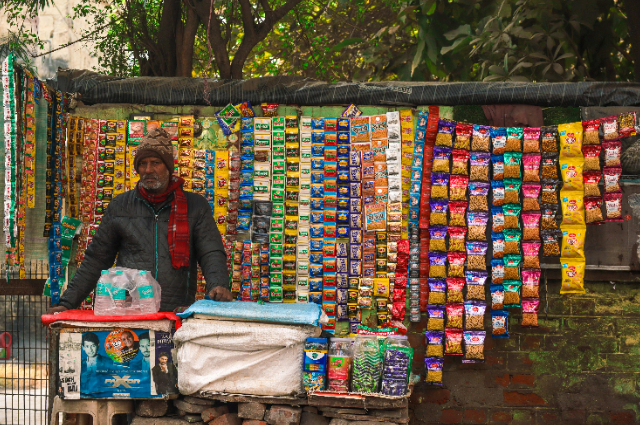
According to the government's own Household Consumption and Expenditure Survey (HCES) 2023-24, rural Indian families direct only about 2.5% of their total spending toward schooling. Tobacco products receive nearly 4%. Gutka, a cheap smokeless mixture, now constitutes 41% of all rural tobacco expenditure, making it the most valuable tobacco commodity in the countryside. For every ₹100 the exchequer earns from tobacco taxes, society bears an estimated ₹816 in healthcare costs, lost wages, and early deaths. The Ministry of Health and Family Welfare attributes 1.3 million annual fatalities to tobacco use. And yet, public conversation frames this as a collection of individual bad habits rather than a systems failure. The evidence suggests otherwise. This is a crisis woven from weak enforcement, concentrated poverty, and competing household priorities and it is deepening each year.
The gutka market has transformed dramatically over a single decade. Between the 2011-12 consumption survey and the 2023-24 round, the proportion of rural households using gutka climbed from 5.3% to 30.4%, a nearly sixfold jump. Geographically, the habit clusters in the central belt: Madhya Pradesh, Uttar Pradesh, Bihar, Chhattisgarh and Rajasthan. In rural Madhya Pradesh, more than six out of every ten homes consume gutka. Uttar Pradesh has crossed the 50% threshold. Meanwhile, inflation-adjusted per capita tobacco spending rose 58% in rural areas and 77% in cities. The share of rural households using any tobacco product expanded from 59.3% (99 million households) to 68.6% (133 million households) , a net addition of 34 million tobacco-consuming families in just over ten years. These are not merely older users persisting with long-standing habits. They represent new uptake, younger households, and deeper normalisation.
The poorest segments of society carry the heaviest load. Across rural India, over 70% of families in the bottom 40% of the income ladder consume tobacco. In Uttar Pradesh, Madhya Pradesh and Bihar, that figure exceeds 85%. Lower-income rural households devote 1.7% of their total spending to tobacco, compared to 1.2% among the wealthiest quintile. This gap, though narrow in percentage terms, translates into real deprivation. A tobacco user from a poor family who redirected that expenditure toward food could add more than 500 calories to the daily meals of one or two children. For households already struggling to eat twice a day, that is not a marginal gain. It is a lifeline.
To understand why this substitution rarely happens, consider the daily reality of an informal labourer or migrant worker. A ₹5 gutka sachet serves two immediate purposes. First, it provides a fleeting escape after hours of physical drudgery. Second, and more critically, it suppresses hunger. When a worker cannot afford three square meals, gutka becomes a functional tool, a chemical shortcut to enduring a long shift. Cultural norms reinforce this economic logic. Gutka features in wedding celebrations, religious offerings, and casual social exchanges. Deep-rooted myths hold that it eases digestion, refreshes the mouth, relieves dental pain, and reduces stress. These are not eccentric beliefs held by a few. There are widespread convictions that guide daily behaviour.
The regulatory history reads as a masterclass in avoidance. India banned gutka in 2012. Within months, manufacturers introduced a two-pouch workaround: one containing pan masala, the other plain tobacco, sold together as a bundle. End users mix the contents themselves. The Supreme Court flagged this evasion as early as 2016, noting that it defeated the ban's intent. Nearly a decade later, the twin pouches remain on display at every village shop. This is not a legal grey area. It is a deliberate end-run enforced by nobody.
Public health researchers have long argued that tobacco deepens poverty by pulling money away from nourishment, medical care, and schooling. The HCES data reveal an even more troubling pattern: as household incomes rise, families do not shift expenditure away from tobacco toward healthier goods. Nutrition programmes and anti-tobacco campaigns operate in separate bureaucratic silos, neither addressing the real competition for limited rupees inside a poor family's budget. A perverse incentive completes the trap. Government-supported healthcare lowers the out-of-pocket cost of falling sick. For a family already choosing between addiction and survival, that safety net, threadbare and overstretched as it is , removes one reason to quit.
India now spends enormous sums treating tobacco-linked non-communicable diseases: lung cancer, chronic obstructive pulmonary disease, heart conditions, and oral and oesophageal cancers from smokeless products. It collects modest excise revenue from the same products. And it looks away as one-third of rural households, and more than four-fifths of poor households in several states, spend more on gutka than on their children's education. The key numbers are not ambiguous: 1.3 million deaths each year, a 77% rise in urban tobacco spending, a sixfold increase in rural gutka use, and 34 million additional tobacco-consuming households over a decade. Yet no state has declared a public health emergency. No parliamentary committee has demanded answers. The absence of a crisis narrative is itself a policy decision.
Until tobacco expenditure is tracked as a core development indicator, alongside food security, school enrolment, and health access , India will continue to lose its youngest breadwinners at 45. And no one will call it what it is.
References
- Ministry of Statistics and Programme Implementation, Government of India. (2024). Household Consumption and Expenditure Survey (HCES) 2023-24. New Delhi: National Statistical Office.
- Ministry of Health and Family Welfare, Government of India. (2023). Tobacco-Related Mortality and Disease Burden in India: Annual Report 2022-23. New Delhi: Directorate General of Health Services.
- Supreme Court of India. (2016). Writ Petition (Civil) No. 855 of 2016: State of Uttar Pradesh vs. Union of India. New Delhi: Supreme Court Registry.
- John, R. M., & Sinha, P. (2023). The economic cost of tobacco use in India: An updated estimate for 2021-22. Indian Journal of Public Health, 67(2), 245-251.
- Ministry of Finance, Government of India. (2024). Economic Survey 2023-24, Volume 2: Public Health and Taxation. New Delhi: Department of Economic Affairs.