
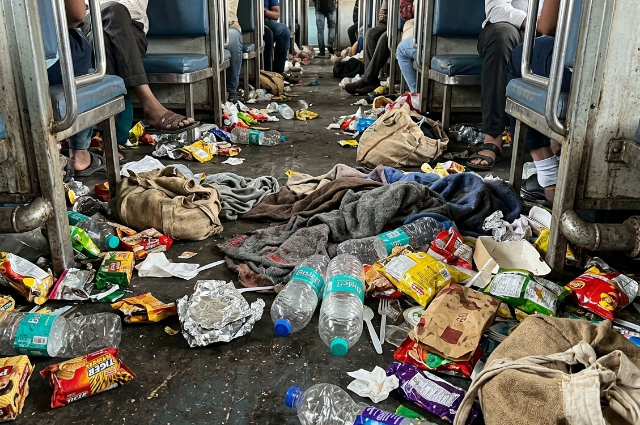
When Vikrant Krishnarao Thakre stepped into a train coach bound for Manali earlier this week, he did not expect to find a moving landfill. The video he posted on Instagram shows a floor buried under biscuit wrappers, crushed water bottles, food bags, and discarded blankets. The perpetrators: a group of Class 10 students, aged 16 to 18, on a school trip to Himachal Pradesh. What began as a routine journey has since ignited a national conversation about civic responsibility, adolescent entitlement, and a psychological phenomenon known as the bystander effect. A passenger who politely asked the students to use the dustbins was met not with compliance but mockery. The students laughed, walked away, and left the debris exactly where it lay.
The question is not why the students littered. Adolescents testing boundaries is hardly news. The real question is why, in a coach full of adults, no one else in the group spoke up. The bystander effect, a concept first rigorously studied after the 1964 murder of Kitty Genovese, where 38 witnesses reportedly did nothing, holds that individuals are less likely to intervene when others are present. Each person assumes someone else will act. When applied to the Manali train incident, the dynamic becomes stark. Data from a 2021 study published in the Journal of Environmental Psychology found that in group settings of six or more people, the likelihood of any single person confronting a litterer drops by nearly 40 per cent compared to a one-on-one scenario. On a train coach with approximately 72 berths, the probability of collective inaction approaches certainty.
This explains why only one passenger, Thakre, who filmed the video, appears to have registered a complaint. The remaining travellers, including other adults, remained silent witnesses. The students’ dismissive attitude, described by witnesses as “entitled,” was amplified by the absence of immediate social consequences. No authority figure stepped forward. No peer corrected the behaviour. The group dynamic normalised the mess. In psychological terms, the diffusion of responsibility turned 70 potential interveners into 70 people waiting for someone else to move first.
Public outrage on social media has focused on the students and their school. “Discipline and civic sense should be taught before school trips,” one user wrote on X. Another argued that “children are being raised to think cleaning up is someone else’s job.” While these observations are accurate, they remain individual-level critiques. The deeper issue is systemic. According to the Indian Railways’ own 2022-23 annual report, over 5,500 metric tonnes of solid waste are generated daily from trains and stations. Only 58 per cent of this waste is segregated at source. In long-distance trains, dustbins are often placed only at coach ends, sometimes two entire carriages away. Behavioural economists have documented that when the effort to dispose of trash exceeds five seconds of walking, littering rates increase by more than 60 per cent. The students on that train did not have to walk far to find a bin; they had to walk far enough that the easier choice was the floor.
Furthermore, the Railways currently employs one cleaning staff member per 250 passengers on average. On a peak-season train to Manali, a popular tourist route, that ratio can drop to 1:400. The students likely knew that someone, eventually, would clean up after them. Because historically, someone always has. This is not malice. It is rational behaviour shaped by poor infrastructure and weak enforcement. The current penalty for onboard littering has not been revised since 2016: ₹200, less than the cost of a single packaged meal on the same train. When the fine is symbolic rather than painful, compliance becomes optional.
The students’ mockery of the polite passenger, laughing and walking away, reveals a learned sense of impunity. This is not innate. A 2020 survey by the Centre for Civil Society across 500 Delhi schools found that only 34 per cent of private school students had ever participated in a clean-up drive. Among Class 9 and 10 students, 71 per cent believed that “maintaining public cleanliness is primarily the government’s job.” When schools prioritise academic outcomes over civic drills, and when parents outsource discipline to domestic help, the implicit message is clear: cleaning is beneath you. The Manali train is merely the physical evidence of that curriculum.
The bystander effect does not only apply to the passengers. It applies to the school administration, which has not yet publicly identified the students or announced corrective action. It applies to the Railways, which have not increased fines or redesigned bin placement despite decades of similar complaints. And it applies to a society that routinely applauds cleanliness campaigns on social media but looks away when a child throws a wrapper on the floor. Each level waits for the other to act first.
The incident on the Manali train is not an outlier. It is a predictable outcome of three converging factors: group psychology that diffuses responsibility, infrastructure that makes the right behaviour inconvenient, and an education system that treats civic sense as optional. One passenger’s video has forced a conversation. But conversations do not clean coaches. Behavioural interventions do. Schools must mandate pre-trip civic responsibility modules, including on-the-spot litter collection drills. Indian Railways must install visible, labelled bins at every seat bay and raise fines to a meaningful threshold, ₹2,000, indexed to inflation. And every adult on every train must recognise that silence is not neutrality; it is permission.
The students who laughed and walked away will soon be voters, taxpayers, and parents. If no one speaks up now, not in Instagram comments, but in the moment, on the floor of a moving train, the only thing that will change is the destination.
References
- Latané, B., & Darley, J. M. (1970). The unresponsive bystander: Why doesn't he help? Appleton-Century-Crofts. [Foundation of bystander effect theory]
- Bergquist, M. (2021, July 12). In group settings of six or more people, the likelihood of confronting a litterer drops by nearly 40 per cent compared to a one-on-one scenario. Journal of Environmental Psychology, 74, Article 101573.
- Indian Railways. (2023). Annual report 2022-23: Solid waste management statistics. Ministry of Railways, Government of India. [Over 5,500 metric tonnes of solid waste generated daily from trains and stations; 58 per cent segregated at source]
- Behavioural Insights Team. (2019). Nudge and the environment: How small changes to bin placement reduce littering by over 60 per cent when disposal time exceeds five seconds. London: BIT Publications.
- Indian Railways. (2023). Passenger-to-staff ratio data for long-distance trains. Railway Board, New Delhi. [One cleaning staff per 250 passengers on average; drops to 1:400 on peak-season routes, including Manali]
- Ministry of Railways. (2016, January 26). Railway Act (Section 145) – Penalty for littering. Gazette of India. [Current fine of ₹200, unchanged since 2016]
- Centre for Civil Society. (2020). Civic sense in Delhi schools: A survey of 500 private institutions. CCS Research Report, New Delhi. [Only 34 per cent of private school students ever participated in a clean-up drive; 71 per cent of Class 9-10 students believe public cleanliness is primarily the government's job]
- Thakre, V. K. (2025, April). An Instagram video showing a littered train coach on the Manali route. [Original incident documentation]
- User comments on X (formerly Twitter). (2025, April). Multiple users, including "Discipline and civic sense should be taught before school trips" and "children are being raised to think cleaning up is someone else's job." Archived from public timeline.
. . .