
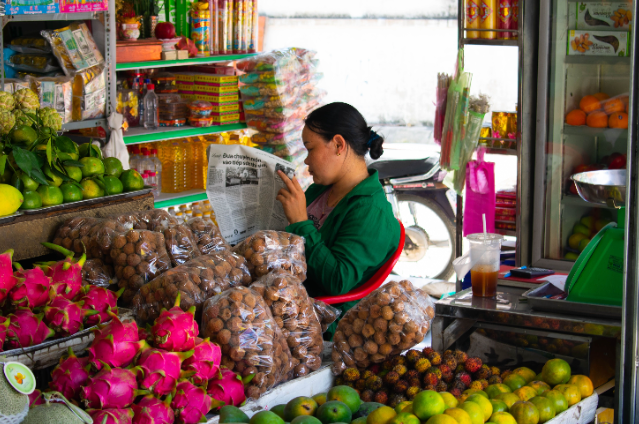
For much of her childhood, Somsri watched her mother count coins from a basket of vegetables sold at the local market, each day’s earnings barely enough to buy rice for the evening. When her father’s drinking debts swallowed what little they had, Somsri, then seventeen, made a calculation that would shape her life. A neighbour returning from Pattaya wore gold earrings and spoke of monthly sums that could buy a buffalo, fix a roof, pay a sister’s school fees. Within a month, Somsri had left her village in Thailand’s northern hills for the neon-lit bars of a tourist town. That was twelve years ago. Today, she owns a small grocery shop and sends her own daughter to university. She has not worked in the sex industry for six years. “It was never supposed to be forever,” she says, stirring tea behind her counter. “It was a ladder. You climb, and then you leave.”
Somsri’s story is remarkably common in Thailand, a country where the sex industry has long occupied a strange and uncomfortable place in the national economy. Though technically illegal, sex work is widely tolerated, operating in a legal grey zone that allows it to flourish without offering workers formal protections. For countless women from the impoverished rural provinces of Isaan and the north, that grey space has become a temporary but rational economic strategy—a way to convert time and bodily autonomy into capital that can later purchase a different life.
The raw arithmetic is brutal and persuasive. A factory worker or hotel maid in Thailand might earn between 300 and 500 baht per day—roughly nine to fifteen US dollars. In the same number of hours, sex work can generate several times that amount. When your family’s rice field floods for the third year in a row, when your mother needs surgery, when your younger brother has just passed the entrance exam for a good school in Bangkok, that differential stops being abstract. It becomes survival. Researchers have long documented that the primary driver of sex work in Thailand is not vice or coercion alone, but the quiet desperation of rural poverty combined with a deeply ingrained cultural sense of filial duty. Daughters, in particular, are expected to support parents and siblings. For those without higher education or marketable skills, sex work can feel less like a moral choice and more like the only working option that pays enough to fulfil that obligation.
Yet what outsiders often miss is the temporality embedded in this calculation. Many Thai women enter the industry with a clear, concrete goal in mind: build a house for their parents, pay off a family debt, save enough for a small plot of land, fund a sibling’s education. The work is rarely seen as a career or identity. It is a bridge. In villages across the northeast, it is not uncommon to meet former sex workers who now run convenience stores, restaurants, or tailoring shops. They speak openly, if quietly, about the years they spent in Pattaya, Phuket, or Bangkok. The shame that outsiders assume is often more muted locally, particularly in regions where the industry has become economically normalised over generations.
This normalisation has deep historical roots. Thailand’s modern sex industry ballooned during the Vietnam War, when the country served as a “rest and recreation” destination for hundreds of thousands of American soldiers. That era established infrastructure, networks, and a certain economic logic that never fully disappeared. Today, recruitment networks in poor villages continue to operate, sometimes with misleading promises about waitressing or massage work, but often with a strange transparency: everyone knows where the money comes from. The stigma, while real at the national level, can be weaker in communities where so many families have a daughter, aunt, or cousin who spent time “working in the South.”
The industry is far from homogeneous. It includes cisgender women, transgender women—particularly kathoey who face severe employment discrimination elsewhere—and migrants from neighbouring countries. Not everyone exercises genuine agency. Trafficking, debt bondage, and outright coercion are real and dark underbellies. But for a significant number of Thai women, the calculation is more nuanced. They navigate a spectrum of choice that is neither full freedom nor total captivity. They borrow from families of origin, pay off loans, remit money home, and save aggressively with an exit date in mind.
Critics argue that any toleration of sex work is a failure of the state to provide real economic alternatives. Proponents of decriminalisation note that driving the industry further underground only removes what little bargaining power workers have. Thailand’s current ambiguity—illegal but tolerated—leaves women without labour protections, healthcare access, or legal recourse against exploitation. Many former workers say they would never recommend the work to their own daughters, but they also refuse to moralise about those who choose it. “I am not ashamed,” Somsri says. “I am ashamed of a country that gave me no other door. But I walked through that door, I got what I needed, and I left. That is my story, and I am the one who wrote the ending.”
The ending is what matters. Ask almost any woman who has left the industry why she entered, and she will not talk about freedom or desire. She will talk about a sister’s tuition, a mother’s hospital bill, and a roof that did not leak. And she will talk about the year she finally stopped counting baht in a bar and started counting them in a shop of her own. For millions of Thai women, sex work is not a destiny. It is a detour. And detours, by definition, are temporary.
References
- Oxfam Policy & Practice. (2026). Commercial sex and the single girl: women's empowerment through economic development in Thailand.
- University of Michigan. Rethinking the Sex Industry: Thailand's Sex Workers, the State, and Changing Cultures of Consumption.
- Bangkok Post. (2017, February 26). No sex, please, we're Thai. Annotation: This report provides direct historical evidence for the article’s claims about the Vietnam War era, noting that 500 American soldiers first arrived in Pattaya for "rest and recreation" (R&R) in 1959, which catalysed the modern industry. It also documents the legal hypocrisy, quoting a police superintendent who insisted, "There is no such thing as prostitution in Pattaya".
- *The Advocate. (2024, November 14). Is equality on the horizon for Thailand's transgender community?.· Annotation: This source supports the article’s mention of transgender women (kathoey) in the industry, explaining that working in Go-Go bars allows them to earn a respectable income and express their gender identity—opportunities often denied in mainstream employment due to legal and social discrimination.
- The Borgen Project. (2025, August 14). Borders and Survival: Migrant Sex Workers in Thailand. · Annotation: This report confirms the "legal grey zone" described in the article, noting that while prostitution is illegal under the 1996 Prevention and Suppression of Prostitution Act, enforcement is inconsistent. It also provides data on migrant workers and the risks they face, including police corruption and health discrimination.
- University of Sussex & Mahidol University. Thai partnerships with Westerners.: Annotation: This research project supports the article’s concept of sex work as a "temporary" strategy, finding that for some Thai women, establishing a partnership with a Westerner is viewed as the most likely route out of poverty and the sex trade.
- Askew, M. (1998). City of Women, City of Foreign Men: Working Spaces and Re-Working Identities Among Female Sex Workers in Bangkok's Tourist Zone.Annotation: This academic study supports the article’s nuanced portrayal of "choice" and motivation. It notes that while poverty is a factor, many women also enter the industry following relationship breakdowns or a desire to escape domestic circumstances, often viewing the work as a temporary "adventure" or act of gangrachot chiwit (spitting one’s life).
- Wikipedia. Child prostitution in Thailand. · Annotation: This entry corroborates the historical timeline of the Vietnam War’s impact, citing that an estimated 20,000 prostitutes worked in Thailand in 1957, a number which rose to 400,000 by 1964 with the influx of US troops, providing numerical context to the industry’s expansion.
- International Labour Organisation (ILO). Employment prospects for LGBT persons in Thailand. · Annotation: This source directly supports the article’s claim that transgender women face discrimination in mainstream employment, noting that many kathoey enter sex work because they are "unable to get regular jobs," reinforcing the structural inequality argument.