
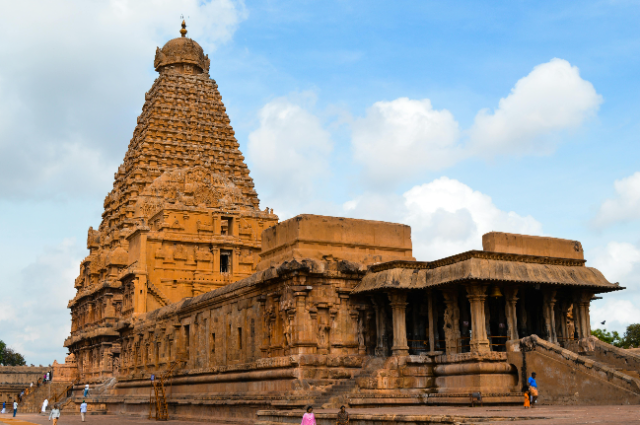
The day begins softly in Thanjavur.
The traffic is still low, no one is out shopping. The Brihadeeswara temple is illuminated with the light of the morning sun, warming it as it has done for at least one thousand years. The light is catching the granite tower of the temple slowly, as if it were built to receive this light very purposefully. If you stand long enough in the courtyard and look up, you may experience something difficult to find words for—something may be beyond admiration or beyond just confusion. As you continue to look at the temple, you will begin to wonder how they built such a temple.
Some places in the world leave modern civilisation feeling embarrassed by its own achievements. It’s not that the places are bigger, taller, or more advanced than what we have; they exist simply because they do. The Brihadeeswara Temple in Thanjavur is one of these places.
Today we have satellites, cranes, laser scanners and engineering software; yet people built this temple over 1,000 years ago without these advancements and still leave engineers and historians at a loss as to how they accomplished this feat.
They didn’t have any of the things we call progressive advancements, but what they were able to accomplish still brings us to searching for answers.
A Temple Born From Imperial Ambition
The construction of the Brihadeeswara Temple, commissioned by Raja Raja Chola I, one of the Chola Empire's most powerful rulers, was completed in 1010 CE in Thanjavur, the capital of the Chola Empire, located in present-day Tamil Nadu. With its completion as the tallest man-made structure in Asia at the time, it served not only as a place of worship but also as a monument demonstrating the Chola Empire's power, piety, and cultural aspirations through the use of stone. More than 1,000 years after its completion, it still stands.
Furthermore, the Brihadeeswara Temple has remained structurally sound without the appearance of a single structural crack, which has led many engineers researching ancient architecture today to question the methods used to construct this invaluable architectural wonder.
The Brihadeeswara Temple was designated as a UNESCO World Heritage Site in 1987; however, it has never stopped being a living temple. Daily religious rituals are still performed at the temple in the same way as they were during the period of the Chola Empire rule. It was never intended to be a monument to the past; it was built to endure.
The Tower That Defies Explanation
The temple's grandest feature is the soaring vimana, which reaches a height of 216 feet from the ground, and this number is not whimsical; it is significant to Vedic cosmology. In Vedic cosmology, 216 represents the cube of six, which is an important number in sacred fallacies, divine names and also in the quantification of syllables of Gayatri Mahamantra. Regardless of whether it was intentional or symbolic, the measurements associated with the temple demonstrate that the architects considered far beyond what was necessary to simply build a stable structure.
Visitors are astounded by the construction of the stupefying number, rather than the actual construction of the tower, which is made up completely of granite blocks without the use of any mortar, cement, or any binding materials. All the stones are interlocked to have a geometric and weight balance; the structure acts as a very large stone puzzle, with gravity being the only component that holds it all together.
The capstone located at the very top of the tower is a large granite stone that weighs an estimated 80 tons; the placing of such a large stone so many miles high more than a millennium ago seems implausible. The most commonly accepted theory of how the builders achieved this was by creating a huge ramp on land approximately six and a half kilometres in length and using elephants and people to slowly lift the stone to the top; however, extensive archaeological research has not turned up any evidence of this ramp. The method remains largely unexplained.
Stone From Sixty Kilometres Away
A different issue arises when considering the material selected for the temple. While the Brihadeeswara Temple is mainly made from granite, the nearest granite quarry is over 60 km away from Thanjavur. All blocks needed to be quarried, carried across the land, shaped using iron tools,
and assembled very precisely. Many thousands of tonnes of granite needed to be moved without modern methods of transport (for example, using cranes and/or other machinery to lift), and yet the final result is a perfectly proportioned, balanced, and effortless-looking structure. In addition to all of this, there is an enormous Nandi (sacred bull of Shiva) located in the courtyard between the temple and the main entrance, which is carved out of one piece of stone and is perfectly aligned with the sanctum. The inner chamber of the temple also houses a large Shiva lingam that increases the sense of verticality associated with the temple, thus accentuating the central axis of worship in the building. Every aspect of this complex seems intentional, and nothing appears accidental.
Architecture That Understands the Sun
The temple's orientation shows much more than just its layout.
On the birthday of Raja Raja Chola, sunlight will travel the axis of the temple and enter the sanctum. Accomplishing such an exact alignment requires an acute understanding of the sun's movements through solar systems and an understanding of astronomy. It has also been historically held that the shadow cast from the tower does not spread outside of the base perimeter of the tower itself. While the technicality says that it continues to remain within the temple courtyard during certain times of the day, the illusion itself exemplifies how mathematically accurate the construction of the temple was. Additionally, the temple's temperature appears to have been purposefully engineered so that, in spite of the extremely high heat levels present in Tamil Nadu, the internal temperature of the building is significantly lower than the temperature of its surrounding metropolitan areas. The massive amount of granite used to construct the temple, the large size of the courtyard surrounding the temple, as well as the surrounding moat-like appearance, create an ideal airflow and temperature environment. The building does not use any electrical power or air conditioners, yet continues to perform adequately after over one thousand years.
When Stone Becomes Sound
The temple was created to please the senses of sight and sound. Inside the mandapam halls, the arrangement of the pillars and walls creates special acoustic effects, allowing certain frequencies of Carnatic music to reach louder volumes by travelling through the geometric form of the stone itself as it resonates at certain frequencies. Musicians who perform there often say that the architecture appears to respond to certain notes they play. The temple's tower has much mystery, as it contains a hollowed-out interior with many winding passageways that are still unreachable today. The purpose of these spaces is still a point of debate among historians and archaeologists today. Are they structural? Ritual? Symbolic? No one knows for sure.
What the Walls Remember
The intricate design of the temple evokes a sense of awe as the wall inscriptions keep an accurate record of both the temple's past as well as that of people who were connected to the temple.
Over 100 inscriptions were made by carving into the stone surfaces of the temple and included area Administrator records, Salary records for temple personnel, and records listing each worker's name, how much weight in gold they donated to the temple, and how much revenue was generated from
the temples located throughout the Chola Empire (including the area of present-day Sri Lanka). There were at least 400 dancers, musicians and priests who worked for the temple, providing it with a vibrant cultural element, not just a place of worship, as well. Raja Raja Chola is listed in one of the temple carvings as donating an amount equal to the weight of his body in gold to the temple.
In the 1930s, another of the temple's "secrets" came to light when historians discovered the murals painted during the Chola period beneath the later Nayaka period murals. Some of the murals had stylistic elements very similar to the elements found in Persian and Central Asian cultures, and historians do not have a complete understanding of why these stylistic elements exist or how they were historically used in the creation of the initiation murals.
The Question That Remains
Before the Brihadeeswara Temple, one is filled not only with awe, but also with humility.
This massive structure was built with no modern-day methods, no machines, no reinforcing steel or concrete, no computers or digital architecture. Yet this magnificent structure remains one of mankind’s most enduring architectural marvels. It has remained together solely through gravitational and geometric force, and the halls continue to reverberate with the sounds of music, the walls continue to tell their tales, and the ceremonies continue, as if time has simply found a way to navigate around it. Ultimately, it is impossible not to notice the lack of modern technology and how we are incapable of creating something so impressive today.
That’s not just a fact in history; that’s a challenge we have yet to resolve.
REFERENCES:
- https://www.tamilnadutourism.tn.gov.in
- https://www.incredibleindia.gov.in
- https://www.britannica.com
- https://www.godscollections.org