
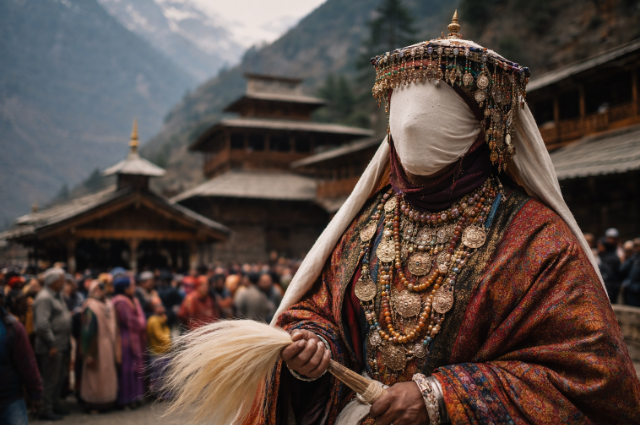
In Kinnaur's lofty Himalayan valleys, the land shapes how people live in harmony with nature, creating a surreal cosmology called the Raulane Festival. It’s a cultural event that has been happening for generations in Kalpa and neighbouring villages
based on seasonal cycles between winter and spring that connect ecology to memory and belief systems. Recently, the Raulane has gained exposure through social media, partly due to its artistry and intriguing aesthetic, but these postings don’t convey the full significance of what the festival represents. Raulane is not a show put on for a paying audience; it is about creating a sacred relationship between the seen and unseen.
Hyperlocal Cosmology
An underappreciated component of Raulane's spiritual structure is that it is hyper-local in nature. Saunis, the spirits associated with Raulane, do not belong to a larger Hindu pantheon; they are rather tied to the geography of their specific area and the area of Kinnaur's ecology.
At its essence, the Raulane Festival is an expression of thanks. Kinnauri oral traditions hold that celestial beings, known as Saunis, come down from high-altitude meadows to protect villagers, livestock, and homes during the harsh winter months. As spring approaches, communities come together in a ceremonial farewell to the Saunis. To dismiss the festival as mythology does a disservice to its rich meaning.
Anthropologically, Raulane can be thought of as an example of ritual ecology, a belief system that arises from environmental realities. Due to extreme conditions in the Kinnaur region, survival typically required cooperative, resource-preserving behaviours and confidence in powers outside of human control. Thus, the Saunis are not simply spirits but are the symbolic manifestations of the protection, seasonal transitions, and uncertainty of the environment.
The timing of Raulane between Holi and the end of winter further enhances the significance of the festival. Raulane becomes a liminal period: neither winter nor spring, neither fear nor relief, but instead a transitional experience between the two.
THE ‘MARRIAGE’
An interesting element of the festival that tends to be misunderstood is the relationship between the Raula (male) and the Raulane (female). Both roles are performed by men. The Raulane is dressed in elaborate traditional clothing and adorned with many pieces of jewellery from his ancestors, representing the feminine divine being embodied in human form. This is not an attempt to be feminine, nor an attempt to create theatrical effects, but rather an example of a ritual transformation in which one’s identity has temporarily been transcended. The Raulane figure becomes a vessel for spirituality and for cultural memories (multiple). The antique jewelry which is worn serves to document generational continuity, meaning each piece of jewellery has been handed down from one family member to another for centuries and, therefore, functions as an external database of one’s lineage. The body becomes a site of represented memory. In wearing these pieces, there is no written history but rather physically enacted memory.
The Raulane is a manifestation of the Goddess who wears traditional Kinnaur women's clothing (doru, choli, pattu) and heavy traditional family jewellery, while the Raula is the representation of the God. The joining of these two beings cannot be viewed socially, as they are connected on a metaphysical level by forming a bridge between two worlds, one of Earth and one of God. Because of this connection, the conjunction of the Raulane and Raula establishes a mystic transition into another level of reality that really can’t be understood by applying normal societal standards. It brings forth an element of gender fluidity through ritualism. The qualities associated with one gender or another are not based on biology but on symbolism, where gender is merely a disguise used to hold the power of divine energies. The Raulane is not simply "a man dressed as a woman"; he represents the arrival of the feminine divine in the world by acting as a proxy. Raulane displays an ancient, long-held respect for gender fluidity in sacred rituals and practices.
Silence, Masks, and the Power of Absence
Festivals can take place with identity being suspended intentionally. The Raula and Raulane at the festival are completely covered and participate in the ritual without
speaking or being seen by anyone else. There are also very strong cultural prohibitions throughout the community against individuals seeing the faces of the Raula and Raulane. Silence represents a connection with the divine in many different ritualistic ways. The simple act of speaking has its connection with humanity, while that of being silent has its connection with the divine. When you take away someone's voice and identity, they no longer exist individually but exist as a being in between the two, visible and invisible, known as a threshold being. By denying voice and the individuality of the participants, he or she ceases to exist in terms of being a normal human with identity and instead exists within a liminal space or a place between the human realm and spirit realm. When a person is concealed, he or she transforms into an unthinkable level of being and this reinforces the notion that the sacred cannot be contained fully through the actions of an individual observing it directly. In modern society, we are consistently looking for ways to value things by way of visibility and using ways of documenting them. Therefore, this type of activity exists in contradistinction to valuing things through visibility.
Tourism vs. Sacredness
In 2025 and 2026, the desire for Raulane grew rapidly, thanks to viral video postings which highlighted its hauntingly beautiful visuals. Although this pandemic has drawn international attention to the area and enhanced its economy, it has also created tensions between local communities and outsiders.
Examples of concerns expressed by local people include:
- Intrusive photography (especially attempts to photograph faces behind masks). - Disrespectful behaviour when preparing for a ritual.
- Sacred rituals reduced to the status of "content".
As these boundaries are slowly being pronounced less, the increase in tourism introduces lifestyle behaviours which challenge the integrity of the ritual by: - People trying to capture "forbidden" moments on camera
- Entering into private space/areas where ritual participants are preparing (backstage)
- Treating the festival as a public interactive space as opposed to one that has a sacred nature.
Individually, these actions may be perceived as being minor. As a collective, however, the cumulative effect of these activities is to alter the ambience of the festival and convert it from reverence to performance. In this way, what was originally considered to be a closed ritual with (or for) the community, is now being altered consciously and unconsciously by the presence of an audience.
Raulane continues its efforts to resist being fully integrated into this cycle of deterioration, due to its formation from oral tradition, its insistence on secrecy, and its
close connection with the physical land. Because of these aspects of Raulane, it is difficult for the festival to completely lose touch with its roots (symbolically). As such, the community's efforts to maintain boundary lines, both social and physical are intended to provide an understanding that the preservation of a tradition is not about preserving a unique or frozen tradition, but about maintaining control over the meaning of the tradition. In this sense, Raulane is caught in a delicate balance between the pull to be visible as a ritual in the new age and remaining rooted in its founding purpose. The community has not categorically rejected external views; in fact, it has adopted a strategy of creating balance between being open to outsiders while also establishing boundaries. Furthermore, this approach reflects an understanding that preserving an oral tradition does not mean isolating it, but rather requires respect.
A Festival Not Meant For Explanation
The compelling element of the Raulane Festival is not only what it shows as a revealing but also chosen to deliberately hide. It is difficult to interpret this festival since it does not suit any preconceptions that others may have about it, because some traditions cannot be understood from the outside; they require a certain type of interaction that is based on respect, restraint, and an acknowledgement of limits. The idea that documenting, sharing and consuming cultural practices lose their cultural relevancy is challenged by the Raulane Festival. The festival implies that the sacred continues to be preserved through a lack of visual information, through the undisturbed, unexplained, or protected spaces that exist around it. Where silence has replaced formlessness in narratives and where concealing is more important than demonstrating, the true soul of the festival always survives there.
References:
- https://www.hindustantimes.com
- https://timesofindia.indiatimes.com
- https://www.indiatoday.in
- https://historified.in