
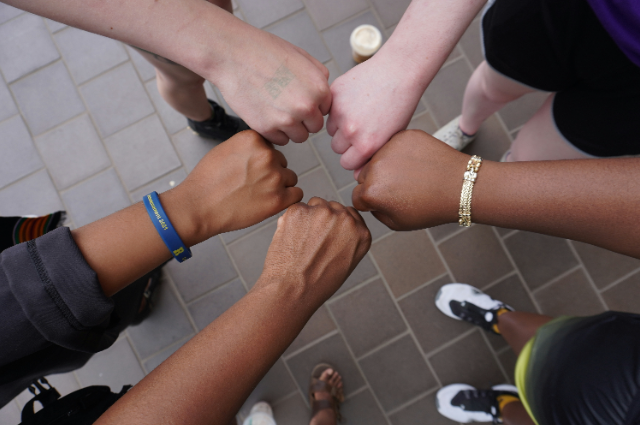
Mera Bharat Mahan, a country where every god found a shelter, where every faith wished to become a part of this holy land. Everything here felt divine; even the soil carried the essence of sacred love. People stood pure at heart, and kindness flowed through their veins. Perhaps this was how even God would describe India. For centuries, this land had been touched by divine beings from different religions, different sources. Their energy and their teachings, together, continued to flow through the spirit of this nation. But somehow, now humans no longer remain truly human. Their hearts began to follow those who preached their own ideas rather than the true ideology of God. Their decisions seemed influenced more by others’ thoughts than by their own conscience.
It started to feel that no single religion alone could make a person enlightened, unless one first chose to be human, to respect brotherhood and to value the bond of neighbourhood. People began fighting to prove the superiority of their religion over others, leaving behind the very teachings they once followed, turning it into a competition. Even young children, who barely understood the world, were seen making jokes about their peers based on religion. Gradually, people were made to feel insecure about their own identity. Religion no longer remained a matter of belief; it started turning into fear and insecurity. In this process, we were slowly losing the true glory of India, almost like a slow poison spreading unnoticed.
People went to such an extent that they shamed each other and even took each other’s lives for their beliefs, for their God, without truly understanding what God really meant. A child, judged by the people around him, was forced to prove his identity, without even knowing why others were being harsh towards him. A woman carrying a baby in her womb was torn apart in the name of religious rage. Did that unborn child even know what religion meant? A family, resting peacefully in their home, harming no one, was locked inside and burned alive just because they followed a particular religion. Did they ever know why their lives were taken away? Women were assaulted, children were killed, people were left injured, losing limbs, losing sight… countless acts of violence unfolded every day and every night. Some happened in silence, some in the open, yet no one dared to stop or question it, because doing so could cost them their own life.
This was not just a feeling; it was becoming a reality supported by what recent studies revealed. In the year 2023, around 32 communal riot incidents were recorded, but by 2024, this number had risen to nearly 59, showing a sharp increase of about 84 per cent within just one year. During these clashes, lives were lost, each representing a story that ended without reason. These figures were not just numbers from a report, but reflections of a society slowly drifting away from harmony. These incidents mostly emerged from actions that hurt the beliefs or values of individuals or communities, often driven by an urge to prove dominance and superiority. Many such conflicts did not begin suddenly; they grew silently over a period of time and then burst out one day in a moment of sudden impulse. Like a chain of matchsticks, one spark lit another, spreading uncontrollably. The fire that burned, destroying both itself and others, often did not truly belong to those carrying it, but was ignited and driven by someone else’s influence.
Many of these incidents did not even carry a valid reason; they were driven purely by hatred. A hatred towards a religion, based on the belief that someone from that community had done something somewhere, creating a fear that if not suppressed, the same would happen again. With such thoughts, such ideologies and such ways of justification, people began to defend inhuman actions in the name of religion, in the name of God. These actions eventually started creating invisible boundaries around us, where humanity, empathy, kindness and even help began to depend on the verification of religious identity. When compassion became limited to certain groups based on belief, was that truly kindness? Did that really bring one closer to God?
This will slowly break the religious harmony, nation like India where people follow many religions by their own choice while living side by side in the same streets and homes. There should never come a day when people lose their peace of sleep out of fear of each other. No one should ever feel unsafe in the presence of another.
Is religion greater than humanity? Does reaching the divine truly require the cost of our humanity? Perhaps, an atheist who shows empathy towards the very creation of God stands closer to the divine than someone who holds deep knowledge of scriptures but lacks kindness in their actions. What is the use of drinking gallons of divine nectar if one cannot absorb even a single drop of its essence? There should arise a sense of harmony among us that goes beyond religion, race, caste and creed, where every individual we pass feels warmth rather than fear. The religion we follow should inspire others to willingly understand us, to step into our homes, and to see our way of life with respect. It should reflect a life that values others’ choices, not one that makes people feel afraid in our presence.