
When parents teach moral values to their children, they hope that those values persist for generations to come. This is how India’s rich culture, traditions, and practices still exist despite the enormous changes happening around the world. Among these, ancestral professions hold a significant place. Several handicraft artisans, weavers, and other artists currently in India have acquired these skills from their forefathers. This has preserved cultural identities, especially at times when rapid industrialisation threatens to wipe out the need for a profession altogether. The willingness of the younger generations to pursue these professions also matters.
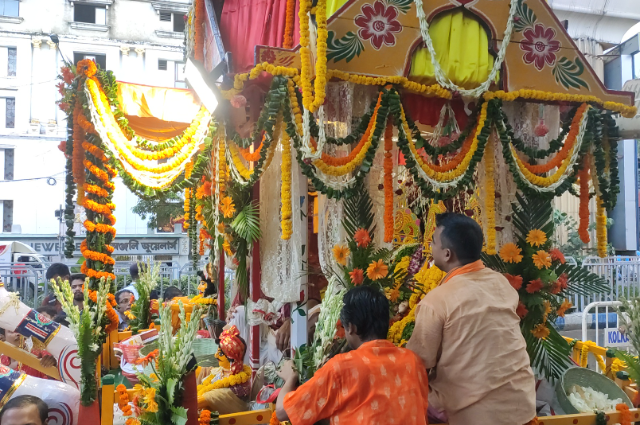
The Puri Jagannath Rath Yatra is one of the prominent and most important Hindu festivals in Odisha. It is celebrated every year, and millions of devotees assemble to witness the chariots of the deities being drawn along the Grand Road in the city of Puri. The deities are Lord Jagannath and his siblings, Lord Balabhadra and Devi Subhadra. There are several histories, facts, and legends behind this tradition. However, the most charming and appealing part of the festival is the grandeur and divinity of the chariots. Every year, new chariots are made from scratch for all three deities. The chariot of Lord Jagannath is known by the name Nandighosh. The chariot of Lord Bhalabadara and Devi Subadra are known as Taladhwaja and Darpadalana, respectively.
The responsibility of constructing these marvellous chariots is vested in the hands of families of hereditary artisans known as Maharana (carpenters), Bhoi (assistants), and Rupakaras (sculptors). It is to be noted that only these family members would be involved in the process since ancient times. Hundreds and hundreds of these artisans collaborate in the making of this enchanting architectural wonder. These family members consider it seva or service rather than employment. These hereditary rights have been inevitably passed on to the younger generation to date.
The process of construction is also no less fascinating. From measurement to carving, all steps are followed as instructed in ancient scriptures. In addition, despite the evolution of technology, no modern tools such as nails or metal fasteners are used.
These artisans have learnt these techniques from their fathers and continue the legacy for the forthcoming generations.
These artisans commence the work on the divine day of ‘Akshaya Tritiya’, which is considered an auspicious day to begin anything, according to Hindu belief. The process begins with collecting timber only from trees like phassi and dhausa from the forests of Daspalla and Ranapur. As the chariots require a huge amount of timber and the construction is annual, a shortage in wood is feared. Hence, measures are being taken to ensure the availability of these trees every year, solely for this process. However, these trees require plenty of years to attain their complete growth, growing the concern. As per official reports, nearly 742 logs of different types are being used to construct Lord Jagannath’s 45.6-ft-high Nandighosh chariot, while 731 logs will be used to build the 45-ft-high Taladhwaja chariot of Lord Balabhadra. Similarly, 711 logs are used for the construction of Devi Subhadra’s 44.6 feet Darpadalana chariot. The chariots come with massive and strong wheels that are suitable for these towering structures. The tallest Nandighosh requires a total of 16 wheels. The Taladhwaja and Darpadalana require 14 and 12 wheels respectively.
From the colours used to the measurements taken, every part and corner of the chariot is symbolic. Firstly, the making of new chariots every year is a sign of renewal, with no residues of the past. The colours are curated in association with various meanings and symbols. Apart from the deities, the sculptures of the horses and other guards are also made with the chariot. Even the ropes used to pull the chariot are considered auspicious and divine, that devotees take a mere touch of it as the greatest blessing. It is believed that the Lord leaves his abode and goes to the Gundicha Temple, believed to be their aunt’s place. Along the way, millions of people seek blessings irrespective of caste, creed, and gender since ancient times.
At the end of the festival, the chariots are dismantled, and their wood is used as fuel in the temple kitchens. This kitchen is believed to be the largest in the world. It cooks around 56 dishes every day and feeds anywhere between 2,000 and nearly 200,000 people.
The unwavering beliefs of the devotees and the unchanged traditions that are still in practice make the festival more than a religious ritual. The ancient chariot-making process is a blend of multiple aspects ranging from hereditary professions to embracing traditions.
At a time when local artisans are on the verge of losing their jobs forever, these artisan families remind us that if Indian cultural and traditional practices exist, Indian craftsmanship and artistry will also continue to exist. Each log of wood used in the chariot speaks tales of knowledge passed down for centuries. These family members stand as the custodians of this legacy, linking past, present and future generations in the thread of devotion and artistry.
References
- Rath Jatra, Festival of Chariots at Puri
- https://timesofindia.indiatimes.com
- https://www.bbc.com
- https://economictimes.indiatimes.com