
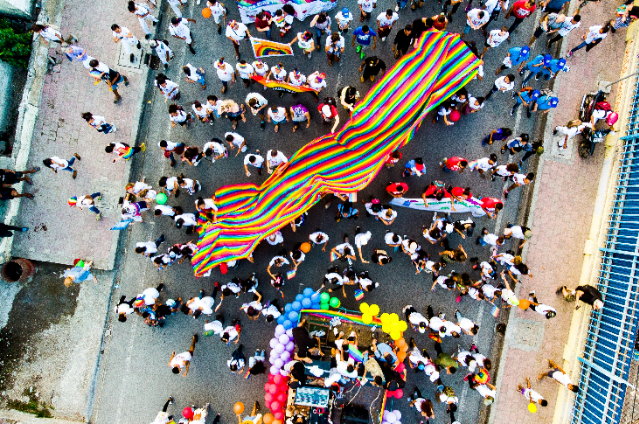
What a wonderful phenomenon is the rainbow? As the bright radiance enters the magnificent, tiny prisms, they disperse, trailing hues. Not one, not two, but seven different colours adorning the vastness of the sky. It expands high above the altitude, enjoying the million gazes from below, on earth. But this rainbow is no longer a mere scientific phenomenon. For the first time on June 25, 1978, the rainbow flag flew high, symbolising the San Francisco Gay Freedom Day.
Science has its own definitions of the rainbow and many other phenomena on Earth. But even science fails desperately before the so-called society. This is about the LGBTQ+ community’s struggle to lead their lives in a society that strongly refuses to accept them.
As part of the struggle, a mass movement took shape back in June 1969, which later came to be known as the Stonewall Uprising.
The beginning of a new perspective
It all began on June 28, 1969, outside the Stonewall Inn, a Gay bar in New York’s Greenwich Village. The bar did not have a liquor license. Earlier, the police had raided several such bars, and people had also strongly protested to defend their rights. But on this day, the protest escalated. Chaos erupted in response to the Police’s aggressive arrests and raids. The commotion kept growing and lasted for six days, way out of the Police’s control. Subsequently, every year, the month of June is observed as ‘Pride Month’ every year.
Usually, the bar served as a place of gathering and socialising for people belonging to the gay, lesbian, and transgender community.
But on that day, the police raids and arrests of the employees in the bar resulted in what turned out to be a major shift for the LGBTQ+ community. The mass movement marked the beginning of pride in the community before the birth of the internet and social media.
What holds even more significance is the fact that Pride Month was first introduced by a bisexual woman. Brenda Howard, popularly known as “Mother of Pride”, was the first person to organise the Christopher Street Liberation Day March on the anniversary of the riots. It was her idea to have a week-long celebration in commemoration of the struggle, which included several activities along with parades as part of the celebration. She was a militant activist who later took up bisexual activism and fought for bisexual rights.
Robert A. Martin and L. Craig Schoonmaker were two other prominent figures who were involved in popularising the term Pride to denote these celebrations.
The Proud Rainbow Hues
Throughout the month, what we see constantly in parades are huge rainbow flags fluttering across streets. People paint these flags on their faces and wear outfits that match the flags. In fact, the flag has now turned into the official symbol of the LGBTQ+ community.
The master mind behind the flag was Gilbert Baker, an American artist. It was Harvey Milk, a politician, human rights leader, and gay rights activist, who had tasked Baker with creating a flag for the community.
Interestingly, the flag’s design was inspired by the classic song ‘Over the Rainbow’ from the movie ‘The Wizard of Oz’. The first flag, by Baker, was reportedly made in 1978 at the cost of five hundred dollars for 1,000 yards of muslin, which was 58 inches wide. Another three hundred dollars for 10 pounds of natural dye in eight colours, and 100 pounds of salt and ash. And the rest was spent on art supplies.
Initially, the flag consisted of eight colours - pink, red, orange, yellow, green, turquoise, indigo and violet.
Each colour had its own symbolism and unique representation.
The pink colour for sex, red for life, orange for healing, yellow for sunlight, green for nature, turquoise for art, indigo for harmony, and violet for spirit.
Later, due to several reasons, including expenditure issues, the 8-colour flag dropped pink and turquoise and evolved into the current 6-colour flag.
Before these flags, it was the pink triangle that symbolised the community’s liberation and rights. This was because the Nazi Concentration camps imposed the symbol on gay prisoners, and they were forced into wearing these badges that distinguished them. What was meant to be a symbol of discrimination or shame later turned into a representation of self-identity and pride.
Pride Month is now celebrated across the world. Though it was observed on the first anniversary of the Stonewall Uprising itself, the celebration was not declared official. It was in 1999 that it was officially declared as Gay and Lesbian Pride Month by Bill Clinton, the then US President. Currently, it has become a global festival with wider participation. Awareness campaigns and discussions on the LGBTQ+ Community’s rights are still being carried out. While the visible victories are certainly to be appreciated, a deeper look must be cast upon the discrimination and inequality that the community still faces. The journey so far is a reminder of the struggles and sacrifices, which we now celebrate with pride.
References