
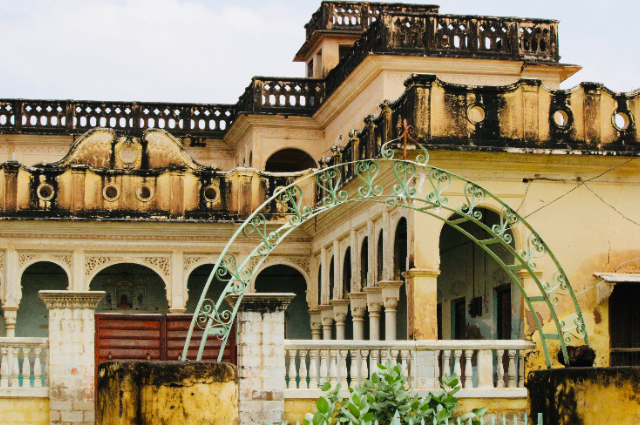
Stand in the courtyard of a 200-year-old haveli in Rajasthan at noon in May. The mud walls are thick, the jaali screens catch the breeze, and somehow — without a single wire running to an air conditioner — it is cool. Then think about the last time a power cut hit a glass office tower in summer. Within minutes, the building becomes unbearable. A structure that costs crores, designed by professionals with degrees and software, fails at the most basic task of architecture: keeping the people inside it comfortable.
Which one is actually more advanced?
That question has been nagging at me every time I travel through our big cities. Walking through the newer parts of Delhi or Mumbai, I keep running into this strange feeling — a kind of friction between my body and the buildings around me. The new constructions feel alienating. They are clean, symmetrical, and expensive. But something about them irritates rather than comforts. It took me a while to put a name to it: these buildings were not built for humans. They were built for photographs.
Older buildings do not have this problem. Step into a colonial-era structure, a stepwell, or even a modest old mosque, and something in your body relaxes. There is no luxury in the modern sense — no automatic doors, no sensor lighting. But there is depth. There is the sense that whoever built this place thought about the person who would one day stand in it. That patience is gone from modern construction.
When Speed Replaced Sense
The reason, I think, is speed. The architecture that spread through the late 20th and early 21st century was shaped by modernism's core promise: standardise, industrialise, replicate. The idea was that stripping design to pure function — removing ornament, resisting local variation, building the same way everywhere — was rational progress. For a while, the arguments were convincing. New materials, new techniques, buildings going up faster than ever before.
But somewhere in that efficiency, the human being got left behind.
The most visible symptom of this in India is the glass skyscraper. In a country where summer heat regularly crosses 45 degrees, these buildings are a design failure dressed up as ambition. Glass facades absorb and trap heat. They require industrial-scale air conditioning to remain livable. The moment that air conditioning stops — a power cut, a breakdown — the building becomes dangerous. The same walls meant to signal modernity become a liability. We have taken a climatic problem and poured concrete around it, then wrapped it in glass.
Traditional Indian architecture did the opposite. Thick stone or mud walls with high thermal mass absorb heat during the day and release it slowly at night. Chajjas and overhangs block the harsh summer sun. Courtyards create natural ventilation. These were not accidents or aesthetic choices — they were engineering solutions arrived at over centuries of living in this specific geography, under this specific sun. What we are doing now is abandoning that accumulated intelligence in favour of something that looks impressive in a developer's brochure.
The Cost of Forgetting
The criticism is not uniquely Indian. In 2019, New York City Mayor Bill de Blasio declared that glass and steel skyscrapers had no place in his city or on the planet. He argued that their energy-inefficient design contributes to climate change and announced his administration would move to restrict glassy high-rise developments. This was a mayor of one of the world's wealthiest cities, with access to every modern building technology available, concluding that a particular style of modern architecture had been a mistake. There is also something less measurable but equally real at stake: the emotional relationship between people and the places they inhabit. Architecture is not just shelter — it communicates. It says something about who built it, what they valued, and who they built it for. The craft in older buildings — the carved brackets, the inlaid patterns, the proportions worked out by hand — carries human intention in a way that a machine-cast concrete panel simply does not. This is not nostalgia. It is the difference between an object made with care and an object produced at scale.
The version of architecture that has spread across our cities is not honest modernism — it is fast construction dressed in the clothes of modernity. Buildings assembled quickly, designed to a budget, with no concession to local climate, local culture, or the human beings who will spend their lives inside them. The philosophy, if it can be called that, is: build it, sell it, move on.
The tragedy is that we already have the answers. They are sitting in our old cities, in our old buildings, in centuries of knowledge about how to build well in this part of the world. We do not need to go backwards — we need to stop pretending that forgetting what we knew is the same as moving forward. A building that keeps you cool without electricity, connects to its surroundings, and still feels human after two hundred years is not primitive. It is exactly what architecture is supposed to be.
References:
- The Problems and Top Criticisms of Modern Architecture. - Arcanum Builders https://share.google
- The Hidden Power of Light: Rethinking Urban Planning, Architecture, and Health https://share.google
- Glass skyscrapers are an environmental disaster that could have been avoided - CityMonitor https://share.google
- https://time.com