
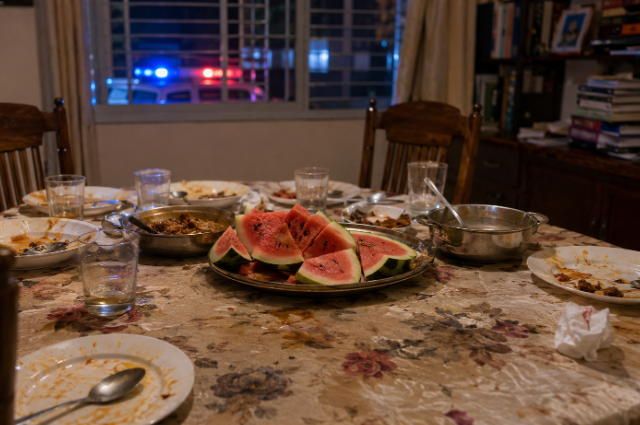
If you chopped a watermelon at one in the morning following a family meal, and by dawn your whole family had perished, how would you respond? The plot of a crime thriller is not like that. That is precisely what took place on the evening of April 25–26, 2026, in South Mumbai's Pydhonie neighbourhood. And one of India's most terrifying and perplexing murder cases of the year has sprung from what began as a horrific food poisoning incident.
That particular evening, everything went wrong.
The Dokadia family, which consists of mobile accessory seller Abdullah (44), his wife Nasreen (35), and their two daughters Ayesha (16) and Zainab (13), had spent a typical Saturday night entertaining five family members with mutton biryani. After eating and laughing, the guests departed. Nothing out of the ordinary. Nothing concerning.
Then Abdullah chopped a watermelon at roughly 1:30 AM. It was shared by the whole family. By five in the morning, all four were throwing up profusely, unable to stand, and being transported to Sir JJ Hospital in bed linens by frightened neighbours. They never returned.
The five diners? All right. Not a single cramp in the stomach. Why? Since they departed prior to the watermelon being chopped.
The Autopsy Shock: Organs Turned Green
At this point, the narrative transitions from being merely depressing to being extremely unsettling. Forensic physicians at JJ Hospital were shocked to learn that all four victims' brains, hearts, and intestines had turned green during autopsy.
Eating rotten fruit does not cause organs to turn green. Viral infections or bacterial food poisoning do not cause them to turn green. Blue-green organ staining after autopsy can
indicate ante-mortem injection of a poisonous chemical, according to medical literature, including a 2024 study from Goethe University. Put more simply, they were killed from the inside out by something that was either purposefully or unintentionally injected into their bodies.
Preliminary toxicology studies also found residues of morphine in Abdullah Dokadia's body, adding fuel to the fire. Strong opioids like morphine are only used in clinical and hospital settings. What was it doing in the body of a trader of mobile accessories who was sitting in his house at one in the morning?
Breaking: FSL Report Verifies Rat Poison: Zinc Phosphide Discovered in Watermelon and Bodies
As of May 7, 2026, investigators' fears have been confirmed by the Forensic Science Laboratory (FSL). Zinc phosphide, a very poisonous substance mainly used as rat poison, was found in the viscera (liver, kidney, and spleen), stomach contents, bile, and abdominal fat of all four deceased family members, according to an official statement from Deputy Commissioner of Police Pravin Mundhe.
Crucially, the watermelon sample that had been kept in the family's refrigerator contained the same toxin. Every other food item in the kitchen, including the biryani, tested negative. The watermelon was the only one that was positive.
Zinc phosphide is not your typical material. When consumed, it combines with moisture in the stomach to create the deadly poison phosphine gas. It can be lethal in a matter of hours. The same chemical is used to eradicate rats and control crop pests. It has no right to be inside a watermelon.
Although the precise method of introduction is still unknown, forensic scientists now suspect that the poison may have been blended or sprinkled onto the sliced fruit. Investigators are rushing to find out if the seller unintentionally contaminated the product. Or was the watermelon intentionally laced with rat poison, knowing that this family would consume it?
The Motive Perspective: A Builder, a Witness, and a 2026 Court Date
This is when things become really suspicious and politically awkward. Abdullah Dokadia was allegedly a key witness in a 2019 fraud case filed at the DN Nagar Police Station, which involved a real estate developer suspected of scamming a female buyer, according to numerous media sources. More importantly, a significant court hearing in that matter was set for 2026, the year Abdullah passed away.
Abdullah was under pressure not to testify, according to the victim in the case of cheating.
But, and this is crucial, the Mumbai Police have rejected this viewpoint. Abdullah's role was as a mediator in a Section 498A domestic assault case, not a real estate fraud, according to Senior Police Inspector Raees Shaikh, who added that this angle has been investigated and mostly ruled out. Investigators have yet to completely rule out a motive.
The Ghost of Null Bazar: An Unidentified Vendor
This is the most frustrating aspect of the whole situation. Abdullah was able to inform someone that he had bought the watermelon from a vendor in Mumbai's Null Bazar neighbourhood before his condition deteriorated that morning. Since then, police have been attempting to locate this dealer.
They are unable to locate him. Police have observed that watermelon vendors in the entire vicinity have inexplicably vanished after the event, not just that particular vendor. The fruit was no longer stocked by other retailers. Some received returns from buyers in a panic. Pydhonie's watermelon sales plummeted overnight.
There would be no incentive for an innocent seller to disappear. The absence of the individual who sold the last meal this family ever had is either the most significant lead in the entire inquiry or a tragic coincidence.
Reasons This Investigation Can't and Shouldn't End
Let's be honest. Three options are now available, and each one requires a response:
First, unintentional contamination. Was rat poison used to commercially sell watermelon as a result of a supply chain breakdown? If so, every fruit vendor in Mumbai and elsewhere poses a risk to public health. Millions of people could be impacted by this food safety problem, which goes beyond a simple family tragedy.
Next is suicide. Additionally, investigators are looking into whether the family committed suicide. However, four individuals, including two adolescent females, voluntarily ingested rat poison at the same time. Without a warning, a note, or an earlier sign of distress? There are major issues with this scenario's plausibility.
Third: intentional killing. A missing vendor, morphine in the father's blood, a watermelon that mysteriously carried rat poison while all other food items were clean, and a targeted poisoning of a household where the father was involved in a delicate legal dispute. If this is murder, it was cold-blooded, planned, and the perpetrator is still at large.
Two girls, ages 13 and 16, have passed away. Like their parents, they consumed the same fruit. They had no adversaries, no legal issues, and no justification for being singled out. Those girls were collateral damage in the harshest meaning of the word if this was a hit on the father. Justice is required for that. Completely stop.
Zinc phosphide is not accidentally or coincidentally present in watermelons; the toxicological data are forensic gold. It must be presented. It is impossible to leave the missing vendor, the morphine angle, the histopathology results, and the vanishing market traders hanging. According to reports, the Mumbai Police are now thinking about filing a formal murder case against unidentified individuals. They ought to.
What Happens Next?
The FSL's verbal confirmation is crucial, but investigators believe the official written report has yet to be properly delivered to the investigation team. Until then, no murder case can be legally filed. The clock is ticking. The greater the wait, the more difficult it gets to locate the vendor, rebuild the supply chain, and preserve evidence.
Police must also explain how zinc phosphide ended up in a watermelon stored in a household refrigerator. Was it laced before purchase or after it entered the home? Was there anyone else in the house other than the family that evening? And where is the seller from Null Bazar?
A Family Wiped Out. A City That Needs Answers.
The Mumbai watermelon death is no longer being looked into as a case of food poisoning. It's a forensic puzzle with murder written all over it: a 13-year-old girl's green-stained organs, rat poison discovered in a frozen apple, morphine that no one can explain, and a vendor who has recently vanished.
The Dokadia family deserved a regular Sunday morning. Instead, they received a death that has caused an entire town to become concerned every time they look at a piece of fruit. The city and this probe can at least figure out why.
References:
- https://thefederal.com
- https://www.dnaindia.com
- https://www.freepressjournal.in
- https://organiser.org
- https://organiser.org