
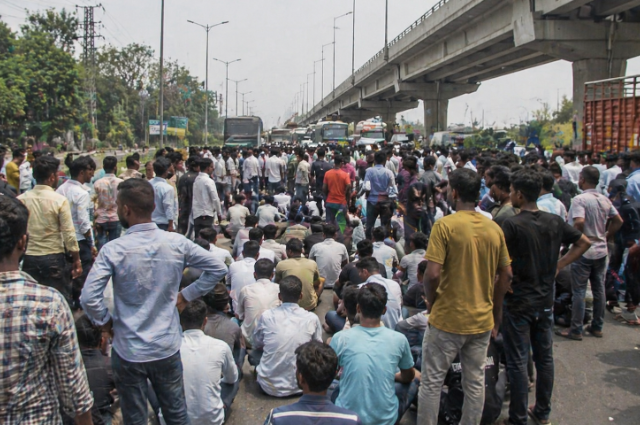
On the morning of April 10, 2026, somewhere in Noida's Phase 2 industrial belt, a garment worker named Vinay Mahoti, 30, who had moved from Bihar, stepped off his factory floor and did not return. He joined thousands of others who concluded that ₹13,000 a month for 10 to 12-hour stints was no longer acceptable. Within days, trucks were on fire; tear gas hovered above Sector 60, and one of Asia's largest planned industrial communities came to a halt. The question is not why it escalated into violence. The real question is: why has it taken so long?
What Triggered the Noida Factory Workers' Protest in April 2026?
The spark was straightforward. On April 9, 2026, the Haryana government announced a 35% rise in minimum pay, dramatically lifting the monthly floor for unskilled workers. The minimum wage in Noida, just over the state boundary in Uttar Pradesh, remains around ₹13,000. Workers in Haryana can now legally earn up to ₹6,000 extra per month, even if they work for the same company with locations in both states. For workers who were already overburdened, the statement was more than simply news; it was definitive proof of something they had believed for years: the system was not broken by accident. It was designed in this manner.
The Wage Gap That Built This Crisis
The stats reveal a harsh story. Over the previous decade, Delhi has increased its minimum pay for unskilled workers by about 90%, reaching ₹18,456 per month. Haryana follows the April 2026 modification. Uttar Pradesh, home to Noida, moved the slowest of the three, but inflation accelerated. Workers report that the real purchasing power of their earnings has been discreetly eroded.
This was extremely flammable because of its topography. This is the National Capital Region (NCR), where Delhi, Haryana, and Uttar Pradesh merge. Workers commute across these borders. Companies have units across these borders. In this narrow geographical area, a salary disparity this large is more of a daily insult than an economic aberration.
Protests began on April 10, led by employees at the Phase 2 Hosiery Complex. They were soon joined by personnel from large export companies such as Richa Global Exports, Motherson Group, Paramount Exports, and others. Work in nearly 300 factories was disrupted. By April 13, the protests had escalated to scenes of vehicles overturned and flames blazing, with protestors smashing past barricades while police in anti-riot gear watched on.
What Workers Were Actually Demanding
It wasn't a mob demanding the impossible. The workers' requests were specific and, frankly, modest: wages comparable to adjacent Haryana, defined duty hours, double compensation for overtime and holiday work, and salary payments by the 10th of each month. They also requested a formal complaints mechanism, which would include a woman-led committee to investigate harassment claims.
These aren't revolutionary demands. These are the minimum conditions that labor law already requires on paper, and garment export workers, who sew the clothes labeled "Made in India" and sold overseas, were not receiving enough. According to civil society groups, eight labour activists, three of whom were women, were detained at Botanical Garden Metro Station during the protests. Two lawyers who attempted to assist the detainees were also reportedly detained.
The Government's Response and What It Means:
After two days of protests, the authorities moved rapidly. The Uttar Pradesh government has proposed mandated weekly offs, double overtime pay, salary released by the 10th, annual bonuses by November 30, and a formal grievance procedure. A high-level committee was formed to look into the core issues.
These are significant compromises. However, they raise a question that no one in government seems eager to answer: if these circumstances could be achieved in 48 hours of disorder, why did disturbance be required?
The Bigger Picture: A Country Growing Without Its Workers
India's economy is expected to increase by 7.6% in FY2025-26. It recently overtaken Japan as the world's fourth largest economy. Despite this, over 88-90% of India's workforce continues to labor in the informal sector, without contracts, social security, or the legal safeguards that would make rallies like these unnecessary.
Research regularly shows that increasing minimum salaries reduces inequality without significantly affecting employment. Furthermore, another study indicated that increased minimum wages generated 26% of India's overall income disparity decline between 1999 and 2018, with no negative consequences on jobs. The garment and textiles sector, which is almost exclusively dependent on low-wage contract labor, has also helped nations such as Bangladesh and Vietnam build their export economies. India's yearly export shortfall in labor-intensive sectors is projected to be $60 billion, due in part to insufficient pay and working conditions to recruit and keep a steady, productive workforce.
The laborers in Noida are not impeding India's growth story. They are the growth story, just as they should be. When workers earn enough to spend, consumption rises. Productivity rises when employees have consistent working hours. Factory fires do not occur when disputes are resolved through a formal process.
The Question That Should Follow Every Protest Like This:
The Noida protests will disappear from the news. Committees will meet. Some compromises will be implemented, while others will be discreetly forgotten. Vinay Mahoti will return to his shift sometime during Phase II. But here's what's worth noting: every successful industrialized economy, including South Korea, Taiwan, and China, achieved so not by suppressing its workers, but by finally increasing them. The workers who manufacture the items are also the customers who purchase them. A factory floor where people can be heard is nearly always more productive than one where they have to set automobiles on fire to get attention.
So, the real question is not whether India can afford to pay its garment workers higher wages. The question is whether India can afford not to listen to its laborers. And what exactly is it waiting for?
References:
- Al Jazeera — Tear gas fired at Indian workers demanding higher wages as living costs rise (April 13, 2026) https://www.aljazeera.com
- News Gram — After Haryana Increases Minimum Wage, Noida Workers' Protest for Pay Parity Descends into Violence (April 13, 2026) https://www.newsgram.com
- India.com — Why are Noida workers angry? Salaries of these workers less than those in Delhi and Haryana https://www.india.com
- Ideas for India (I4I) — Policy Roundup: Labour laws, GDP data, MNREGA — on minimum wages and wage inequality research https://www.ideasforindia.in
- India Briefing — A Guide to Minimum Wage in India in 2026 (April 14, 2026) https://www.india-briefing.com
- Wikipedia — Economy of India — GDP growth figures and labour force data https://en.wikipedia.org
- Business Today — How minimum wages may be hurting vulnerable workers and costing jobs (April 24, 2026) https://www.businesstoday.in