
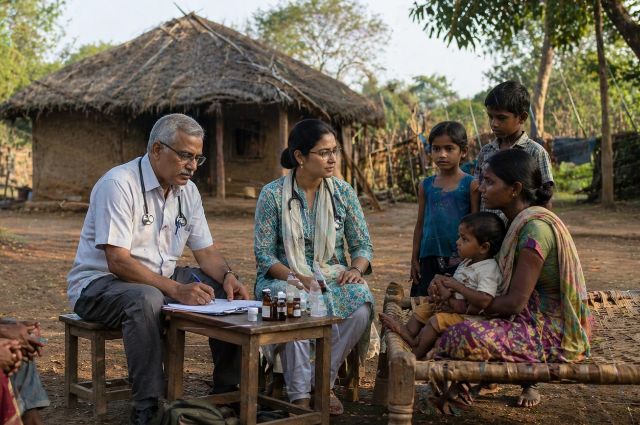
The history of mankind, on the other hand, seems to have a rather strange way of narrating stories. He is celebrated, revered, and glorified, while the woman is relegated to the shadows, her role and sacrifice glossed over, even forgotten in the pages of time. This, too, is a story that deserves to be retold. Whenever anyone speaks of the development and evolution of Melghat, Dr. Ravindra Kolhe, an individual who has dedicated his entire life to uplifting one of the most underdeveloped parts of our nation, comes into the picture. However, there remains one part of this story that has always gone untold that is of Dr. Smita Kolhe, an individual who is equally deserving of recognition and celebration as he is.
Melghat: Where the Earth Forgot Its People
Not only was Melghat a geographically isolated area, but it was also systematically neglected. This area of Amravati district, Maharashtra was a place that did not enjoy even the basic human rights of its people. Villages such as Bairagarh were places that were isolated from the world with absolutely no access to roads, electricity, or health care facilities. Malnutrition was common among the children, and there were alarming rates of infant mortality. Babies died due to easily avoidable diseases, and women gave birth to babies without any help from medical professionals. Life itself in this region was not assured because of the rugged terrain and neglect from the system. Choosing to survive and work in this region was definitely not easy.
Ravindra Kolhe: The Man With a Mission
The entry of Dr. Ravindra Kolhe into the area of Melghat was ideologically-driven rather than being motivated purely by sympathy. As part of the first group of doctors trained under the MBBS program at the university of Nagpur in 1985, the teachings of Mahatma Gandhi and Vinoba Bhave had influenced him profoundly, focusing on serving the most vulnerable members of the society. The book “Where There Is No Doctor” was also inspirational because of the emphasis placed on delivering health services where the need is greatest without having to depend on sophisticated medical facilities. Aware of the difficulties awaiting him in such circumstances, he took six months training in Mumbai to learn how to serve people even without using any medical instruments. In addition, he learnt how to deal with cases like pneumonia without using x-rays, and conducting deliveries without sophisticated medical tools. Ideology influenced Dr. Kolhe in other ways as well. He put forth stringent demands for marriage because the candidate had to agree to live away from civilization and earn only enough money for her subsistence, while remaining committed to the welfare of the community.
And Then There Was Smita : Already a Doctor, Already a Force
Smita Kolhe was not an aimless soul looking for some purpose before getting into this story. Smita was a qualified physician of Ayurveda and Homeopathy, who had a secure future and the means to lead an easy city life. Marrying Ravindra was neither a compulsion nor a matter of devotion. Smita made a deliberate decision after understanding the nature of the life she would have to lead once she decided to be with him. It took great courage and wisdom on Smita’s part to embrace such a huge challenge, and this makes her story so inspiring and admirable. Instead of following a dream conceived by someone else, she adopted this dream and turned it into her very own goal.
₹5, A Court, and A Promise Worth Millions :
This unusual union in the year 1989 mirrored their unique beliefs. There were no rituals, nor were there any social extravagances or financial transactions; it was simply a court marriage which is rumored to have only cost them ₹5. However, this seemingly simple occurrence hid the level of dedication involved. Smita did not join Ravindra in Melghat merely to be his wife; she joined him as a doctor willing to render services. She was the second doctor in the region and had taken upon herself the task, along with Ravindra, to treat the patients and resolve this issue of a shortage of medical facilities. They charged the bare minimum, ₹1 per patient, thus making health care affordable even for the poorest of families. They led a life similar to that of the villagers, sharing the same conditions, which enabled them to develop an easy rapport. Right from the start, their relationship was marked by equality in all aspects.
When a Mother Chose Her Village Over Her Child’s Safety :
One of the defining moments in Smita’s life occurred when her own child became seriously ill. The natural course of action here would have been for her to provide her son with the best possible treatment, which involved going to a big city where there were more sophisticated hospitals. Everybody advised her of that course of action. However, Smita took the courageous step of treating her own son under the same conditions that were available to the people of the villages. She did not want special treatment that could not be enjoyed by the people among whom she worked. She declared with firm resolve that she would not give her own child anything that other parents could not give their own children. She took this step because of her commitment towards equal opportunities for everyone. It is through such actions that she earned the complete trust of all the village folks.
“She Could Have Asked For a Home, Yet She Asked For Roads Instead’’ :
In one instance, when a politician offered to construct her a house as he came to help her, Smita chose to make yet another extraordinary move. She did not ask for something that would provide her with personal comfort but requested something more than that. By asking for road construction in her area, she showed the amount of foresight she possessed. With roads, access to healthcare, education, markets and many other facilities could become possible. In doing this, she proved that she was a true leader who cared for people and their welfare above her own personal gain. The change in infrastructure in the area of Melghat is a testament to it.
These Statistics Have Her Fingerprints All Over Them :
The changes that have occurred in Melghat are not merely part of a tale; they are concrete developments. The mortality rate among infants, which had been disturbingly high at approximately 200 deaths per 1,000 live births, had fallen drastically to almost 40. The pre-school mortality rate too had plummeted. Healthcare services continued to be available to all, even the poor, for their ₹1 cost structure ensured that there would be no denial of care to anyone because of lack of money. Apart from the healthcare initiatives, progress made in agriculture increased food availability, and the area was on its way to becoming a suicide-free area. It is easy to attribute these gains to general causes; however, it should be noted that it has taken hard work and perseverance on behalf of Ravindra and Smita to make these achievements possible.
Same Sacrifice. Different Headlines :
Although their contributions have been equal, the appreciation accorded to them has not been uniform. There is a general inclination in society to view men as the leaders while the women play supportive roles. Although they have contributed equally to success, the nature of the action undertaken by them varies depending on the gender they belong to. In this case, while a man can be referred to as visionary, a woman is considered devoted. The problem is not confined to this particular story alone but it has become a common phenomenon across all sectors. Although the couple was honored with the Padma Shri award, there was a clear imbalance in their portrayal in the media and other quarters. In many instances, the identity of Smita was viewed from the perspective of being a wife and not as an individual contributor.
Call Her What She Was — An Equal :
Now, it is time to set the record straight not out of pity but out of truth. Dr. Smita Kolhe was not a side character in someone else's story; she was the doctor who was a decision maker and a leader whose efforts helped to change the entire fate of Melghat. She decided to become a serving soul despite all the possibilities of choosing a different path. She made hard decisions that made her commitment more clear. She contributed equally to all the efforts that helped improve the lives of thousands of people. To treat her any differently is nothing but extremely wrong. Perhaps, in acknowledging Dr. Kolhe for whom she was in reality, we will learn to see other countless stories of women who have been erased from history books. And maybe, just maybe, as we begin to tell these stories right, the future will remember its women not as shadows beside greatness, but as greatness itself.
References :
- https://pmc.ncbi.nlm.nih.gov
- https://pubmed.ncbi.nlm.nih.gov
- https://www.moneycontrol.com
- https://timesofindia.indiatimes.com
- https://www.delhi-magazine.com