
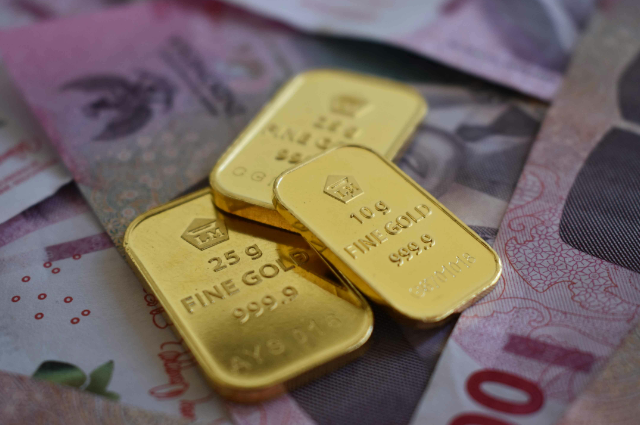
Imagine this. A young couple in Jaipur, saving for months, enters a jewellery shop to buy gold bangles for their approaching wedding. The store owner grinned. The bangles shine. The transaction has been finalised. It's a completely normal, absolutely lovely Indian moment, but suddenly a headline emerges on the television with Modi forbidding Indians from buying gold.
Now zoom all the way out to the Persian Gulf, where a battle is raging thousands of kilometres away. to the rupee declining in value relative to the dollar. In just two months, India's foreign exchange reserves have decreased by around $38 billion. To a prime minister in Hyderabad speaking at a microphone and making a statement that no Indian politician in recent memory has spoken quite so bluntly: "Stop buying gold. At least for a year."
When Narendra Modi issued that appeal on May 10, 2026, and repeated it the next day in Vadodara, the country erupted. Jewellery stocks plummeted. Social media erupted. Opposition leaders pounced. And millions of ordinary Indians wondered what my gold bangle had to do with the Iranian war; this seemed suspicious, or perhaps confusing.
The answer is everything. Understanding why or the core purpose behind Modi’s tactics is one of the most critical economic lessons India has ever had to learn.
The Number That Should Shock You: $72 Billion
Let's begin with a number that should be highlighted, written in red, and read twice: India imported $72 billion worth of gold during the 2025–2026 fiscal year. Not in rupees but in Dollars. There are 72 billion of them.
To put that in perspective, that is more than India spends on defence imports, more than it makes from software exports during the same time period, and roughly equal to the GDP of a small European country. It disappears annually in exchange for metal that is kept in temple vaults, bank lockers, and almirahs all over the nation.
The trajectory of this figure is what makes it even more astounding. India's gold import bill was over $35 billion just two years ago, in 2022–2023. It has almost doubled in the last two years. The twist that worries economists the most is that import quantities actually decreased this year. Despite purchasing fewer tons of gold, India spent significantly more due to the sharp increase in global prices. India paid more and received less as the average cost per kilogram increased from about $76,600 in FY25 to almost $99,800 in FY26.
Nowadays, gold makes up between 5 and 10 per cent of India's total imports during periods of high demand, making it the second largest drain on the nation's foreign exchange behind crude oil, a commodity that India truly needs to sustain its economy. In comparison, gold typically just lies there, shimmering.
From Your Living Room to the Strait of Hormuz: The Invisible Chain
Here is the reasoning why a wedding purchase in Jaipur is linked to a catastrophe happening in the Persian Gulf through a web of unseen economic ties. This is where the personal becomes the national.
The Strait of Hormuz, a tiny waterway through which around 20% of the world's oil passes every day, has been clogged as a result of the Iran war, which has had disastrous effects on the world's energy markets. This is hardly a far-off geopolitical story for India, which imports over 89% of its energy needs. Every Indian who purchases gasoline, pays for transportation, or consumes food that was cultivated using fertilisers transported from Gulf ports is directly impacted.
India's foreign exchange reserves fell from $728.5 billion as recently as late February 2026 to $690.69 billion on May 1, a $38 billion decline in just two months. India's current account deficit, or the difference between its foreign earnings and expenditures, is expected to reach $84 billion by 2026, according to IMF predictions. Every needless dollar spent on imports feels like a self-inflicted pain because of this structural overhang.
And this is the exact moment when gold turns into the monster that nobody wants to recognise.
Oil is non-negotiable; India must purchase it. Fertilisers must be imported. But gold? Gold is a choice. It's a cultural, financial, and emotional choice, but it's still a choice.
Additionally, when a nation is losing foreign exchange during a war, decisions have far-reaching effects.
How Your Gold Bangle Weakens the Rupee — and Raises Your Petrol Price
Since economics is rarely taught in terms of bangles and fuel pumps, this is the section that most people overlook. However, the relationship is harmful, direct, and genuine.
India loses money for every dollar it spends on importing gold. The rupee depreciates when too many dollars depart, and too few arrive. India will have to pay more in rupees for each barrel of oil it buys if the currency declines. Fuel prices rise as a result. Transporting things, such as consumer goods, medications, and vegetables, becomes more expensive when fuel prices rise. Families that have nothing to do with purchasing gold end up with that inflation on their dinner tables.
The rupee has already had the worst year-over-year performance of any major currency in 2026. While rival markets in Asia and Latin America continue to draw robust inflows, net withdrawals of foreign institutional investment have reached $21 billion this year. A large current account deficit that is partially fueled by gold imports is one of the structural reasons why India is currently off the radar of international investors.
The math becomes convincing if gold imports were significantly halted for even a single year: India's merchandise trade deficit, which is estimated to be over $333 billion in more comprehensive estimates, might significantly decrease. At 1.3 per cent of GDP in the December quarter, the current account deficit would decrease. There would be less pressure on the Reserve Bank of India to deplete its reserves in order to protect the rupee. Additionally, crude oil, semiconductors, pharmaceuticals, and vital technology are items that India genuinely requires.
None of this harm is caused by a single bangle. However, 1.4 billion people do import $72 billion worth of gold annually.
But Gold Is Not Just Metal — and Modi Understands It
To write off the significance of gold in Indian culture as folly or vanity would be dishonest and, to be honest, offensive. Neither is it.
Gold is the sole reliable savings option for hundreds of millions of Indian families. Banks have failed. Cash has been eroded by inflation. The financial markets seem far away
and dangerous. However, gold has never reached zero. It has never experienced a sudden decline in value. Neither a broker nor a smartphone has ever been necessary. For families without official financial safety nets, having funds in your possession is crucial.
Gold is culture as well. It is the inheritance that a mother gives her daughter. It is the safety a father offers during his child's nuptials. It is a little, shiny, tactile representation of centuries of tradition. No prime minister can deliver a speech and expect it to be forgotten.
Modi is aware of this. His appeal was therefore carefully phrased as a postponement rather than a prohibition. He did not advise against purchasing gold. "Wait a year," he said. He did not declare a tax or impose a moratorium. He inquired. And that request, which was voluntary, moral, and appealing to something more profound than individual convenience, was clothed in the language of patriotism, national responsibility, and the same collective spirit that brought India through COVID lockdowns.
It is very unclear if such an appeal will be successful. It is completely voluntary to comply. There's no way to enforce it. Additionally, jewellery stores are staying open despite the Prime Minister's polite request.
The Inconvenient Question: Is This Enough?
This is the point at which the article must be truthful since persuasive arguments based on partial truths eventually fall apart.
Despite its economic foundation, Modi's speech has also come under heavy criticism. The Prime Minister's public announcement that India has a foreign exchange issue and wants to reduce gold and travel expenditures may have sent a signal of weakness to international financial markets that the Reserve Bank of India could have handled much more discreetly and expertly, according to critics at The Wire. In internationally integrated financial markets, communication strategy is a delicate matter, and some economists contend that this approach was incorrect.
The unsettling reality of burden distribution is another. Already under pressure from stagnating earnings, high inflation, and slow job growth, the middle class is being forced to give up the aspirational purchases they have fought so hard to achieve. In the meantime, there is no comparable public appeal for India's oligarchic wealthy elite, whose wealth has increased significantly under this administration. The majority of the austerity being demanded is a sacrifice made by the middle and working classes.
Furthermore, genuine policy cannot be replaced fundamentally by voluntary appeals. Better formal savings products that rural and semi-urban households genuinely trust, a working Gold Monetisation Scheme that has generally underperformed, and financial literacy initiatives that reach Rajasthani families sitting on the floor of jewellery stores rather than just economists in Delhi are all necessary if India is to truly lessen its reliance on gold imports.
The diagnosis made by the appeal is accurate. The remedy must be far more extensive than a speech.
The Choice Is Yours — But So Are the Consequences
Let's return to that Jaipur couple.
They have a very human, emotional, and reasonable need for gold bangles. No one has the right to make fun of them for it. However, they might hesitate if they really realised that their purchase is just one drop in a $72 billion yearly torrent that is devaluing their currency, driving up the cost of gasoline, and straining the reserves that safeguard India's economy during a conflict. Not because they were ordered to by a politician. However, the implications affect all 1.4 billion of us, not just those who can afford to purchase gold, because the numbers and chains are real.
That is Modi's real argument, devoid of political theatre and nationalism. And the argument is valid on that specific economic point, regardless of your mistrust of the messenger or your anger at the government for other reasons.
India's love of gold does not have to end. It must recognise the price of its affection. "Patriotism is not only about the willingness to sacrifice one's life on the border. In these times, it is about living responsibly." — PM Narendra Modi, May 10, 2026
References:
- https://www.aljazeera.com
- https://m.thewire.in
- https://www.ummid.com
- https://www.impriindia.com
- https://kpiasacademy.com
- https://www.asianmirror.us