
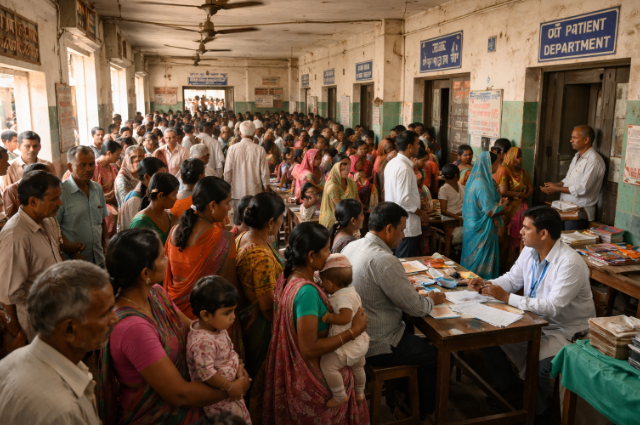
As soon as I enter the Main Wing of the hospital every day, I see flocks of patients sitting and striding in the narrow corridors. The crammed outpatient rooms on the ground floor are usually flooded with people on weekdays. Old people with sticks walking wobbly, asking for directions. Small, barefooted kids holding the pallu of their mother's saree, looking curiously at the doctors. Men and women carrying around newborn babies, perfectly swaddled in the softest and newest fabric, even when their own clothes look shabby. Young pregnant females with tired eyes are waiting in lines for the routine antenatal checkup. A plethora of emotions gushes through me. Everyone has a story, a hopeful gaze, and the relentless wish to get cured at the earliest.
You could see a baby making its way into the world in labour rooms, and the eighty-five-year-old breathing his last in the Intensive Care Unit and the ventilator making one last deafening beep to let him rest in peace. The hospital is a microcosm, as I see it. Most Indian government hospitals cater to a diverse range of patients daily, providing free or minimal-fee care. Undoubtedly, the government allocates a bountiful budget for a wholesome healthcare system, but the ground reality largely differs from the expected. Most hospitals still lack facilities, and many of the available ones are either inoperational or ineffective in meeting the demand of high daily patient capacity.
I'm a final-year student in a government medical college of Telangana. After years of flipping through books and more books, we are being properly introduced to hospital life. And I can assure you, as exciting as it may sound, the challenges and the complexity of this profession continue to baffle me and shape me into a tough yet empathetic being. The struggles of the people who cannot afford a semi-private room in a famous hospital are something we would never understand if we could not see them in the first place. I have seen doctors longing to help patients with utmost care, yet the absence of facilities often suggests referral to a higher centre.
We watch shows like Grey's Anatomy and The Good Doctor. They give us an idea of an ideal multidisciplinary institution where every disease is being cured but in reality, in our country, many a times we fail to save patients who could have made through, only if the hospital was more equipped or the doctor was more versed in their knack had they gotten a better environment to learn or better referral services were at their disposal. It's truly heart-wrenching to tell a delirious mother that her beloved son could not be saved or to see young children clueless that their parent is no more. Their helplessness could be cut with a knife. Every second is heavy in ICUs. The number of beds is far less than needed. Several severely ill patients are left stranded in wards. The hospital pharmacy often suffers from a shortage of medicines, prompting poor people to go to chemist shops and buy expensive medicines. The long queues at sample collection areas exhaust patients.
One can often gauge a nation's development status by evaluating its healthcare system. India still stands among the developing countries despite its bejewelled economy and powerful global stance. We are definitely progressing at a miraculous pace, but healthcare still lags. India ranks 130th out of 193 countries on the 2023-2024 Human Development Index.
Shocking! Right? The standard of living and health status of a major chunk of the population are below par. So, where are we exactly failing at? Let's look at the major problems faced by our healthcare system, which continues to sabotage this nation's growth intrinsically.
Low Government Health expenditure
The total health expenditure is around 3.8% of GDP as of FY22, which is quite low compared to the global average of over six per cent. Even though relentless efforts are underway to enhance our health infrastructure and make it more accessible, the process is slow.
Ill-equipped and underconstructed infrastructure
Recent times have seen a growth curve in the construction of healthcare institutions, but equipping these hospitals is far slower than their construction. Tall hospital buildings stand proudly with gleaming white walls, but have ill-equipped, dingy rooms. Political upheavals often influence their construction. Public outcry for better facilities is often ignored by the authorities. There are around 26 thousand hospitals ranging from primary health centres to tertiary care institutes in towns and cities. Only 75 of the government medical colleges include speciality blocks, which makes fine tertiary care more inaccessible and time-intensive. As cancer cases are alarmingly increasing, it's imperative to mention that India has only about 400 PET-CT machines, which are an absolute necessity in diagnosing the spread of cancer.
Inexperienced and fewer health personnels
There is a substantial shortage of experienced, well-trained and active staff in most institutions. The ones available are often overworked and exhausted due to high patient load. Poor management of the staff results in chaos and significant strain on the system. Most institutes function on minimal resources and inadequate staff.
Outdated techniques and inexperienced technicians
It's shocking that many of the tertiary centres still use outdated diagnostic techniques in the absence of newer equipment. The Widal test for typhoid fever is a century-old test, but still used in many Indian laboratories. Sputum examination continues to be used in the absence of better and more accurate techniques like CBNAAT and indigenously developed TruNAAT. Human examination and observations are prone to errors. So, manual work should be replaced by automation for accuracy, reducing the time duration of the tests, and reaching the diagnosis early.
Tremendous Workload and Underwhelming Care of the Professionals
If you happen to notice, you'll find most people in healthcare are chronically fatigued. They have lacklustre eyes, they are constantly juggling several tasks and often hungry and dehydrated. The healers are unhealthy. Therefore, we should stop glorifying healthcare professionals as God or His Equivalents. They are just people like you and me who have chosen this profession. And if we expect good care from them, we need to give them better experience, better tools, ample space for working and most importantly, proper rest.
Unbridged gap between the government and the private sectors
One of my relatives had recently received treatment for an occipital lobe brain tumour. The treatment is offered by huge private institutions, as government hospitals lack the staff and equipment for the surgery. Her family liquidated all their funds and auctioned off the family heirlooms to pay for the treatment. The landscape widely differs between the government and the private healthcare sectors. The quality of care, affordability, accessibility and availability of care have stark differences. Private institutions offer better services, but are priced way too high. A poor person would skip this option and go to government setups where the care is compromised, but he could not afford the treatment. Even though the government is tackling major diseases through National Health Programmes, the patients are often unaware of the benefits. Private institutions are often deemed as money extortion machines. This gap needs to be bridged. Both sectors should work in harmony to deliver the most comprehensive and effective healthcare.
The global health system is very thoroughly designed and advanced through automation, technology and innovation, whereas the Indian landscape seems to struggle. The pace of growth is infinitesimally slow, and the pangs of the suffering of the citizens are worrying.
Indian Healthcare vs Global Healthcare
The expenditure and the coverage
India spends 3% of its GDP on healthcare against the global average of 10%. Health insurance is also low for the Indian population, resulting in major financial crises during healthcare emergencies and oftentimes, people succumb to the illness due to a delay in care.
Disproportionate staff management and insufficient infrastructure
India has 0.67 physicians and 0.51 hospital beds per 1000 population. On the other hand, developed nations have around 2-3 physicians and 13 beds for 1000 people. The reasons are the delayed construction of hospitals and a smaller number of doctors trained. But even a more significant cause of this disproportion is the population explosion in India. India has overtaken China in being the most populous country in the world.
The Focus of Diseases
India, being a developing country, still hasn't achieved any significant relief from infectious diseases and suffers vastly during any pandemic. The second wave of the COVID-19 pandemic was disastrous in the country. One could track the serpentine diseased and death incidences on Google that didn't touch the baseline for several months. The non-communicable diseases are also following a rising trend and are occurring in a younger population, which is a major concern for health institutes.
Affordability of services
India offers several costly procedures and treatments at minimal costs while offering governmental incentives to the needy and elderly. Initiatives like Pradhan Mantri - Ayushman Bharat Scheme have made treatments affordable and within the reach of poor and financially unstable families. Medical tourism in India is quite popular in neighbouring countries.
Digitalisation of services
India has innumerable young minds that are introducing innovative services to make healthcare more accessible to people. A productive amalgamation between doctors and engineers has brought about tracking apps and online consultation services to people in remote areas and better mapping of diseases.
Let's discuss the crucial ways we can upgrade our system and make it so efficient that an old widow in a distant Telangana village receives the prophylaxis of filariasis, a young mother could get maximum postnatal checkups, every child is nourished and his or her health is closely monitored and the infectious diseases like Tuberculosis and pneumonia could be wiped off from the face of our country.
Construction and adequate equipment of the health centre
All the health centres must receive ample grants to renovate, equip and restock. A more extensive budget should be allocated for healthcare, the salaries and stipends of the staff and faculty should be regularly paid, and incentives awarded.
More comprehensive approach
Better staffing and training of healthcare professionals would enhance the quality of services. A dynamic and regularly introspected system would bring about better facilities and a more elaborate healthcare network. Without specialists to operate, the equipments are a waste. So, an army of extensively trained personnel should be employed in running laboratories and diagnostic facilities.
Health Programmes and campaigns
Creating awareness and drawing more people to the hospitals should be preceded by extensive campaigns and health programmes. Community participation should be encouraged. Young mothers and pregnant women should be educated through primary health education. Elderly people should receive free treatment at any healthcare facility. Prevention is always better than treatment, so disease prevention and prophylaxis should be a mandatory step in Programmes.
At last, health should be for all. It's a basic human right. No country has ever progressed in the shadow of famines, starvation or an epidemic. Health is the primary requirement to build a better community, thus a country. It's not only my job or yours; bringing about a healthier society is a burden that falls on each shoulder. It's our collective effort that can yield fruitful results. In a democratic nation, where we get to choose our leaders, let's vote for the ones who promise us a better healthcare system. We should extend support to the non-governmental organisations that strive to uphold good health as a primary goal.
The world we create today is the world we will be living in tomorrow. Let's make our world a better place.