
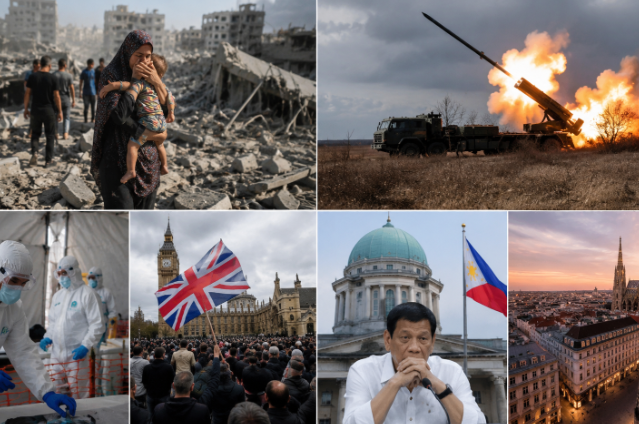
There is a specific sort of exhaustion that occurs when a crisis is no longer a one-off phenomenon but becomes a state of affairs. Not the sudden shock of something disastrous, but the heavy load that comes with many things being disastrous at once – endless wars, governments that can no longer count on the consent of the governed, viruses that evade national borders as if such lines don't exist, and political families that struggle with the demands of democracy. This is the state of the world in May 2026. It is not quite the world on the brink of catastrophe; rather, it is the world that has passed the point of no return and is now figuring out how to cope.
All the pressures that weigh upon the international system are hardly unprecedented individually. War has always left its ugly mark on history; epidemics have always threatened the very survival of civilisations; political figures have always made their mistakes. But what makes today different is the combination of all three. In six different time zones and twelve different news cycles, one week in May 2026 saw a declaration of an Ebola emergency in Central Africa, a new form of warfare involving drones that is subtly rewriting the rules of engagement for modern warfare between Ukraine and Russia, a democratically elected British government that was losing credibility with its citizens in an unprecedented manner, a scandalous impeachment process in Southeast Asia that seemed like a political thriller, and a culture shock in Vienna, which somehow gave rise to a sense of joy. Any attempt to analyse each incident separately will lead to misinterpreting them.
However, the Gaza war, which has been going on for three years now since the attack by Hamas against Israel that occurred in October 2023, has gone past being a military engagement into an arena that is difficult to define. The killing of a Hamas military commander, who was involved in planning the October 7 attacks, announced by Israel early in the year, was significant in the sense of the strategy involved, but made little difference to the humanitarian equation on the ground. According to estimates provided by the Hamas-run health ministry, Palestinians have died in excess of 50,000, and although this may not be verifiable, it is regarded as largely credible information by the UN.
They are not mere statistics. According to Save the Children, during the height of the ground war, ten children per day on average had limbs amputated, every instance constituting “a lifetime of medical needs,” when healthcare is severely undermined in Gaza and prosthetic limbs are extremely rare. One UNICEF representative recently returning from Gaza estimated that at least a thousand children had either one leg or both legs amputated in the initial months of the war. That figure has undoubtedly since increased, and what was once simply termed a humanitarian catastrophe has become what development economists refer to as a “disability crisis” - an entire generation of children whose disabilities are a permanent reminder of their past, their present, and likely even their futures in Gaza. The spectre of history casts an ominous shadow over this discussion. In the aftermath of the civil war in Lebanon, researchers found that the fifteen years of cyclical devastation resulted not only in
damage to infrastructure but also in an actual breakdown in the structure of human capital - a whole generation raised without steady schooling, healthcare, or the security needed for healthy cognitive development. The same debt is accruing in Gaza at a compressed, more intense pace. There can be no misunderstanding regarding the psychological research into the effects of violence, displacement, and hunger on neurodevelopment. Not only must we ask ourselves when this stops, but we must consider the nature of the society rebuilt after the cessation of gunfire.
When Vladimir Putin spoke to journalists following his nation's Victory Day parade last month, he gave an unusually worded statement about the ongoing conflict. "Things are coming to an end," he told reporters when prodded about the war in Ukraine, adding, "I think things are reaching an end, but still, it is quite a serious thing." While the Kremlin denied that Putin was issuing any sort of ultimatum, the analysts from the Institute for the Study of War pointed out that there were no obvious signs of de-escalation on the ground.
The backdrop behind Putin's statements is crucial here. According to NPR, the past few months have seen Ukraine launch one of its most extensive drone attacks against Russian territories since the full-scale invasion commenced back in February 2022. Ukrainian forces have reportedly bombed oil refineries, electric substations, and logistical centres far behind the front lines in Russia – all actions which have fueled domestic frustrations in the Russian country, according to Bloomberg.The message from Kyiv is clear: the cost of occupation is not static; it compounds. The drone campaign represents something philosophically important in modern warfare - the democratisation of long-range strike capability, where a nation without air superiority can nonetheless impose persistent risk on an adversary's rear areas.EU Foreign Affairs chief Kaja Kallas, responding to a deadly Russian airstrike on Kyiv in late April, put the situation bluntly: while Russia claimed to seek peace, it was simultaneously launching mass attacks on civilian infrastructure. "The real obstacle is not Ukraine but Russia," she said, "whose war aims have not changed." This is the essential interpretive problem with Putin's recent conciliatory language. Ceasefire based on Russian maximalism of land annexation and neutralisation of the NATO flank by an agreement that effectively sidelines NATO from eastern operations is temporary, not a conclusion. It is a breathing space, a very risky one given what was learned from Russia's behaviour in the 2014-2022 period regarding its utilisation of frozen conflicts to mobilise for new attacks. Europe and Ukraine know each other very well.
It is another matter whether Washington still has the necessary understanding to act accordingly. Comparisons to previous crises of British leadership are uncanny but not perfect. In 2022, Boris Johnson faced a shocking personal fall as a result of an ethical meltdown caused by a scandal. Liz Truss had only forty-five days as Prime Minister, during which her ideological misjudgment was harshly criticised by the markets before she could receive parliamentary support. Neither does Starmer's situation fit either of these models. It is different in being less spectacular, more structural, and even more destructive to the very idea of good governance. What Starmer has done is not something catastrophically wrong; rather, it is his apparent failure to do anything radically right. He led the country through economic inertia, a period of strain within the civil services, and growing concerns about immigration, without managing to take decisive action to address these problems. Hiring Gordon Brown and Harriet Harman as advisors post-election has been compared to bringing cartographers from centuries ago in order to solve the country's navigational problems. What is happening in Britain is also true in other parts of Europe. Governments in Europe belonging to the centre left and the centre right parties are coming to realise that victory in the elections alone does not suffice anymore. People in 2026 are not only unhappy with the results; they are unhappy with the whole framework of politics. With the emergence of Reform, Greens, Plaid Cymru, and the disintegration of the two-party system into at least five major power blocs, we have arrived at a situation where the real problem is that of democracy itself. Political dynasty families in the Philippines have a complex and long history of turning their legal systems into instruments of power struggles between each other, and the continuing saga of Vice President Sara Duterte’s impeachment is no exception. In May 2026, the Philippine House of Representatives passed an impeachment bill against the vice president, 257 to 25, marking her as the only public official in Philippine history to face two separate articles of impeachment against her. This comes amidst years of unprecedented political turmoil in the country, fueled by accusations of corruption, misuse of classified funds, connections with extra-judicial killings, and a threat purportedly issued by Duterte against the president, his wife, and the Speaker of the House. These charges against Duterte of culpable violation of the Constitution, betrayal of public trust, corruption, and participation in extrajudicial killing are grave. However, the political dimension cannot be underestimated either. Members of the Duterte family come from one of the most influential families in Southeast Asian politics. For example, Sara Duterte's father, Rodrigo Duterte, finds himself under arrest in The Hague for crimes against humanity connected to his drug war. Despite all these accusations, she declared her intentions to become the presidential candidate in 2028 already back in February 2026. As such, the act of impeachment becomes more than just the judicial decision - it becomes a battle for future power among the two rival political factions. It is an irony well known throughout Southeast Asia that while the formal structures of democratic government-parliaments, judiciaries, and electoral bodies-are being undermined by personal and family feuds among elite politicians, the risk lies not only in the corruption of these institutions but more importantly in the perception that they have been corrupted, thus stripping them of the only means of effecting a nonviolent transfer of power. Experience has repeatedly shown us that the result will come about in an abrupt and violent manner.
On May 17, 2026, the World Health Organisation classified the Ebola outbreak that hit the Democratic Republic of Congo and Uganda as a Public Health Emergency of International Concern, the highest level of concern possible in world public health. The Ebola outbreak, which originated from the very uncommon Bundibugyo strain of Ebola, had resulted in over 500 suspected cases and 130 suspected deaths at the time, reported WHO Director General Tedros Adhanom Ghebreyesus. Confirmed cases were reported in Kampala, Uganda, after being infected by individuals who travelled to Kampala from the Ituri province of the Democratic Republic of Congo. One confirmed case included that of an American medical missionary, who was sent to Germany for treatment after testing positive for Ebola. This is the 18th time the DRC has experienced an Ebola outbreak since the virus emerged in the region
back in 1976. The last outbreak to hit the DRC concluded as recently as December 2025. This phenomenon, however, is not an accident but a consequence of structural determinants like political instability, conflict hampering access to healthcare personnel, inadequate surveillance mechanisms, poverty, and suspicion towards Western medicine that originated in the colonial era. What sets the 2026 outbreak apart is the lack of a licensed vaccine for the Bundibugyo strain. Vaccines against Ebola produced during the West African Ebola outbreak between 2014 and 2016 targeted the Zaire strain of the virus. The emergence has also come at a time when there was another concern already brewing - an earlier scare of hantaviruses in May that occurred on a luxury cruise liner, which received plenty of attention from the international media. Medical experts have been critical about the imbalance in coverage, whereby few cases of a slowly spreading hantavirus in a luxury cruise ship were receiving extensive international coverage compared with the increasing numbers of cases of Ebola virus infection in Central Africa. This disparity is quite telling about how global health management works, particularly regarding the allocation of attention and lives. In addition, the COVID-19 pandemic led to significant changes in world psychology, which continue to be processed. It caused at once an increased awareness of the risks associated with infections and increasing mistrust towards official authorities responsible for public health issues. Consequently, there is now a paradoxical situation whereby more people fear pandemics than ever before, but the ability to organise a global response to such threats is lower than it was a few years ago. Vaccine resistance is growing; budgets for preparations for the pandemic are being significantly reduced. The World Health Organisation barely manages its budgeting responsibilities. And then on May 17 in Vienna - the same day the WHO declared the Ebola crisis - Bulgaria claimed its very first win at the Eurovision Song Contest.
Pop singer Dara, who had been labelled "electric" by many critics for her powerful stage presence, won performing a song entitled "Bangaranga" - an energetic electronic song that used a traditional Bulgarian dance known as kukeri, which involves men going through towns wearing fur coats with bells and masks to chase away evil spirits. With a total of 516 points, she claimed not just the jury but also the public televote votes. And there is something about this that might warrant some consideration aside from purely the sporting side of things. While cultural spectacles such as the Eurovision show may not negate geopolitical considerations, they have an ability to do one thing that does not always come about through the news cycle: they offer a common ground where emotion supersedes national grievances, if only for a while. There are many things to be said about the kukeri traditions embodied by "Bangaranga," but one of them is that it is, in essence, a ritual made expressly for troubled times; a communal ritual of exorcism in noise and movement and energy. Perhaps there was more than a little bit of serendipity involved in winning this contest in a world so clearly anxious. This has been the case throughout history during times of war. During the Blitz of London, movies played. During the siege of Bosnia, the Sarajevo String Quartet gave concert performances inside buildings that had been damaged by bombs. During the COVID lockdowns, impromptu balcony concerts occurred spontaneously all across Europe. It’s not an escape into entertainment, but rather a defiant act of insistence against letting the lowest expressions of humanity define the entirety of our existence. What unites these apparently unrelated incidents - from Gaza to Ukraine, from London to Manila, from Ituri to Vienna - is not a singular reason or a singular culprit. Rather, it is an erosion, occurring concurrently, of several key stabilising principles that held for the post-Cold War era. That wars would be decisively won swiftly and with relative precision. That democracy would allow for gradual reforms that could temper public opinion. That global health infrastructure, developed slowly following the crises of 2014 Ebola and the coronavirus pandemic, would be enough for the next time around. That political families can be contained institutionally without the elites getting involved. Adam Tooze, an historian, came up with the idea of "polycrisis," which refers to situations where different crises overlap and feed into one another, making the situation difficult to handle. The entire world today exists in such a polycrisis situation. It becomes more difficult for a government dealing with the aftermath of a pandemic to garner support from the citizens when it is asked to continue with its military efforts abroad. Diplomats wNone of this implies an imminent catastrophe for the world. Humans have managed polycrises before, but one might consider the 1930s as an example, despite the potential dangers of doing so.
However, what it does imply is that the systems created to deal with global instability, such as the United Nations Security Council, the WHO, NATO, and even democratic governance as a whole, are all being challenged by strains they were never meant to withstand. The challenge facing these institutions for the remainder of 2026 and beyond will not be whether or not they survive, but whether or not they can evolve in time to become relevant. Those who have been juggling their efforts between the Middle East and Eastern Europe find themselves too busy to focus on the erosion of democracy in Southeast Asia. Adaptation is not something to think about for a child in Gaza who has lived all their life amidst war. Adaptation is a question of mere survival for them. For an engineer building drone bombs in Ukraine to carry out the strikes against their rivals, adaptation is technological. For a Labour Member of Parliament who has been witnessing Reform UK taking a lead in those constituencies where Labour has ruled for decades, adaptation is politics.
These may seem like separate stories from different parts of the world. Yet, these are all part of one single story - the story of the emerging world, and the story of navigating through the process towards a future state that has not yet been achieved.
References:
- Reuters: "Over 50,000 Palestinians killed in Gaza war, Hamas-run authority says" — https://www.reuters.com
- UNICEF / Save the Children reports on child casualties in Gaza: https://www.savethechildren.org
- UN OCHA Gaza statistics and UNRWA updates: https://www.ochaopt.org
- Think Global Health: "Two Years of the Gaza War in Three Health Charts" — https://www.thinkglobalhealth.org
- New Voice of Ukraine: "Facing drone strikes and elite panic, Putin aims to end the war by late 2026" — https://english.nv.ua
- NPR: "Ukraine launches large-scale drone strikes on Russia" — https://www.npr.org
- European Pravda / Yahoo News: "Chief EU diplomat reacts to Russia's deadly strike on Kyiv" — Kaja Kallas statement, April 2026
- Al Jazeera: "UK's Starmer battles for political survival amid calls for exit timetable" — https://www.aljazeera.com
- NPR: "Keir Starmer's party lost big in U.K. local elections. Here's what comes next" — https://www.npr.org
- Wikipedia: "2026 Labour Party leadership crisis" — https://en.wikipedia.org
- Al Jazeera: "Philippines launches VP Duterte impeachment trial amid political division" — https://www.aljazeera.com
- Rappler: "House impeaches VP Sara Duterte for a second time" — https://www.rappler.com
- WHO: "Epidemic of Ebola Disease in DRC and Uganda determined a PHEIC" — https://www.who.int
- CDC: "Ebola Disease Outbreak in the Democratic Republic of the Congo and Uganda" — https://www.cdc.gov
- CNN: "What we know about the latest Ebola outbreak after WHO declares global health emergency" — https://www.cnn.com
- Axios: "Why health officials are worried about containing the Ebola outbreak" — https://www.axios.com
- Eurovision.com: "DARA wins the Eurovision Song Contest 2026 for Bulgaria" — https://www.eurovision.com
- Rolling Stone: "Bulgaria Wins Eurovision 2026 With Dara's 'Bangaranga'" — https://www.rollingstone.com
- AP News: Philippine Vice President Duterte impeachment proceedings coverage — https://apnews.com
- Institute for the Study of War (ISW): Analysis of Putin's war-ending statements, May 2026 — https://www.understandingwar.org