
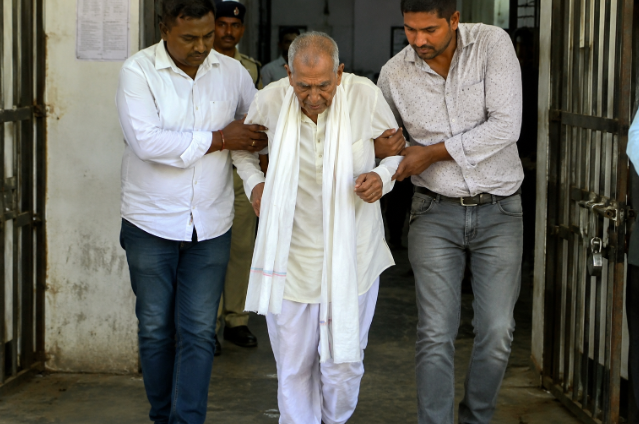
In 1992, there were no smartphones, social media, or coalition government in India, which was dealing with the aftermath of the Babri Masjid and liberalisation. The Berlin Wall collapsed three years before 1992. Nelson Mandela was not the president of South Africa yet. In Raghavpur of Vaishali district in the state of Bihar, an incident occurred wherein some pieces of glass falling on a footpath led to a fight, and a criminal case was filed. This case concluded in May 2026 when 84-year-old Deep Rai was convicted of attempting to commit murder.
Rai, a fragile individual who could not walk by himself, was carried to court by two individuals for his hearing. This photograph became viral, but people failed to see the irony that this was not the case of an old man; rather, this was the case of a fundamentally flawed legal system that could stretch a trial for thirty-three years and then term its conclusion "justice."
As stated by the court in its judgment in the Vaishali case, the facts are fairly routine for cases of agrarian disputes. On November 10, 1992, Adalat Rai and his aunt Ram Sakhi Devi were seated near their house when an encounter took place between Deep Rai and his gang regarding the positioning of broken pieces of glass in a common path between two houses. As per the prosecutor, the accused persons, namely Deep Rai, along with four others belonging to his family, were found to be carrying arms. The prosecution's case sheet was made on March 13, 1993. The framing of charges came only in June 1999, six years after the crime had taken place. Then the matter went through the trials for the next twenty-seven years, where Additional District & Sessions Judge Manoj Kumar Tiwari held Deep Rai guilty under Sections 147, 148, and 307 IPC and 27 of the Arms Act. He was given three years' imprisonment. Due to his age and bail status during the course of the trial, the judge decided to apply Section 389 of the CrPC and released him on provisional bail pending the filing of his appeal in the High Court.
Four co-accused, namely Nakeshwar Rai, Jagdish Rai, Naresh Rai, and Nagdev Rai, were all awarded ten years' rigorous imprisonment. Four others who were accused died before the decision was made. Reread the sentence. Four people died before the case concluded. They came into the legal process as accused persons and left as dead bodies without any judgment having been delivered by the court. Regardless of their guilt or innocence, they never knew from a judicial authority whether they were guilty or not.
The Deep Rai judgment does not fall under the category of an isolated judgment. This judgment is quite normal based on the grim statistics of India's judiciary system. Till 2025, the Indian courts were dealing with pending cases amounting to about 52.5 million cases.
This number had risen by about twenty per cent since 2020 and till 2024, as per the India Justice Report 2025. While district and subordinate courts that form the main interface of Indian citizens are responsible for almost 85 per cent of pending cases, with around 47 million cases pending in them. More than 1.8 lakh cases have remained pending in both the district and High courts for over thirty years. The Calcutta High Court alone constitutes 94 per cent of all such pending cases. The state of Bihar, where Adalat Rai first filed his complaint around three decades back, had 38 lakh pending cases, according to a recent estimate. The average waiting period for a case in the state of Bihar is 10.5 years. There is about one judge for every lakh population in the state of Bihar, and therefore, the case of Deep Rai becomes a matter of statistics rather than a scandal. The ratio of judges per million populations in India is approximately 21, whereas, according to the 120th report of the Law Commission of India, there should be at least 50 judges per million populations, and this is just a small fraction of 100 per million in the United States. While India operates on 25,000 lower court judges' sanctioned strength, it works with only about 21,000 judges, representing a 20% vacancy rate. Each of the judges in some courts has a burden of handling 15,000 cases. According to the 2025 India Justice Report, the average load on the district judge in India is 2,200 cases per annum. The Case Clearance Ratio – the proportion of cases decided in relation to the cases instituted in a given period – has remained between 90% to 95%. The 5% to 10% shortage, when accumulated for several years, adds up. According to legal luminaries, the economic loss due to the delay of justice in India is roughly ₹2 lakh crore per year. It would be wise to say there is a philosophical dilemma behind the Deep Rai case, which cannot be addressed using the purely procedural approach – whether delivering judgment after three decades following an alleged offence constitutes justice. Complainant Adalat Rai must have been living under a legal cloud for thirty-three years already, having to go through the court procedures, provide evidence and witnesses, spending both his time and money on this, and yet receiving no guarantee that everything will end up well. For family members involved in prolonged criminal trials, litigation turns out to be almost another life dimension: appointments in court replace everyday schedules, legal expenses get budgeted, and witnesses change their place of residence and forget things. As shown by the results of a study conducted by the Indian organisation DAKSH in 2017, it takes three to five years, on average, for an ordinary court trial in India to be over.
The case of Deep Rai involved rural litigants from Bihar, which is one of the states that scores low on indices of per capita legal expenditure, judicial institutions, and legal aid in India. The India Justice Report 2025 indicates that India spends only ₹182 per person annually on its judiciary, and legal aid is allocated ₹6.46 per person. Such numbers speak volumes. They inform citizens, especially marginalised citizens, precisely what value their access to justice has for the government. However, prolonged litigation imposes costs unevenly. A rich litigant can hire experienced lawyers, take several adjournments without any economic burden, and, when necessary, deploy the legal machinery as a tool to their benefit by virtue of delays in the procedure. In the case of the rural poor and marginalised litigants, such as a farmer or a labourer, each hearing means a lost day's pay, a wasted bus fare, and an evaluation of whether it would be more beneficial to concede defeat due to sheer exhaustion.
It has been highlighted in the 268th Law Commission Report that around 60 per cent of arrests in India are unnecessary, especially considering the situation of the poor who cannot afford the cost of bail and sureties. It is evident from statistics produced by the National Crime Records Bureau that Schedule Castes, Schedule Tribes, and religious minorities are highly over-represented among undertrial prisoners compared to their proportion in the total population. As far as 2025 is concerned, about 76 per cent of India's prison inmates are undertrial prisoners or those who have not been found guilty of committing an offence but have been held pending further investigation and trials. The number of undertrial prisoners held in prison for a period of three to five years has almost doubled from 2012 to 2022, while those held beyond five years have more than tripled. In no way are they waiting for judgment in a constitutional dispute case. They belong to ordinary criminal cases where they failed to gain bail, not due to any lack of evidence, but due to their inability to pay surety.
The reason why no political party has been able to generate a mass movement, based on the fact that there are 1.8 lakh cases that have been pending for over three decades, is that no manifesto for any election has highlighted this fact as an issue as crucial as it should have been. This is not due to a lack of voter participation or concern among the masses. The reason for this situation can be understood in the context of how the citizens of India have come to accept their fate through years of experience. As long as anything keeps failing for such a long time period, people will slowly start accepting it as part of the environment. This phenomenon is known as institutionalised death of expectations among sociologists.
India was not wholly inactive either. The initiatives like the e-Courts Mission Mode project, fast track courts in cases dealing with women and children, and Gram Nyayalayas were sincere and effective efforts towards structural reform, albeit inadequate. The Case Clearance Ratio of the Supreme Court showed a rise of 4.83 per cent during November 2024 and May 2025. However, such measures amount to mere bandages being applied to an ever-growing wound. In 2025, the number of cases in arrears had grown past 52 million, registering a growth of 2 per cent compared to the previous year.
The images of Deep Rai, feeble, being assisted by two people as he enters court for the final pronouncement on the case involving him, in the year when the Babri Masjid was demolished, have been seen by many as a tale of ultimate, if belated, justice. The system had worked, though it had taken some time. The guilty were punished. Justice had been served, in some way. This interpretation is not incorrect; however, it is grossly inadequate. Certainly, there was a hearing, the facts of the case were studied, and the guilty were convicted. However, the very case, which saw the conviction of one set of people, saw the deaths of another four in limbo. Thirty-three years of the lives of two families have gone into solving this case. The case has been solved through a system that holds within it more than fifty million cases like this one – and in Bihar alone, 38 lakh of them. Rather, the true question raised by these pictures is whether a judicial process that can only take three decades to resolve a village dispute about a footpath – an incident in which glass was broken, but nothing of any broader national significance occurred – can truly claim to remain part of any functional justice system in a democratic country. Moreover, whether Indians are now so used to the process taking such a long time that they have stopped considering it a problem altogether. Adalat Rai lodged a complaint in 1992. It took 34 years for his case to be decided. Some time during those thirty-four years must come a moment in which one can no longer deny that there exists a question of how the delays of this system can no longer be considered an issue with the system and are rather evidence that the system itself is the problem.
References:
- LiveLaw – Bihar Court Sentences 85-Year-Old Man in 1992 Attempt to Murder Case: https://www.livelaw.in
- Free Press Journal – 33 Years Later: Bihar Court Convicts 84-Year-Old Man in Attempt-to-Murder Case: https://www.freepressjournal.in
- National Judicial Data Grid (NJDG) – Live Data on Pending Cases: https://njdg.ecourts.gov.in
- India Justice Report 2025 (Tata Trusts): https://currentaffairs.khanglobalstudies.com
- StudyIQ – Judicial Backlog in India: Challenges and Potential Solutions (August 2025): https://www.studyiq.com
- Telangana Today Editorial – India's Undertrial Crisis Demands Urgent Prison Reforms (April 2026): https://telanganatoday.com
- IIPRD – Justice Delayed, No More: The Supreme Court's New Deadline (September 2025): https://www.iiprd.com
- DAKSH India – Access to Justice Survey (2017): http://dakshindia.org
- Law Commission of India – 120th Report on Manpower Planning in the Judiciary: https://lawcommissionofindia.nic.in
- Law Commission of India – 268th Report on Amendments to Criminal Procedure Code: https://lawcommissionofindia.nic.in
- Deccan Herald – Justice Delayed as Judge-to-Population Ratio Stands at All-Time Low: https://www.deccanherald.com
- Open Government Data Platform India – NJDG Court-wise Pending Cases (August 2024): https://www.data.gov.in
- India Data Map – Pending Court Cases in India: 2025 Overview: https://indiadatamap.com
- Bharatnama (Substack) – Why 5 Crore Pending Cases Paralyse Justice in India (June 2025): https://bharatnama.substack.co
- Republic World – Tareekh Pe Tareekh: Pics of Frail 84-Year-Old Man After Being Declared Guilty in 1992 Vaishali Attack Case Go Viral: https://www.republicworld.com