
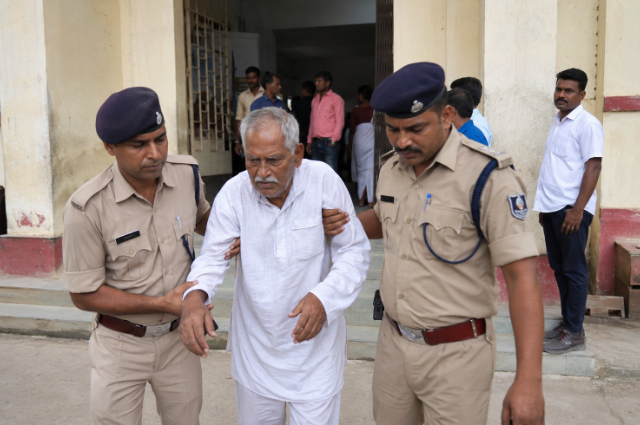
A court in Bihar's Vaishali convicted 84-year-old Deep Rai for attempted murder and rioting stemming from a violent 1992 dispute. After 33 years of trials, the court finally sentenced the old man to 3 years in jail and granted provisional bail on Tuesday.
The incident dates back to November 1992, when he and his associates allegedly placed broken glass on a pathway near a neighbour's home and attacked the couple when they objected; Deep Rai was then 51 years old. A chargesheet was filed on 13 March 1993; charges were framed in 1999, and the verdict finally came in 2026 — three decades later, by which time four other accused had already died.
Reportedly, Rai and his associates allegedly placed broken glass on a pathway near a neighbour's home and attacked the couple when they objected. A chargesheet was filed on 13 March 1993, charges were framed in 1999, and the verdict finally came in 2026 — three decades later, by which time four other accused had already died.
Adalat Rai was the informant, while his aunt, Ram Sakhi Devi, was the injured victim; along with others, they were sitting outside their home when a dispute began.
The old perpetrator, appearing weak due to health issues related to his age, was supported by two police officers as he made his way to the courtroom. After the judge delivered the verdict, Rai, who lives in Juravanpur, Vaishali district, remained silent.
"Since the maximum period of imprisonment of accused Deep Rai has been fixed at three years and the accused was already on bail, therefore, under Section 389 of the Criminal Procedure Code, upon his giving an application to the effect that he will file an appeal in the Hon'ble High Court and obtain bail, he shall be temporarily released on the bond furnished by him", Court recorded.
The prosecution examined ten witnesses during the trial. After that the Additional District and Sessions Judge Manoj Kumar Tiwari found 85-year-old Deep Rai guilty of several serious crimes related to an incident from 1992. He was convicted for rioting, rioting while carrying a deadly weapon, and attempting to murder someone. Additionally, he was found guilty under a law related to the illegal use of firearms. The court decided that Deep Rai took part in a violent group. They were accused of opening fire upon the victim. Due to this, both thinformant and his aunt and other two other villagers ended up being severely injured.
Court convicted the remaining four family members, Nakeshwar Rai, Jagdish Rai Alias Jisha Rai, Naresh Rai and Nagdev Rai, to 10 ye strict imprisonment each, while Deep Rai was granted relief due to the age factor.
"...the weapons used in the incident were undisputedly lethal firearms, and not ordinary lathis or sticks. Therefore, no doubt remains regarding the intention and knowledge of the accused persons that they caused these injuries with the intent to murder". Court noted.
One very worrying question this case makes us ask is whether it would have taken so long if the person accused was rich. Most likely, the answer is no. In India’s legal system, having money makes a big difference. Rich people can hire the best lawyers, ask for many delays, get bail quickly, and use their influence to slow down the case. They can use every trick in the book to keep their trial going for many years. On the other hand, poor people, whether they are victims or accused, have to face a broken system that is very hard for them. Because they cannot afford good lawyers or long court battles, they suffer the most. This means that powerful and rich people who are accused of serious crimes like rape, murder, or big corruption often do not get punished properly. Meanwhile, ordinary people get stuck in long, difficult legal fights that cost them a lot of time, money, and hope for justice.
What makes this situation worse is how normal it has become. Over time, public anger has turned into frustration, and finally into quiet acceptance. When people feel that change is impossible, they stop demanding a fairer system, and this lack of outcry allows the problem to continue. If our legal system is built on the promise of fair trials.
This problem is made worse when public debate shifts away from accountability and into social and political divisions. When criticism is dismissed or labelled as unpatriotic, it becomes difficult to hold leaders accountable, and systemic corruption continues without being challenged. Instead of focusing on the fairness of the laws, society becomes divided, which allows the core issues in the system to go unaddressed.
The case of Deep Rai represents a much larger, institutional challenge. It serves as a clear example of a legal process that moves slowly for ordinary citizens, offers flexibility to the influential, and continues functioning because society has become accustomed to these delays.
References: