
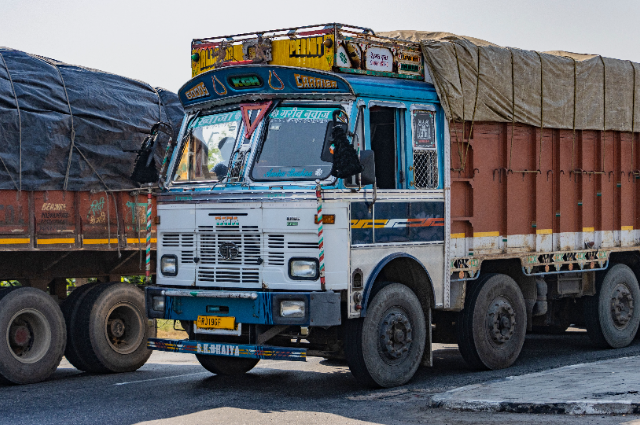
A timeless and symbolic expression, which is commonly written on the side of trucks, "Horn OK Please", is found mainly in India. At first, it may seem unusual, as the words are painted in gigantic fonts, decorated vividly in vibrant colours, immediately attracting a crowd; they have their meaning behind. It was often argued whether these were a cultural symbol or an untold narrative speaking directly to its readers.
Several years ago, side view mirrors were rarely found on commercial trucks, while the install mirror would be blocked by the massive, bulky cargo, again preventing drivers fr properly seeing what is right behind them. In such a situation, visual signals were not trusted. Since their view is blocked, a horn for alerting truck drivers was simply used instead; a spark of survival wisdom. Truck drivers would simply slow down or move aside for other vehicles to pass.
The record of "Horn Please" went permanently on the rear side of the truck when its drivers confronted the problem of limited sight on the road, so it was a gentle way to ask drivers trailing behind, "Please honk your horn so I know you're there and trying to overtake". From that time period, it had become the signal for communication, and today it symbolises road culture and truck driver camaraderie.
While "Horn Please" appeared flawless then, how did "OK" get trapped right in the middle? "Horn" was s on the left side of the truck while "Please" was written on the right, and "OK" was font at the dead centre.
The answer was simply provided in three different theories by historians and truckers. First of all, OK was used to suggest the drivers trailing directly behind trucks' assurance to pass. Some truck drivers even used a manual light blue bulb right above the OK, so when truck drivers saw the road ahead was clear, they would light the bulb, signalling to the vehicle behind that it was OK to overtake. There is no official statement about the OK invention, and somehow it ended up serving rightly thus, it was never removed. Furthermore, on older, narrower single-lane highways, the words were actually painted in separate positions to specify a safety zone.
Secondly, it was to serve as a point of reference to a massive global shortage of diesel during World War II when India had no choice but to shift transport trucks to the worst alternate to fuel oil: "kerosene". As it lacks the lubricant found in regular diesel, making it an unsafe substitute for gasoline, even the slightest collision would cause misfire and a literal blast. However, over decades, kerosene was abbreviated to OK, dimming the shortage of fuel in its shadow. This way, the OK between Horn and Please was to point out the truck was on kerosene.
In the mid-20th century, the TATA Group held an absolute monopoly on manufacturing commercial trucks in India. Around the same time, a subsidiary called Tata Oil Mills Co. (TOMCO) launched a budget washing detergent powder called **"OK"** (complete with a lotus flower logo).
The back of Ta's newly manufactured trucks was simply used as a rolling billboard for the purpose of advertising the soap and getting it familiar across rural and urban India; thus, painted the brand name "OK" right in the gap between "Horn" and "Please." The soap eventually flopped, but the template stuck around long enough to become tradition.
The iconic phrase of South Asian truck art that has become recognition and a tradition of India is slowly fading away as it is now considered too risky and unreliable in many states. By 2015, states such as Maharashtra actually prohibited the usage of "Horn OK Please" on commercial vehicles for the reason of noise pollution it causes. It is also debated that wide modern highways, multi-lane roads and reliable side mirrors mean drivers should rely on flashing headlights rather than excessive honking. Officials stated that the message was the main cause of unnecessary use of the horn, which cost the community their health and peace as well. Additionally, "Horn OK Please" has become less important with upgraded features and its original functional need reduced.
Not to mention, this phrase gave it a distinct Indian flavour with its peculiar grammar, making it unforgettable. The Maharashtra Motor Vehicle Rules say that if truck drivers keep using the slogan "Horn OK Please" on their vehicles, they can be fined or have their permits taken away. Many activists liked this decision because they think it helps make roads safer. But a lot of truck drivers and painters did not agree. They see the slogan as a big part of their identity and culture. For them, it is more than just words — it shows their personality and the tradition of their work.
The slogan is often painted in bright, colourful designs on trucks, which makes the vehicles look lively and creative. This colourful art is a special part of their culture and shows the skill and pride of the painters and drivers. The bright colours and beautiful patterns make the trucks stand out and celebrate their culture.
So, while the rules aim to improve safety, many people feel it is important to keep this colourful and creative tradition alive. They believe that the art and culture shown through these slogans are an important part of life on Indian roads and should be respected.
References: